
DIGITAL NOMAD LIFESTYLE: CAN THE HYPE BE JUSTIFIED?
Is this so-called lifestyle overrated? Possibly.
I think there’s a certain debonair feeling attached to the idea of being a digital nomad. Being able to work from ‘anywhere in the world’ sounds fun, young, adventurous, and carefree. But is it? Or have we seen things from a rose-tinted glass? Glamorizing and romanticizing a particular kind of lifestyle that, we believe, would make our lives better, happier, and richer?
About four years into being a location-independent creative consultant/writer, I noticed that ‘The Lifestyle’ has been strongly associated with the idea of embracing freedom, endless traveling, and making money out of the Internet (including your blog, YouTube, or Instagram).
Most recent graduates I talked to are curious about how they, too, can adopt this lifestyle. Being able to work-from-anywhere has become their ultimate life goal (that, and being in a relationship). Some of the most recurring questions I got from time to time include:
How can I get paid to travel?
How can I find a job that will allow me to work from anywhere?
How can I be an ‘online influencer’?
Or for those who are already employed:
Should I quit my job to travel and be a digital nomad instead?
At some point, as these questions started coming in more frequently, I began to think that maybe (just maybe), there have been some misconceptions about this location-independent lifestyle and being a digital nomad. And maybe (just maybe), I can give another perspective to the many layers of this lifestyle based on my own experience.
But before we begin, let’s make sure that we’re on the same page.

Here is what Wikipedia says about being a digital nomad:
Digital nomads are a type of people who use telecommunications technologies to earn a living and, more generally, conduct their lives in a nomadic manner.
Here is what Daniele said about being location-independent:
To be location independent is not about having the freedom to travel, but the freedom to be anywhere you want (or, most importantly, NEED) to be.
With these being said, if you know someone who wants to adopt the digital nomad lifestyle, or has always been aspired to build a location-independent career, feel free to share this post with them.
***
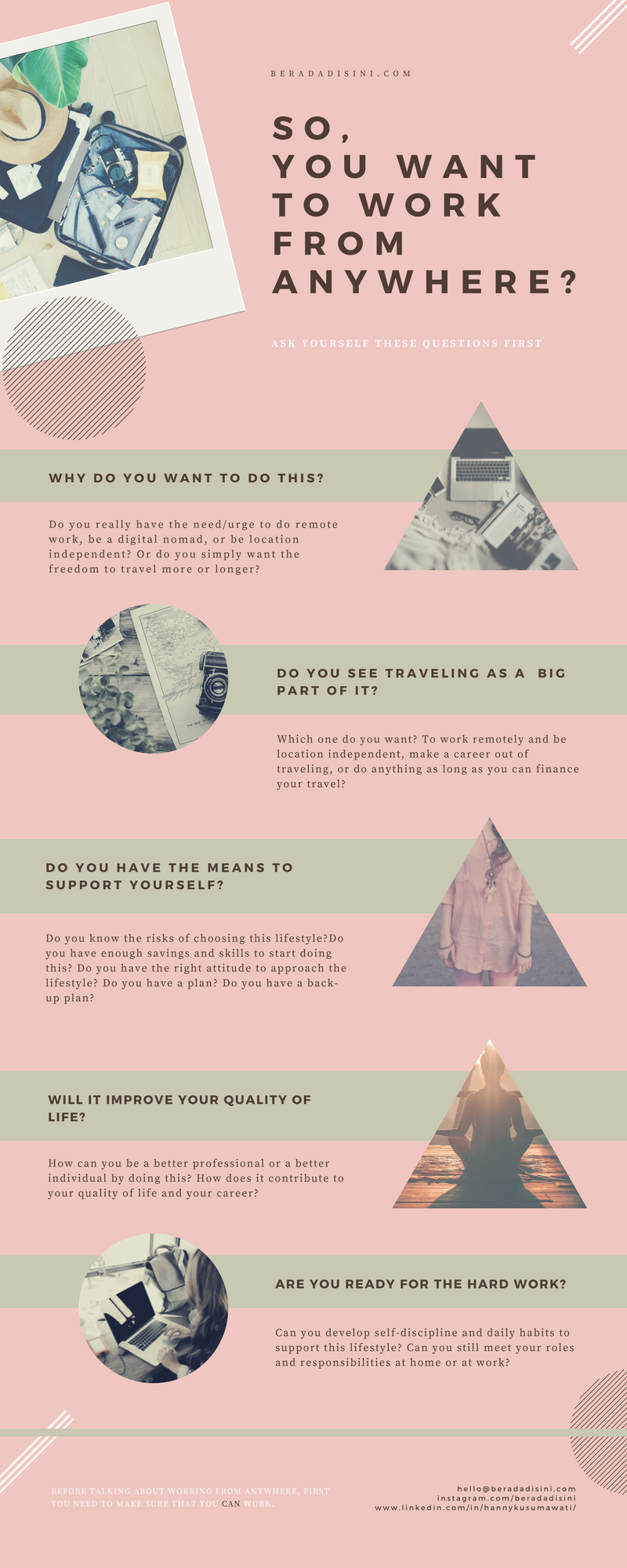
1. WHY DO YOU WANT TO WORK FROM ANYWHERE?

Do you have the need/urge to do remote work, be a digital nomad, or be location-independent? Or do you merely want the freedom to travel more or longer?
I think this is the first question that you need to ask yourself. Do you want to adopt this lifestyle only because seemingly it will give you more chance and freedom to travel—or because you have the need or the urge to do it?
There are two reasons why I’m now working as a location-independent consultant/writer.
First, after my mother passed away a few years ago, my father lives in our family house all by himself. I want to have the freedom to be with him whenever I could; or should. For instance, when he got hospitalized for a few days and had to go for a series of physiotherapy last year, being location-independent allows me to be with him when needed: preparing healthy food, accompanying him to the therapy unit, and looking after his day-to-day progress for about two months.
I could imagine how stressful it would be if I were still working full-time in a corporation. Of course, I could apply for leave, but what if workloads were crazy, or if my teammates were also on holiday? What if I would still need to commute now and then to meet clients? And is it even possible for me to take a 2-month leave without feeling (or looking) bad? I don’t know.
But being location-independent allows me to be where I need to be. It gives me more flexibility to focus on what’s important or urgent at certain moments in life.
Second, after working for more than eight years in a communications consultancy (which I loved), I started to ask where it would lead me to. My last position was the Creative Director—a post I had been dreaming of since I was still in college. So, it was only natural for me to ask, where could I go from here? What would my career ladder look like from this point onwards? Where would I be if I continue this career of choice for another 5, 10, 15 years?
I could dream of something like a Managing Director, Vice President, Regional Director of a global communications agency, or maybe an owner of my own communications consultancy or creative agency. If everything goes well (and smooth), that’s how my career ladder would finally progress.
Then, I realized one thing: I don’t want them.
The images of those positions and possibilities do not excite me. The idea of managing hundreds of people or owning a successful agency is not something that amuses me.
I merely want to create things. I want to come up with excellent write-ups or meaningful stories. I want to tell stories that matter and to do something kind. I want to teach, to share the things and skills I’ve learned throughout the years. I want to do this based on my values, my interests, and the things I believe in—together with people I like and respect.
I decided to quit my job so I can do more of the things I have always wanted to do. Being independent also gives me more opportunities to work with smaller companies, individual clients, or NGOs, that could not afford to work with big consultancies.
These are my two reasons for choosing the location-independent lifestyle. What about you? What are your reasons? What are your whys? Do you have other reasons apart from wanting to travel more?
2. DO YOU SEE TRAVELING AS A BIG PART OF REMOTE WORKING?

Which one do you want? To work remotely and be location-independent, make a career out of traveling, or do anything as long as you can finance your travel?
Quite a lot of people I talked to would mention ‘traveling’ when asked about remote-working, being location-independent, or being a digital nomad. However, the truth is this: being location-independent or being able to work anywhere, does not mean that you have to travel regularly. You don’t. This also doesn’t mean that you have to do things that are related to traveling, like being a travel agent, travel photographer, travel writer, or travel blogger.
We’ve mentioned digital nomads before. According to the Wikipedia entry, they are the ones who live their lives in a more or less nomadic manner. They like to move from one place to the next while making a living through the Internet.
True, some digital nomads are travel bloggers or have travel-related work, but some also do other types of work that can be done as long as there’s an Internet connection. There are therapists, developers, designers, accountants, consultants, teachers, psychologists, business owners, entrepreneurs, start-up founders, personal assistants, and many more. The possibility is endless.
Being a digital nomad also doesn’t mean that you have to be a freelancer or own a business.
Many digital nomads are employed by a corporation or an organization that allows them to work remotely. Some require them to go back to their headquarters a few times a year, some don’t—but these people are more or less free to work from ‘anywhere’. Based on how good you are, the nature of your work, and the flexibility of your company or organization, remote-working can always be an option to be discussed.
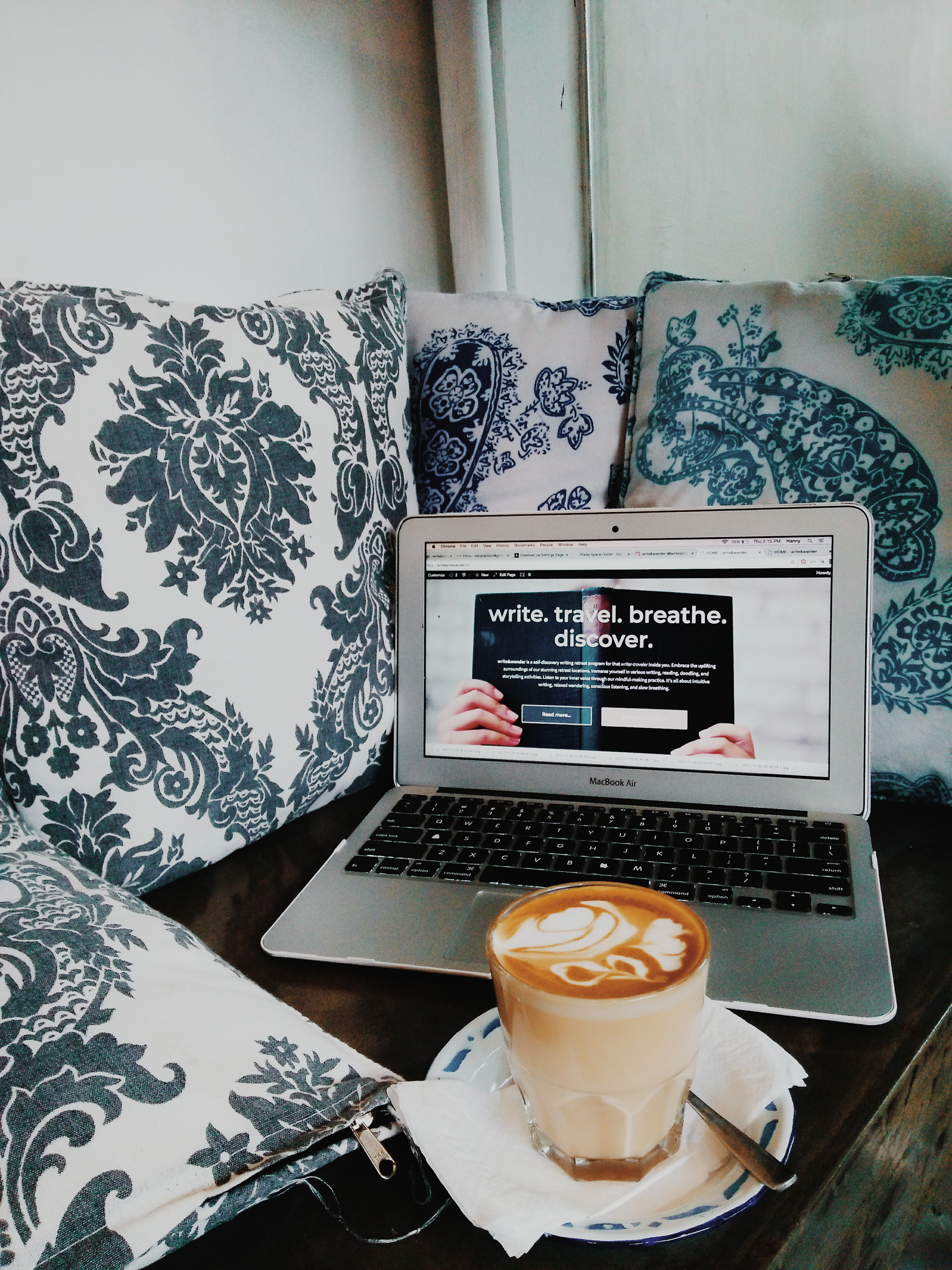
On another hand, there are people who adopt a location-independent lifestyle. They might not travel or move around so much, but if they want to, they can work from ‘anywhere’ they like. For some, this means working from home or a cafe. For some, this means working from a co-working space in a foreign country, a bus station, or a secluded beach (but seriously, working with your laptop by the beach under the hot sun IS NOT nice—plus, where is the charger?).
So the idea is more on the ability to work from wherever you need or want to, not on the traveling part.
Some people are not only looking into being a digital nomad or being location independent. Some truly want to make a career out of traveling because it’s something they love or are good at. This is where all those travel-related jobs come into the picture.
Some others just want to travel—and are willing to do any work that can help to finance their travel. For instance, you’ll meet some people who do volunteer work abroad in exchange for food and accommodation. Some work as bartenders, hostel cleaners, or fruit pickers to get some money in between their travel destinations to support themselves. (I am not going to discuss the issue of legality here).
The question would be, which one do you want?
3. DO YOU HAVE THE MEANS TO SUPPORT YOURSELF?

Do you know the risks of choosing this lifestyle? Do you have enough savings and skills to start doing this? Do you have the right attitude to approach the lifestyle? Do you have a plan? Do you have a backup plan?
If you want to be a digital nomad or simply be location-independent (where you can work from ‘anywhere’) there’s one thing we need to clarify: before talking about being able to work from ‘anywhere’, first, you need to make sure that you CAN work, from wherever you are.
The thing is, as fun as it seems, being a digital nomad or being location-independent is not about beautiful Instagram pictures or slouching in bed with nighties and watching Netflix at 11 AM. Sure, it’s part of the deal—maybe 10% of the time if you’re lucky (or if you are an Instagram celebrity). The other 90% is similar to any typical working-class out there: work, peeking into your savings account, thinking about how to pay your bills, handling complaints, fixing problems, improving your skills and systems, and more work.
If you’re a freelancer, add up to this list more time, work, and energy to find clients, send offers or proposals, and go out networking to let people know that you (and your products/services) exist.
So, on the bottom line, this lifestyle is still about work. The question is not about how you can adopt a location-independent lifestyle. The question is: WHAT can you DO to adopt a location-independent lifestyle?
Do you have particular skills, attitudes, networks, or work experiences that will allow you to work from wherever you like? When you are not under close supervision, can you still give your best at work? When you can be flexible with your working hour, can you be disciplined about it? When you do not have your colleagues or partners next to you to discuss or brainstorm ideas, can you manage?
Especially if you are a freelancer without a fixed monthly salary, have enough savings before transitioning into this lifestyle. I would say that the ideal amount would be at least 3-4 months of your basic needs—enough to fulfil your monthly bills and responsibilities for a while.
I don’t like it when being a digital nomad or being location-independent is associated with being a burden for someone else, being childish, reckless, careless, or selfish. It shouldn’t be.
That’s why, apart from having enough savings, you also need to create a backup plan. What will happen if, after six months or a year, a location-independent lifestyle is not something you enjoy?
Sure, if you are employed, you might be able to go back to work from your company’s headquarter. But for freelancers, this could be even more challenging. How fast do you think you can find other jobs when the clock is ticking? Do you have a well-enough reputation that people will open their doors to give you work opportunities at the time when you most needed it?
Do you have other plans if things don’t go the way you want them to be?
I transitioned into my location-independent lifestyle with the compensation I got when I left my previous company (after eight years of service) and having the company as my 1-year retainer client. This means I know that—if everything’s okay—I will be quite well-off for about a year. Plus, I will still get monthly payments from my retainer client for at least another year.
There’s nothing reckless or careless about my decision, and I think neither should yours.
4. WILL WORK-FROM-ANYWHERE IMPROVE YOUR QUALITY OF LIFE?

How can you be a better professional or a better individual by doing this? How does it contribute to your quality of life and your career?
One of the reasons why a location-independent lifestyle suits me is because it improves the quality of different aspects of my life.
Working from home; when I am back in my family house in Bogor, enables me to spend some time with my father and my dog.
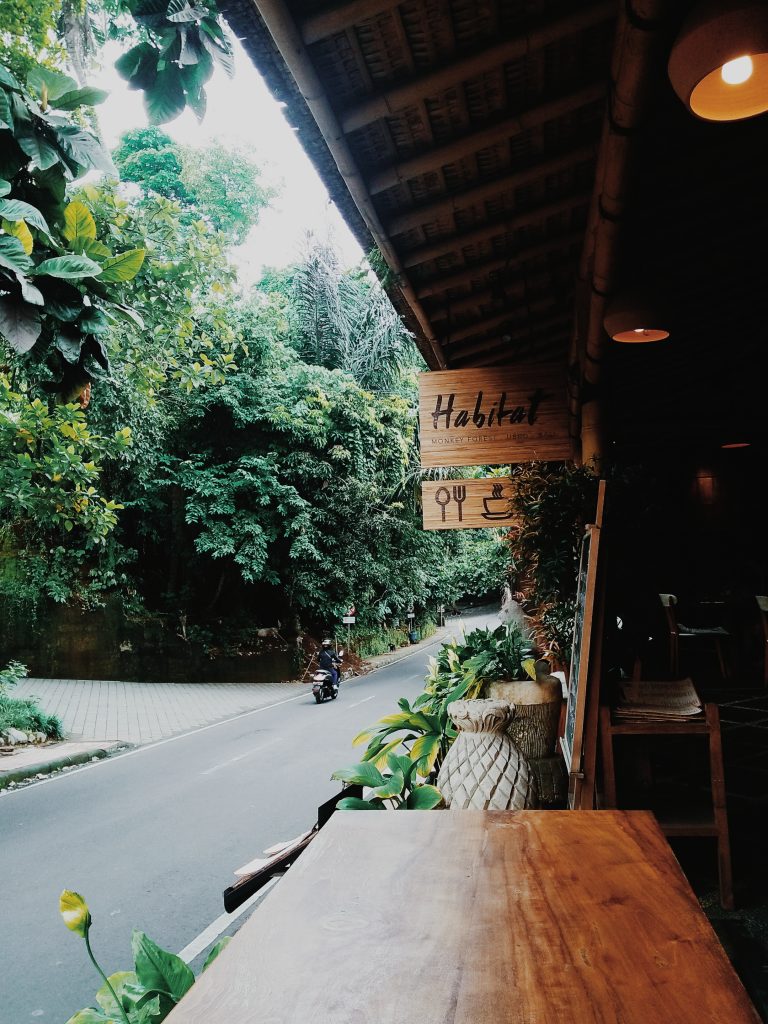
Working from Ubud—my second base when I’m in Bali, enables me easy access to beautiful views and the opportunity to live close to Nature; surrounded by a plethora of healthy and mindful stuff—from food and exercises to organic products and social activities. I can also benefit from the fact that Bali is an hour ahead of Jakarta, which means I am always 1 hour ahead of my clients. When I am up and ready at 10 AM, replying to emails or submitting some documents, office hours for my clients in Jakarta had just started.
For similar or even better quality than Jakarta, prices for memberships in co-working spaces, accommodation, as well as food and beverages are significantly lower. This means I can save more while enjoying a better quality of life in general. Although Ubud was relatively quiet, it is still quite near to big cities like Denpasar—where I can fix my gadgets or laptops when necessary.
Another reason why I choose Ubud, Bali, as my base and Hubud as my co-working space is because it provides me with a vibrant and creative ecosystem where I can meet people, discuss, collaborate, and learn some new skills from other members.
To be honest, when it comes to focused work and meeting deadlines, I love doing solitary work from my rented house. I work best alone, so I don’t work from the co-working space on a daily basis. But I still need a community of like-minded people to function.
It can be uninspiring at times when you’re always working solo. It’s important for me to bounce ideas with different people and learn about other people’s perspectives. It keeps my mind curious, intrigued, and active. It keeps me up-to-date with what’s happening in the world. Inspiring talks, skillshare, and events organized by co-working spaces are always fun because they provide me with ideas I could apply in my next projects—or even in my personal life.
On another note, being location-independent also enables me to provide more corporate training or workshop outside Jakarta when needed, without having to worry about travel time or having to leave ‘the office’ for too long. It also gives me more opportunities to join classes, courses, or workshops on writing or crafting, even when they happen on a weekday, during office hours.
Since I am also in a long-distance relationship, being location-independent gives me more flexibility to spend some quality time with my partner. It helps that he is also a location-independent entrepreneur, so we don’t have to rely on the number of our leave days to meet up.
So, for me, a location-independent lifestyle merely works because it improves my quality of life. Isn’t that what we’re all looking for?
For some, however, a location-independent lifestyle could—on the contrary—decrease their quality of life.
Some people could be so happy to finally be able to work from home but end up frustrated because working from home gives them too many distractions. Children are crying or seeking attention, a salesperson is knocking on the door, something spills on the kitchen floor and they just have to clean things up. Since working from home doesn’t work, they allocate some time to go out and work from a coffee shop instead, only to realize that they have spent more time and money every day on driving down to the coffee shop, buying coffee, and paying for gas and parking. These are the time and expenses they thought they wouldn’t be spending when they are working from home.
Working from “anywhere in the world” can also pose a few logistical complexities. How do you know where to get healthcare if you’re working in a completely different country for a few weeks? What about prescriptions and other must-haves that you’ve grown comfortable with? Although with the Internet we can get everything from medicine to something as random as Versace eyeglasses in just a few clicks, these problems will eventually catch up. To be honest, some things in the world are just a lot easier when you have a stable residence: sending and receiving packages, upgrading your Internet speed, sorting stuff out with your banks, paying taxes, contacting an accountant…
Familiarity and convenience aren’t bad things. So, just know that this can go out the window if you move to a different location to work on a regular basis.
When you’re working from another city or country, do ask yourself whether you have chosen a place that can improve your quality of life and fit your lifestyle. If being location-independent only makes you even more stressed, worrisome, and miserable, what is the point?
5. ARE YOU READY FOR THE HARD WORK?

Can you develop self-discipline and daily habits to support this lifestyle? Can you still meet your roles and responsibilities at home or at work?
Freedom can be an advantage or a disadvantage. Some things flourish when they are given a lot of freedom; others might perish. What about you? Are you ready for the hard work despite the freedom and flexibility you will have when you can work from ‘anywhere’ in the world?
Once, I was assigned to be a host on a fam trip that invited some local and international travel bloggers. For those of you who think that being a professional travel blogger is fantastic, think again. Throughout the trip, I realized that I could never be a professional travel blogger.
These travel bloggers had to stick to a too-packed itinerary, sometimes only get a 4-hour sleep before hopping on a 6-hour bus ride, then off for the second flight of the day. At each destination, they needed to take pictures, record videos, fly a drone, listen to the guide’s explanations, and write down some information for their blog post. On the bus, the boat, or the plane, they started transferring and editing their pictures and videos, because they needed to post something every single day. They had to try foods they didn’t like, visit places they were scared of, or get involved in activities they hated.
But work is work.
I, myself, instantly passed out every time I saw the hotel’s bed. I stole some sleep on the bus, the boat, or the plane whenever I could. Those travel bloggers? They worked. I was amazed at their stamina and dedication. I wouldn’t be able to do that.
I am the kind of ‘travel blogger’ who goes on a journey somewhere and write about it three years later, then taking pictures from a stock photo website because I have accidentally deleted the travel-picture folder on my laptop.
So no matter how ‘glorious’ it might seem, work is work. Hard work is hard work.
And just because you’re a digital nomad or a location-independent worker, it doesn’t mean that you can ditch your roles and responsibilities—both at home or at work. Faraway doesn’t mean non-existent. Just because you can still be in pyjamas at 11 in the morning (lazying around with a bag of chips), doesn’t mean you should. Just because now you have the freedom (and hopefully, the means) to travel anywhere and anytime you like, doesn’t mean you would.
***
Now that you have come to the end of this post, is being location-independent still sound promising to you?
I think it’s human nature to think that the grass is greener on the other side. The truth is, there are many miserable digital nomads and struggling location-independent workers around. On the contrary, some of my closest friends are thriving and having fun climbing the corporate ladder in multi-national companies.
Here’s the thing: if you can’t be happy working from where you are right now, most probably, you will find something to be unhappy about when working from anywhere else. Just make sure that you have prepared yourself and answered the five questions above truthfully before making the jump to adopt a location-independent lifestyle.
Because truly being location-independent means you are always your independent self, wherever you are.












 Reader’s Email:

 In my case, when I started freelancing after leaving my corporate job a few years ago, I was surprised to find myself feeling low and unhappy. It was confusing. Wasn’t this my ideal kind of working condition? To work from anywhere, to work with clients I like, to work on projects I am inspired with? Then, why did I feel distressed?