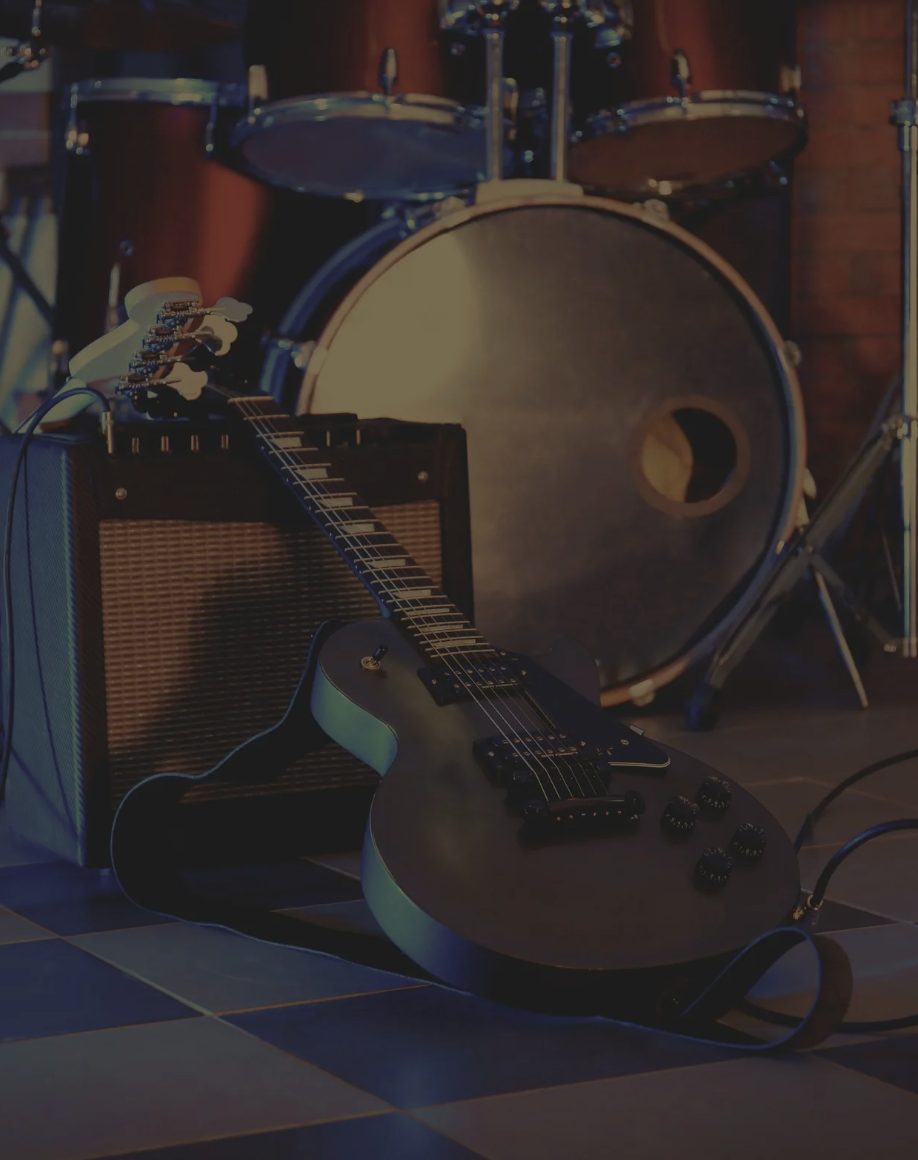
we used to say we wanted to be rock stars

In our teens, we formed a band. The lineup was based more on who was in our circle than on musical skill. Maybe there was someone you liked, and even if they didn’t play any instruments, surely they could shake the tambourine.

We listened to songs on a duct-taped Sony Walkman that once belonged to someone’s older sibling, rewinding or fast-forwarding by inserting the 2B pencils we had used on multiple-choice exams into the cassette spools so we wouldn’t have to spend money on new ABC batteries from the roadside stall across the parking lot.

We already spent more than we could afford to rent a rehearsal studio at the other end of town. Someone skipped lunch, someone lied about needing a math textbook, someone saved pocket money for two weeks, and someone else had rich parents and paid the rest. The room was damp, the carpet stained, and there was always that smell of cigarettes and wet shoes—even though we weren’t supposed to smoke and had to leave our shoes outside.

Then we started playing.

The drums,
the bass,
the keyboard,
the rhythm,
the lead guitar,
the vocals.

And unlike us—yawning through civics, reading Shoot comics and Sweet Valley Twins novels in biology, writing unsent letters to our crushes in economics, ignoring geography because we didn’t like the stuck-up teacher—this time we were focused, determined, completely immersed. We watched each other for cues, counted under our breath, nodded when we almost got it right, and laughed hysterically when we didn’t. We wished the staff would never knock on the glass and tell us our time was up.

We packed up in a hurry; it was late. Most of us had to be home before our parents did, but we carried the day’s homework in our heads: lyrics to memorize, drum fills to land, guitar solos to smooth out… and tempo—everyone, tempo.

Of course, later in life, we realized we hit the notes hard but not right, that we were often out of tune, off-key, off-tempo—full of far more enthusiasm than competence.

But did that matter on stage, in one corner of the tile-walled school hall—with its uneven platforms, terrible acoustics, flickering lights, and cheap speakers?

One boy gripped the mic too tightly, hoping the girl in the third row would understand this was actually a love letter; one girl, her fingers so used to years of classical piano, ecstatic to play the keyboard far louder than she was ever allowed to at home; one boy at the back, failing almost all of his classes, hit the drums so hard as if he were trying to prove something to himself more than anyone else; one girl, doing her best to shake the tambourine during the chorus because this was the closest she had ever felt to belonging.

We used to say we wanted to be rock stars, but I don’t think we meant the stage, the tours, the lights, the fame, or the applause. I think we meant the moment right before the song starts—when someone counts in, when everyone looks at each other in anticipation and nods, when the air is electrically charged and reverberating with a mix of anxiety and excitement, when, for a second, it feels like something clicks and things might actually come together instead of falling apart.

I think we meant striking a chord with people who resonate with us without translation—who nodded their heads, tapped their feet, clapped along, and heard rhythm where others heard noise; who didn’t shush us or ask us to be smaller, quieter, or better to be loved.

I think we meant those rare moments when time faded out—when your hands moved before you could think, when the sound of your voice was echoed louder than your doubts, when you weren’t watching yourself from the outside but were fully inside it; when you weren’t playing the song—the song was playing through you.

I think we meant the freedom and confidence to be unremarkable: messy, too loud, slightly off—and keep going; to have fun while making something, anything, with the people we vibed with, without having to wait until we were ready, or good, or qualified. To take up space without first adjusting ourselves to fit what’s missing.

Maybe we really meant remembering those moments ten, twenty, thirty, forty years later: us standing in a damp room, sharing one dirty pair of earphones, passing around a dented microphone, missing half the notes, forgetting the lyrics, and just having a blast: the best times of our lives.

And maybe that’s the part we didn’t understand back then: how to hold on to that unfiltered joy as we grew older.

So sometimes I wonder, did we ever really want to be rock stars, or did we just want to feel alive in a world that often asks us to settle down, to play it safe, to wait until we are polished, perfect, ready, and on track?

We used to say we wanted to be rock stars, but maybe we just meant we wanted to be alive without holding anything back.
hanny
WANT TO SHARE WITH SOMEONE WHO NEED THIS?
3 a.m. buddy

I was in my twenties
when a friend asked me
if I wanted to be his 3 a.m. buddy
—one of the biggest compliments
anyone’s ever handed me.

Because a 3 a.m. buddy is someone
you trust with unfiltered
hours, way past the middle of
the night,
where everything is heightened:
sounds,
silence,
sensations,
emotions,
memories,
histories…
loneliness.

A 3 a.m. buddy knocks on your door,
red-blooded eyes in a hoodie, with
MSG-loaded snacks you didn’t ask for,
turning the TV on to play a show
nobody cares about, that
you pretend to watch anyway, or

stays sober while you’re only
two sips away from dissolving;
bravely makes silly moves on the
dance floor of the city’s most
pretentious club, so you can laugh
too hard at nothing
before
you resume crying, or

drags you out into the elevator,
messy hair, sweat-stained shirt and all,
down, down, down the empty lobby,
past the night security,
to a dim 24-hour street stall selling
steaming hot instant
noodles that taste like survival, or

sits with you on the dirty sidewalk,
bathed in the eerie orange streetlights,
next to the overloaded trash bin,
parked motorbikes, late-night taxi
queues, stray cats, no judgment, no
interrogation, no questions, just
a presence without expectations or
explanations, or

squats with you on the rooftop, waiting
for the sun to rise,
plastic spoons and cheap desserts
from the minimarket below your
apartment complex.

They don’t have the language yet, and
you don’t have the language yet, just
feelings spilling, leaking, gushing over
the edges.

These ordinary, mostly low-budget, half-asleep
moments, where your 3 a.m. buddy
holds themselves together
or pretends to,
so you don’t have to
perform,
so you can just

break

down.

So, yes, I told him,
I’ll be your 3 a.m. buddy.

hanny
WANT TO SHARE WITH SOMEONE WHO NEED THIS?
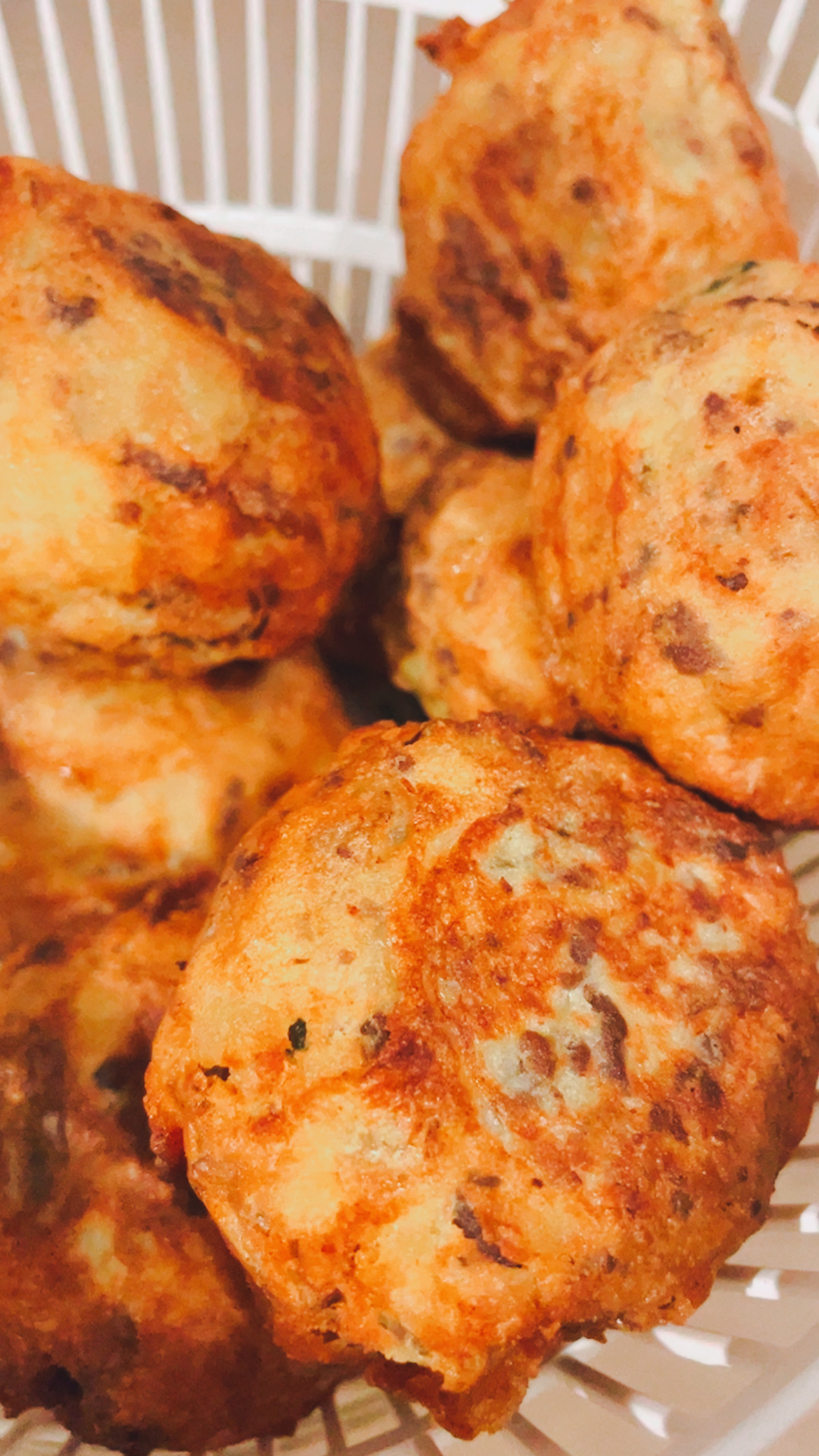
Perkedel Kentang

Like most Indonesians, my love language is food.

If you’re a tourist spending some time in the country, you might find it weird that hotel staff or new acquaintances ask you if you have eaten*. It was something that originated during the colonial times, they said. Most people couldn’t eat regularly those days, as food was scarce. When you met someone you cared about, you asked them if they had eaten—if they hadn’t, you shared your food with them.

It’s something that we carried within us, I believe. Food is something we’re always ready to share with friends, families, neighbours, and guests—from birthdays to graduations to funerals, we open our house and invite everyone to just serve themselves with food from the buffet or the dining table, or we pack a little bit of everything inside those carton meal boxes and deliver them to our neighbours, or carrying the boxes to the office to share with our colleagues.

Whether we’re celebrating or grieving, we mark every milestone in life with food.

So, of course, it was only natural that my cooking repertoire expanded exponentially when I moved to Amsterdam. I relearned how to make all the things I want to eat to sustain me and my mood throughout the seasons (so thankful for the Indonesian supermarkets around me, where I can get grilled fish paste, salted egg, or lime leaves). I slowly built my confidence and, after a few successful tries, tweaked the recipes and made them my own.

Stews, clear soups, porridges, and coconut-based broths such as rendang, sop, semur, gulai, bubur ayam, and opor for autumn and winter; stir-fries and grilled/fried/steamed dishes such as tumisan, pepesan, sate, gorengan, and balado for spring and summer.

Cooking the kind of meals I crave is my way of nurturing myself.

It’s funny because my friends and I are always asking each other, “What do you feel like eating?” instead of “What do you want to eat?” as if there’s a direct correspondence between how you feel and the kind of meal that matches the occasion (but, yes, of course, there is). We’ll brave 2 hours of traffic jam just to go to a certain street food stall, or even take the train to another city over the weekend for what we call “culinary adventure”—basically stuffing ourselves with good food the whole trip. Asking myself what I want to eat, going to the supermarket, and cooking it myself is pale in comparison to those efforts.

Food heals me and makes me feel better. I am a simple person at heart.

Naturally, cooking is my way of nurturing others, too.

They said you should not make any important decisions when you’re hungry. I don’t always have the right words, but I always have 20 minutes to cook more rice, can always whip some eggs with spring onions and shallots, and it doesn’t take 10 minutes to prepare stir-fried green beans and tempe with garlic and soy sauce. Hot jasmine tea pouring non-stop into your cups. Come, sit, eat. Take out some takeaway containers from the drawers. Do you want to bring some leftovers home?

This is what you need to know: if I ever cook for you, I actually love you.

*) Another common question tourists usually find intrusive is, “Where are you going?” Actually, the person who asks doesn’t really want to know where you’re going; they just want to make small talk, so you can reply with something like “jalan-jalan” (going for a walk).

hanny
WANT TO SHARE WITH SOMEONE WHO NEED THIS?

After over five consecutive years of ringing in the New Year with excited chaos of house parties and chatty dinners, my introverted self found this New Year’s Eve a breath of fresh air, where we can trade in the high-energy festivities for a cozy night at home. It was everything I needed. I have always told people I am such a simple person, and spending New Year’s Eve at home made my heart truly sing.

We started the night in the kitchen; D was whipping up our signature mascarpone cream that had made us swoon with delight last Christmas. We rolled out tiny sausage-filled pastries on the tray and waited for our lasagna Bolognese from the Italian supermarket to bubble away in the oven. We stayed alert for the clock to turn its hands while finishing our rerun of Reply 1988 and the last episode of Shameless, then fell into the grip of the documentary Biggest Heist Ever, which left us wide-eyed and engrossed.

D and I shared our thoughts and plans for the year ahead, and I revealed my priorities for the New Year after looking back to evaluate my 2024. I realized I had nothing much to say about 2024 that did not involve work and the shop (which had many unforgettable moments and achievements!). However, some of my semi-personal dearest memories from last year include:

1) swimming in the clear and calm water in Isola d’Elba,
2) finally managing to stretch my own raw canvas; and
3) having my 30-minute “silent time” at my acupuncture appointment every Tuesday.

I didn’t write a lot last year. Almost not at all, to be honest. I didn’t have the time to daydream or type a draft of a story or even a tiny essay I would love to keep for myself. I didn’t do much deep journaling, didn’t read that much, didn’t feel inspired. I felt tired and anxious most of the time as if I was racing under invisible pressure—and I knew that something needed to change.

David Sedaris said there are four significant burners in our lives: family, friends, work, and health. To succeed, the theory said you can only have three of the four burners on simultaneously. I don’t know if I want to “succeed,”—but I know I want to feel the joy of living life, no matter how mundane that life looks to someone else.

I have been enjoying sniffing my Earthly Records’ incense paper in the morning as I arrive at my journaling desk, and I fell in love with one called “Blissful Ripple“—my theme for 2025. I don’t plan to keep three burners on next year. I only want to focus on one: my health and well-being, and see if it will create a blissful ripple effect on the other three burners of my life. I don’t mind having the four burners on and off now and then or having four of them on but on really low fire.

As New Year was approaching, we indulged in the sweetness of Pandoro cake with a dollop of our fresh-whipped crema di mascarpone and watched the fireworks exploding around us from the balcony with a bottle of prosecco, then silly-danced to the loud bachata song, Obsession—turning the speaker super loud since we’re the only ones in the building and all the neighbors were going on holidays.

We decided to “camp” on our sofa bed, throwing our blankets and pillows to sleep under the living room’s skylight; the distant crackle of fireworks lulled us to sleep in comforting closeness, closing one year and starting the other with shared warmth and simple joy. We woke up to the light rain, heavy grey clouds, and raucous wind outside, the signature Amsterdam winter weather—then had a cup of cappuccino and assembled our LEGO flowers.

So here’s to new beginnings and quiet nights, where the best memories are made in the tender moments shared with loved ones.

Featured photo by Annie Spratt on Unsplash
hanny
WANT TO SHARE WITH SOMEONE WHO NEED THIS?

After I finished Sanderson’s Mistborn (the first book in the series) during a vacation, I went to the bookshop one Saturday to pick up the second and third books in the Mistborn trilogy. I have been in my Sanderson’s bubble for a while now since I watched his lectures about Writing Science Fiction and Fantasy at Brigham Young University, and I think I’ll be spending more time cuddling up with his books for the rest of the year!

I stepped into the bookshop confidently and enthusiastically, climbing the stairs to the first floor, where they have the Sci-Fi and Fantasy bookshelves—and stopped in front of the shelves where Sanderson’s should be displayed. It was supposed to be where I found them a month ago when I got my first Mistborn book, right? Wait. Why I couldn’t see anything from Sanderson? I took a deep breath and tried again. Maybe I was too excited. I scanned the shelves of writers… P, Q, R, S… yes, these are the fantasy authors with “S”. Schwab. Shannon. Smith. But no Sanderson? It couldn’t be right. I started again, further this time, just to be sure, from L, M, N, O, P, Q, R, S…

I frowned. What happened? Why there was no Sanderson? Did they take his books out of the display? Was it because they are all sold out? Did they move it to the bottom rack? (I squatted and checked the hidden bottom rack, but found nothing). Did they not display it because they are some “old” series? Maybe the bookshop didn’t have enough display space, so perhaps they had them at their storage instead? This was quite strange because Sanderson was a big name in this genre. My thoughts were filled with questions, confusion, and speculations…

I stood there again, my eyes never leaving the racks—from top to bottom, left to right. I couldn’t be mistaken. I didn’t skip any lines or rows; the books were just not there. I gave myself another 10 minutes scanning the racks, then decided it might be time to give up, found a staff, and asked away. I sighed and turned around to wave a staff when I caught a separate rack called “SANDERSHELF”—full of Sanderson’s books! The rack was just there—right behind my back all these times, as I was desperately looking at his books on the colossal shelf where his books were previously displayed.

The staff, apparently, has moved all his books from the Sci-Fi and Fantasy rack and created a new shelf specifically for Sanderson’s books! I didn’t see or notice it because I was sure the books should be in the Sci-Fi and Fantasy rack as before. I was too fixated on finding the books there to even consider turning or walking around to see if I could find the book somewhere else (right behind my back, for instance).

I snatched the second and third Mistborn books immediately as if they would disappear otherwise, paid, and went to the small cafe inside the bookshop to have my mango smoothie. As I sat there, ready to flip the first page of the Well of Ascension book, it dawned on me.

Sometimes, we become so fixated on what’s right in front of us that we lose sight of anything else. We pour all our thoughts and energy into a single pursuit or problem, desperately trying to change or find something, only to grow increasingly frustrated and tempted to give up. It’s easy to feel disappointed and overwhelmed, convinced that the solution is right there… where we thought it would be, but somehow out of reach.

But perhaps what we truly need is to shift our gaze from what’s in front of us; to step back and look around with fresh eyes. By taking our gaze off and broadening our perspective, we may be surprised to discover that the answers we seek have been there all along, waiting patiently for us to notice them.

The world is vast and full of wonder, and sometimes, the most extraordinary breakthroughs come not from a laser-focused determination and struggle but from a willingness to pause, reflect, and see the landscape in a new light. So, the next time you find yourself consumed by a seemingly insurmountable challenge, you may want to take a deep breath, look around, and trust that the path forward may reveal itself when you least expect it. Because sometimes, you may find that what you seek has been waiting for you—right behind your back.

Photo by Darwin Vegher on Unsplash
hanny
WANT TO SHARE WITH SOMEONE WHO NEED THIS?

Do it because it’s fun. Because it brings you joy; because it’s meaningful to you. Do it because it gives you simple tiny pleasures. Do it because it makes you smile, because it fills you with energy and inspiration, because it brings warmth into your heart. Do it because your life feels more exciting when you’re doing it. Do it because you have always wanted to; because you have always dreamed about it, because you enjoy spending your time doing it; because you know deep in your soul that you need to do it—not for others or numbers or algorithms, but for you. For you.

hanny
WANT TO SHARE WITH SOMEONE WHO NEED THIS?
Beradadisini Love Letter to Self

I took up a personal journaling project this week: writing a love letter to myself before bed. I work on a thin A6-size handmade paper journal I got from a paper artist, Els.

The journal is thin and small enough, so it doesn’t overwhelm me. It feels like I am only going to work on a small project. However, the handmade paper, with its textures and colors, is also beautiful enough to make me feel like I want to do something with it every evening.

The love letter is simple, concise, and short. I thank myself for what I do that day—even as simple as cooking meals for myself or taking the time to rest. I praise myself for the smallest achievement that day (like not being angry when things go wrong or treating someone kindly). On tough days, the letter can be full of words of comfort and assurance. I write all the things I wish to hear. The letter is me telling myself, “I see you. I hear you. I know how hard you try; I understand what you’re going through.”

I think most of the time, we can be too hard on ourselves when we do something we regret or when we make mistakes. We can keep talking ourselves down and replaying the scenes of what we think should not happen repeatedly.

But most of us don’t take enough time and patience to appreciate ourselves when we do something good, don’t mess things up, or make an effort at anything—no matter how small.

Writing a love letter to yourself is about acknowledging ourselves—and appreciating those efforts that we often take for granted, such as getting out of bed in the morning or making it through another challenging day.

To me, this project is a lovely way to use my tiny journal at the end of the day. It is also a calming, creative, and relaxing reminder-to-self that my effort counts—and that I am worthy of love and appreciation from myself.

“Would you like to try working on a tiny journal where you’ll write love letters to yourself from time to time?”

hanny
WANT TO SHARE WITH SOMEONE WHO NEED THIS?

This is what standing up for yourself can look like:

Keep doing the things you love doing the way you enjoy doing them, even when everyone else tells you otherwise. Let your heart sing the tune of its soul; even if you’re the only one finding it beautiful. Do not let anyone or yourself crush your spirit or take away your capability to dream, to love, to wonder. Celebrate yourself.

Standing up for yourself does not have to look aggressive. It does not have to feel like a fight. It’s not always about convincing others or explaining yourself and your decisions with the hope that everyone else understands or accepts your choice.

Standing up for yourself can also look like something ordinary—something small; like a tiny wildflower sprouting through a crack on the highway. It can look like something persistent—some tiny flickers in the dark that just refuse to die. It can also look like those quiet moments when you whisper to yourself,

“It’s okay. Keep going. I got you.”

Photo by Annie Spratt on Unsplash
hanny
WANT TO SHARE WITH SOMEONE WHO NEED THIS?

I was watching Kimberley’s video the other day, where she mentioned our tendency to envision our future self (or even looking at our present self) based on ‘the library of our past’—and something clicks inside of me.

I tend to do this as well: referring to my past successes, failures, experiences; or even my family background or my upbringing—to define who I am today.

Sometimes, it feels like having an explanation on why I have certain triggers or behaviors. Other times, it feels like having the foundation to decide where to go next, and most of the time, more than I’d like to admit, it feels like having a perfect excuse not to change or not to face my fears.

But, in line with what Kimberley said in her video, what if one day we wake up with no memories or attachment towards our past? Who are we today if we are not the sum of our past? Who are we today if we start our journey onwards with a clean slate? What if we no longer refer to our past hurt, past trauma, past achievements… to live our lives today, or to shape our future? How are we going to think and behave differently? How are we going to live differently?

***

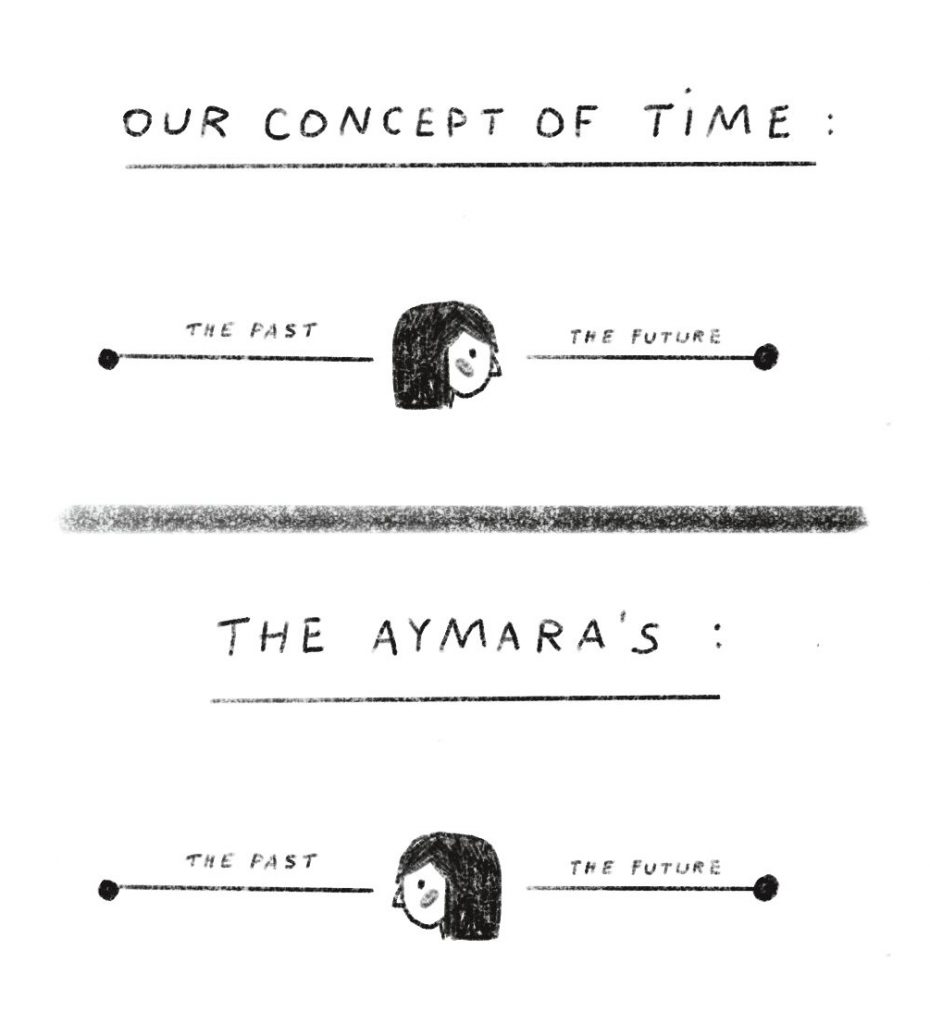
This idea reminds me of the concept of time as understood by the Aymara people—who inhabit some of the highest valleys in the Andes, northern Chile. While most of us think of the past as something that happens behind us and the future lies ahead of us, researchers found out that for the Aymara people, it’s the other way around.

The Aymara people see the past as something that lies ahead of us, and the future as something that lies behind us.

Notice how in our concept of time, we tend to see the future as the continuation of the past, how it seems like we are ‘stepping’ into the future from the past, or ‘carrying’ the past into our future.

The Aymara’s concept of time, on the other hand, invite us to see the past as something that lies in front of us: something visible to the ‘eyes’, something ‘known’—while the future is something behind our back: something unforeseen and unknown, representing potentials and possibilities.

To me, it’s like an invitation to step back (instead of stepping forward) into the future without ‘seeing’, without knowing where to go, without following a pre-made map. Sure, we can’t erase the past. It has happened already, and their traces are right there, right in front of us.

However, as we step back into the future, the past we see in front of us doesn’t particularly give us a clue on where we should go or where to step on next, as the ‘road’ behind our backs remains unknown.

The only way we can get a hint about where we’re going and where our steps are slowly taking us is by taking a leap of faith and walking that ‘moonwalk’: stepping further ‘back’ into the future.

***

I ask these questions often when I am working on my journal these days:

  • Who am I today if I am not defined by my past?
  • How can I live as who I am today, as who I want to be today–without referring to who I was yesterday, without referring to my past experiences or memories? What would I do today? How would I behave today? What would I believe in based only on everything I experience today?
  • How would I treat the people in my life today if I do not feel the need to adjust my approach based on my past experiences with them? How could I relate to them as my present self, instead of my past self?

_______

Photo by Lia Stepanova | Illustrations by Beradadisini
hanny
WANT TO SHARE WITH SOMEONE WHO NEED THIS?
Hanny illustrator
Hi. I'm HANNY
I am an Indonesian writer/artist/illustrator and stationery web shop owner (Cafe Analog) based in Amsterdam, the Netherlands. I love facilitating writing/creative workshops and retreats, especially when they are tied to self-exploration and self-expression. In Indonesian, 'beradadisini' means being here. So, here I am, documenting life—one word at a time.

hanny

TAKE WHAT YOU NEED
VISIT THE SHOP