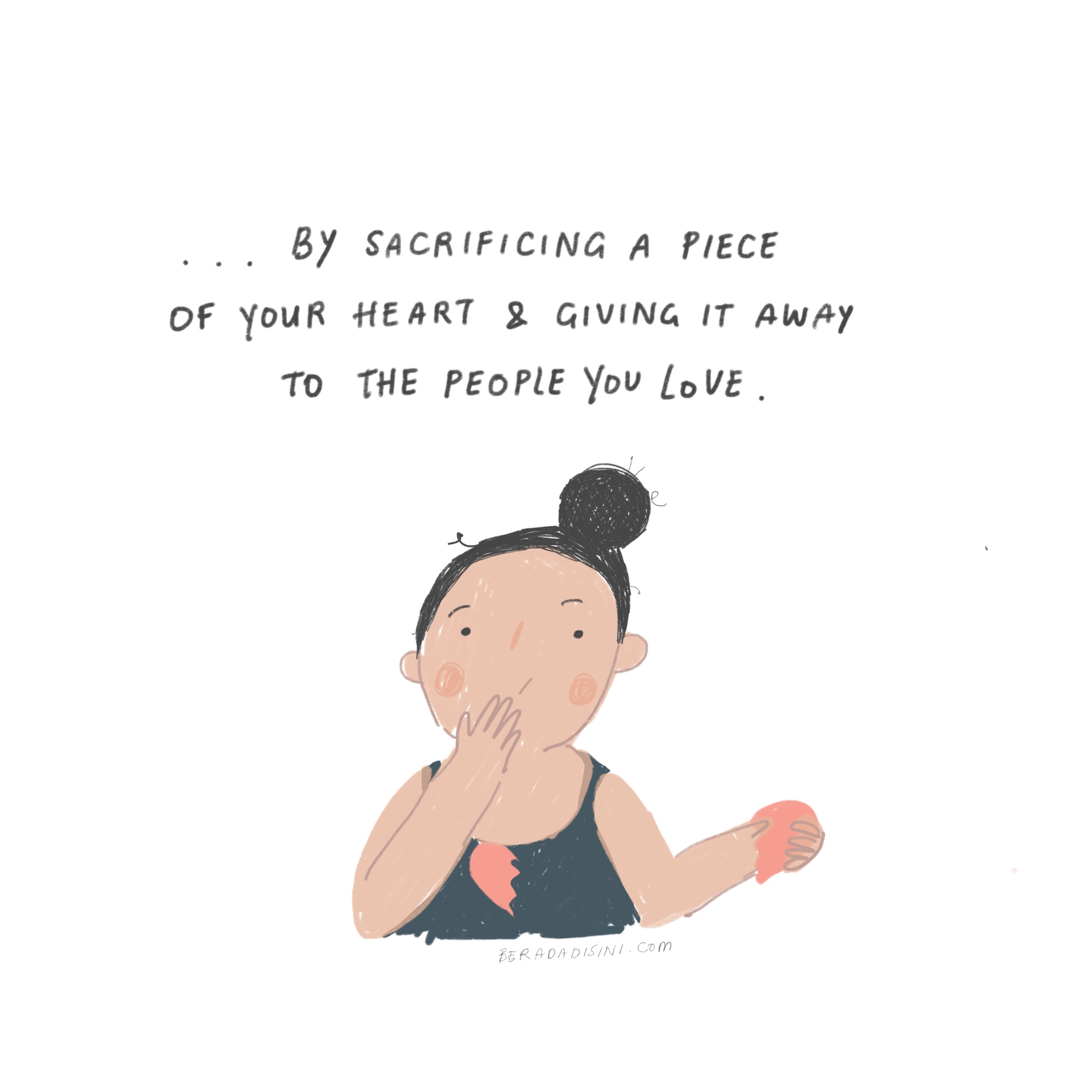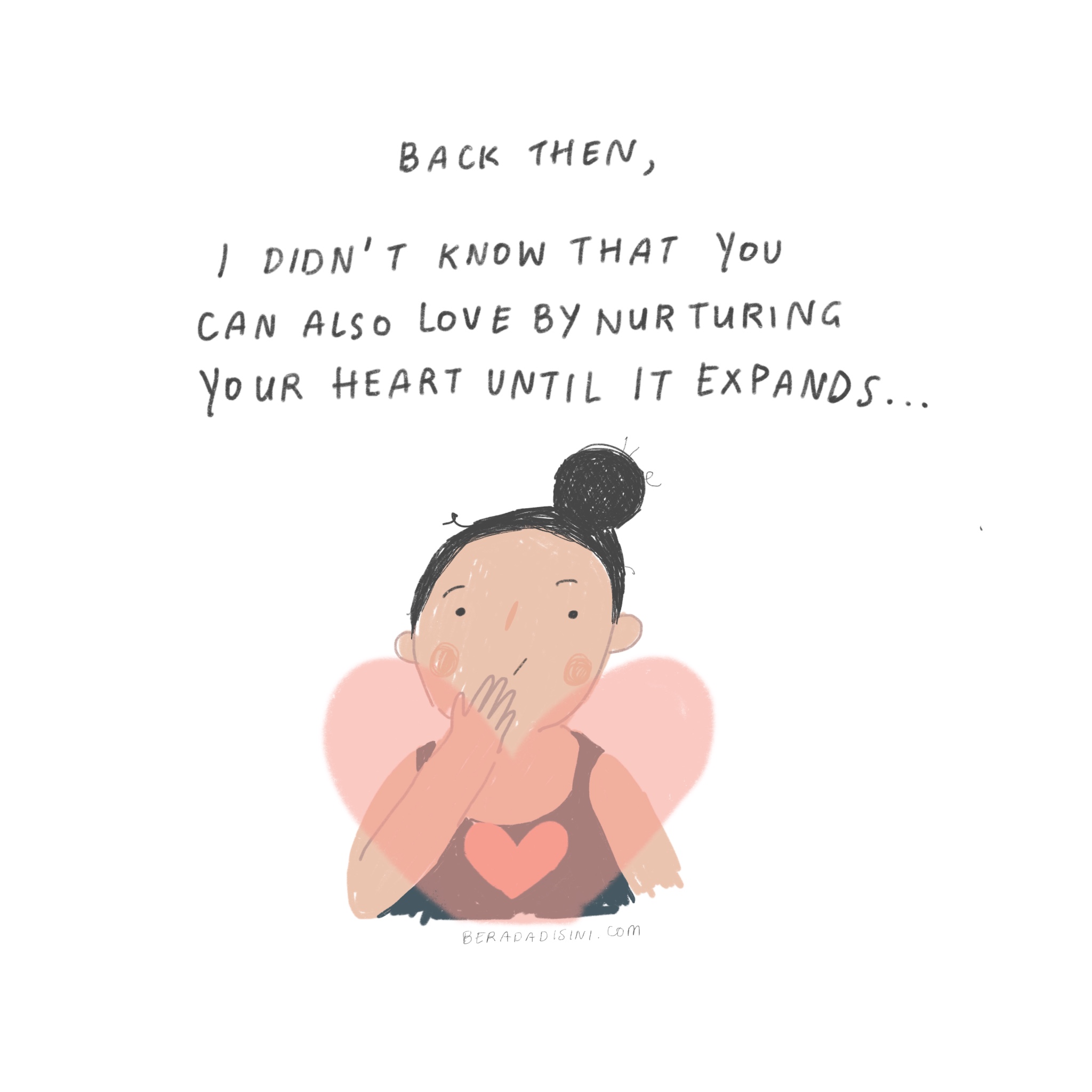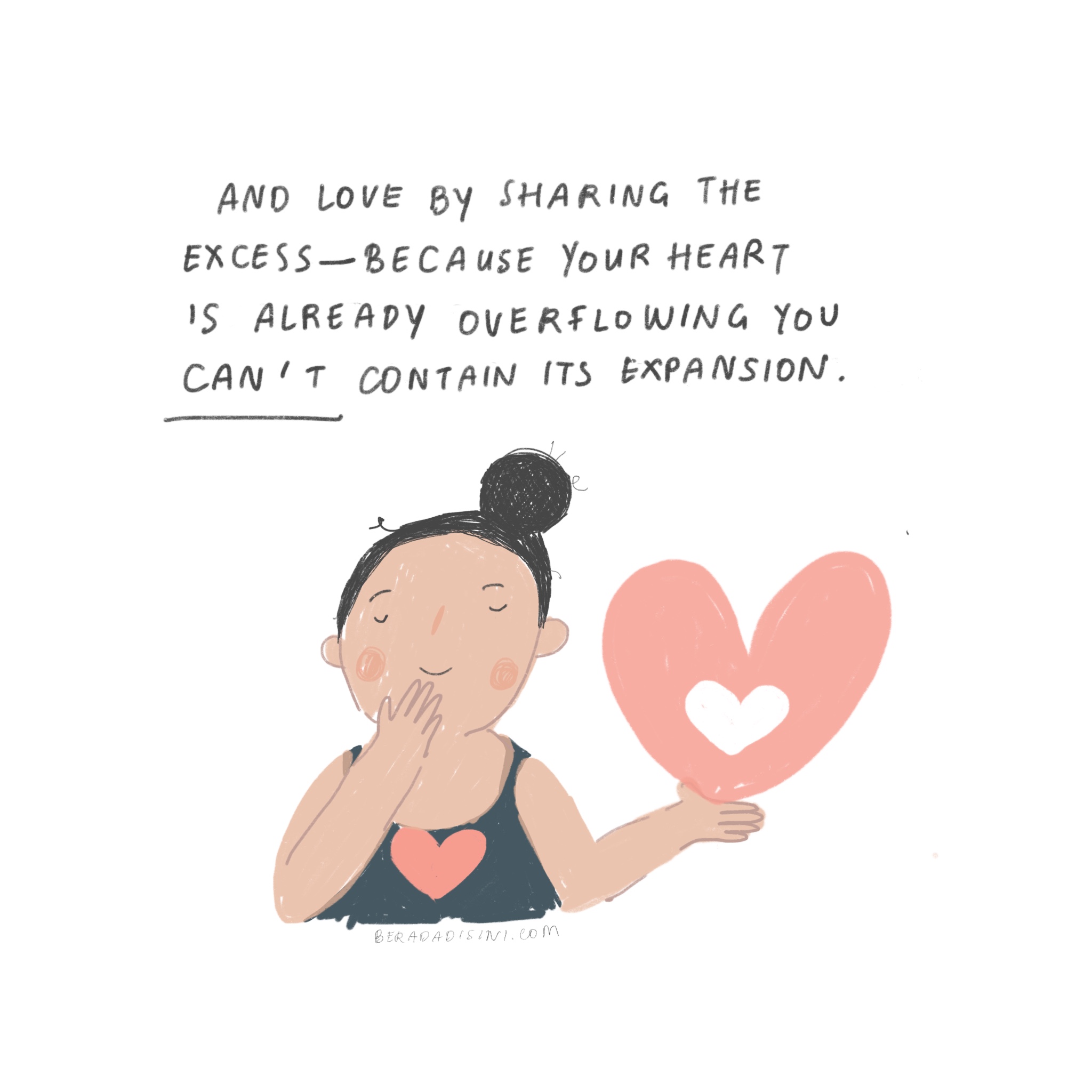
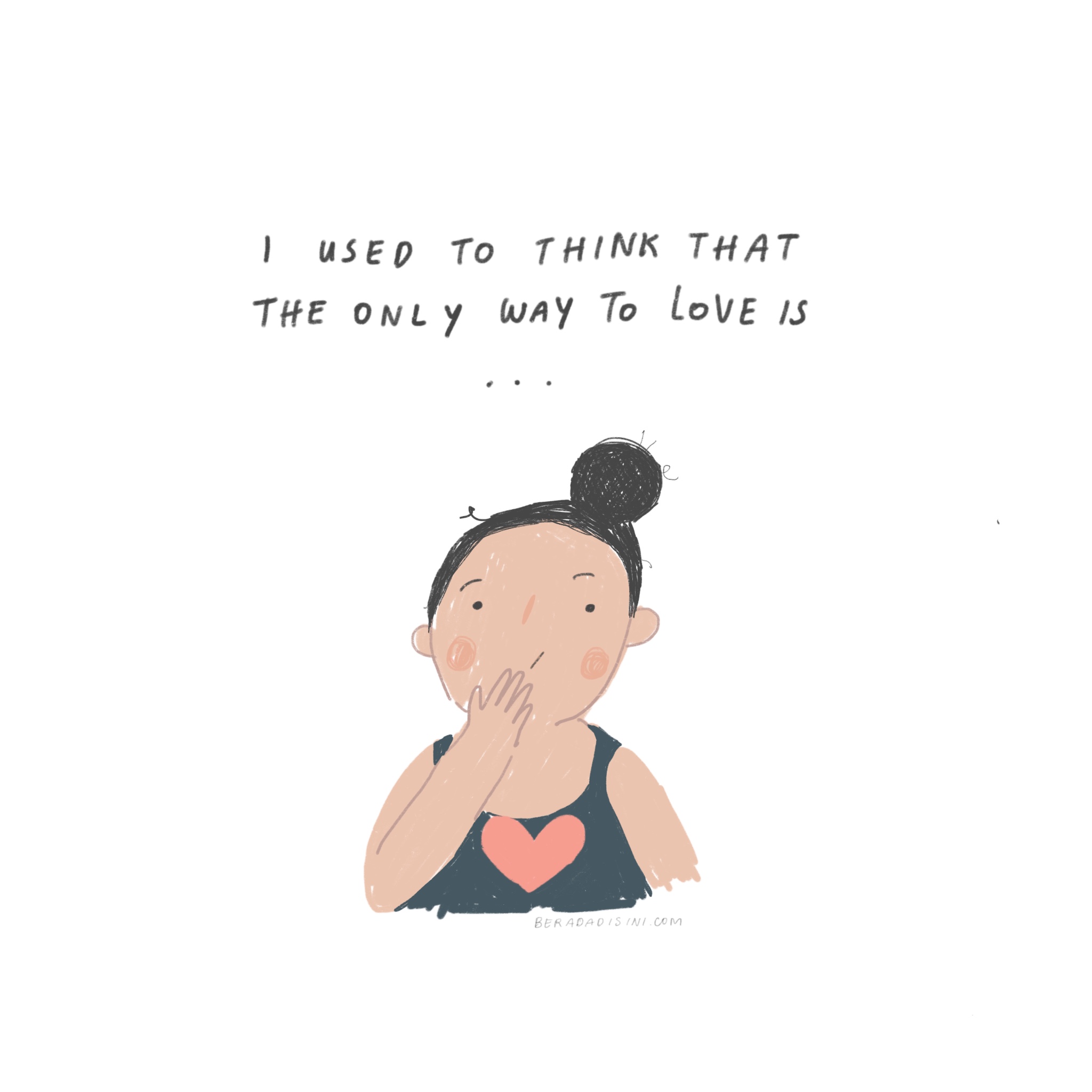
I published this illustration on Instagram yesterday, and it seemed like the message resonated with a lot of you. Thus, I decided to post that illustration here, along with a chapter from my interactive playbook, Break, Hearts.

I used to think that love is synonymous with ‘sacrifice’.

I could still remember the pride that was swelling inside of my broken heart from being able to say: “I’ve sacrificed so much for him!”–as if by sacrificing more, I had won a nonexistent competition to prove my significant contribution to the relationship; while the other party contributed much less. So, I sacrificed more to show how I can love more and to be loved more. I hurt my feelings to protect other people’s feelings.

Only in the past few years have I realized that love is not about sacrificing something–or someone. It’s not about succumbing to anything–or anyone. We don’t have to choose who or what to be sacrificed to be able to love (and to be loved).

Love should be a win-win instead of a win-lose. A relationship is not a matter of mutual sacrifice. It’s about being able to compromise. And yes, it took me a long time to understand the difference between the two.

When I love from a broken heart and hurt feelings, I came from the mindset of lack. Therefore, when I have to share the love inside of me, it has to feel like a sacrifice–because now that I’ve shared it, I ended up with less.

When I learned how to love from a heart that is full and content (because self-love has become my top priority), I realize that loving could leave me with a whole functioning heart–not only a fraction of it. It’s not a sacrifice. It’s a pleasure. There’s so much love inside of me to give; I can’t help but sharing it with the people I love.

***

Excerpt from the interactive playbook, Break, Hearts.

There are times when picking ourselves up after a heartbreak feels almost impossible. We feel as if we’ve lost ourselves. We feel as if the version of ourselves—the one when we were in a relationship—is missing. Strange. Because we cannot lose ourselves, can we?

But, the truth is: we can.

At certain stages in our lives, we can lose sight of our real selves. It is particularly for this reason that we have the term ‘self-discovery’—a journey to rediscover ourselves. But how do we lose sight of ourselves in the first place?

Most of the time, by pretending to be someone else.

We pretend to be someone we’re not to please others or to receive their approval. Some of us play this role for so long to the point where we start to believe that we are who we pretend to be.

Fake it until you make it, they said.

This is precisely what some of us are doing.

We are pretending to be the version of ourselves that—we believe—will be approved by others more, will be wanted by others more, will be loved by others more.

For this reason, a lot of us enter a relationship by pretending to be someone we’re not. We are doing the things we don’t typically do, behaving the way we don’t usually behave, and tolerating stuff we often won’t tolerate.

We are obsessed to find out what our significant other like or dislike, want or do not want. We believe that if only we knew all these, then we can present ourselves as an ideal partner. We are not confident that appearing as our true selves will interest our significant other enough.

Thus, throughout the relationship, we keep molding and readjusting ourselves to please our significant other: craving for their approval. The problem started to kick in when we were tired of putting on a show and realized that we have turned into the person we are not.

In such uncomfortable situations, our real selves sometimes appear, to the point that during fights or argumentations, our significant other might say: “It feels like I don’t know you anymore.”

Which, to this extent, might be valid.

On a day-to-day basis throughout our relationship, we might have presented ourselves as someone else. Someone we thought would better suit our significant other. We’ve been wearing masks.

However, who is it that our significant other truly loves? Our masks or ourselves? If we appear in front of our significant other unmasked, do we think he or she would still recognize us—let alone love us?

At the tipping point when we realize that we have repressed our true selves only to please our significant other, a word makes itself visible: sacrifice.

We feel as if we’ve made sacrifices throughout our relationship. Sometimes, we ask, “Why am I the only one who make these sacrifices?”

But here’s a hard pill to swallow: love should not feel like a sacrifice.

Sacrifice means one person gets nothing while the other person gets everything. If it feels unfair, we are right. It is unfair.

The more we sacrifice, the more we got frustrated with our relationship, with our significant other, and ourselves. The more we sacrifice, the more we’re losing ourselves.

The thing I’ve learned throughout the years is this: in a healthy relationship, we do not need to make sacrifices.

We compromise.

hanny
WANT TO SHARE WITH SOMEONE WHO NEED THIS?

Since I was little, I have always wanted to be a writer. I grew up reading Blyton, Lindgren, and Hitchcock, wanting to be just like themhaving the ‘superpower’ to create a parallel world and transport people to experience different lives and undergo different adventures. I spent my teenage days writing stories. During the weekends, I typed and typed and typed, only went to bed at around 4 or 5 am with a jittery feeling of not knowing how the story will end.

When later in life some of my short stories and travel narratives got published in an omnibus by two of Indonesia’s major publishers, I was so proud. It was like an achievement in itself: a dream come true. When I caught a glimpse of those omnibus on the shelves of a bookstore, I thought to myself, “Now I can really call myself a writer!”

But here’s the thing: I don’t feel like a writer anymore.

I posted a question on Instagram a few days ago as I was pondering about this issue, and I’m so relieved that some of you are kind enough to let me know that you are also facing the same dilemma and even share your struggles.

Have you ever felt trapped by the label you gave to yourself? Have you ever felt as if you’ve outgrown the label?

I didn’t know when the label ‘WRITER’ started to bother me, but it must have been getting on my nerves for the past few years. Not that I am not into writing anymoreon the contrary, I am still writing and I can’t stop thinking of future book projects (something is brewing for the end of the year!). However, oddly, these days the ‘writer’ label I have glued unto myself feels somewhat suffocating. When I have to speak in front of an audience or delivering a workshop, when the organizer introduced me as a writer, I feel like a fraud, a liar.

“But, why?” you might ask.

I don’t know. I can’t precisely pinpoint the reasons: maybe because I don’t feel like I have been productive. Maybe because I have experienced the feeling of ‘being a published writer’ and now that I have known the feeling I was no longer curious. Maybe because I wanted to do more than ‘just writing’. Maybe because I’m a little bit bored with this whole ‘writing thing’. Maybe because I have just started expanding my creative expressions to drawing and filming. Maybe because that label feels too limiting and doesn’t give me enough room to experiment in life.

Whatever the reasons might be, it’s not about reasoning at all. It’s more about how I feel; no matter how irrational it might sound.

The thing is, lately, I have learned to trust my feelings and rely on them more. I mean, who am I to call myself a ‘writer’ when I don’t feel like one?

Only then it dawned on me that I was the one who gave this label to myself. Even if the label was attached to me by someone else (publisher, workshop organizers, etc.), I was the one who decided to embrace the label, voluntarily. Thus, I actually have the power to ditch the label when it no longer suits me. I can bid the label farewell. I don’t have to walk around carrying the label on my shoulders when it feels too heavy. When I decided to drop the label, I don’t have to conform to what other people might expect from that particular label.

So, I decided to do it today: to drop the label and not to think of myself as a writer anymore.

I was feeling a bit scared, actually: should I do this?

But then I realized that this is a label I created or embraced for myself. It’s only a label. Just because I decided not to call myself a writer anymore, it doesn’t mean that I can no longer write. Maybe, I can even write more and better once I am done associating myself with the label.

I am having fun trying to find a new label that might fit me better at this stage. Some of you might say, but what’s the point of ditching a label to attach a new label unto yourself? Why can’t we just be humans without labels?

To which I would say: I am trying to get there. To be who I am, no labels attached.

However, for practical reasons, I still need to label myself with something (new). At least for myself, so I won’t feel too lost. Then, of course, to introduce myself to potential clients during meetings or networking events. (Do you know that since I quit my job and work independently, I haven’t printed my name card because I still couldn’t decide what I wanted to put as a title?).

So, after listing down the things I’m doing now (personally and professionally), plus listing down the things I would want to do in the future (personally and professionally), I am happy to attach a new label unto myself.

I am a creator. A creator of experience in life, a creator of content in the digital world.

I think, for the time being, I like the label. It fits me nicely like a new pair of jeans. Surely, just like a new pair of jeans, it’s still a bit stiff (and, you do know that faint smell of ‘the store’, don’t you?). I would need to wear it more, so I can wash it and crack it a little bit to make it even more fitting. Oh, and in the next few days, I will also need to adjust my bio/profile here and on other social media platforms. Indeed, more work and adjustments, but it’s okay.

So, here I am, with my new label, intending to create more playful and meaningful content (or experience) on and off the Internet. When it comes to working, I could say that I help my clients to do just the sameand during workshops, classes, or retreats, I am basically sharing about the same thing.

On another note, maybe I’ll also get tired of this label one day and granted myself a new one in the next 3, 5, or 10 years. Who knows? However, I guess that’s the point.

Life is about forever rediscovering something new about ourselves. It’s about growing and evolving. And why should we feel bad about retiring an old label? We’re not supposed to feel bad when we’re retiring a piece of clothing that has become too tight or too worn out for us, aren’t we?

With that being said, maybe I can start designing my name card and get them printed out next week.


PS: If you could drop a label that has burdened your life lately, what would that label be, and what would you embrace as a new label?

hanny
WANT TO SHARE WITH SOMEONE WHO NEED THIS?

Reader’s Question:

How did you start journaling in the first place? How do you split your time between other parts of life (daily tasks, work, responsibilities, etc.) and journaling? How do you design your time-tracker journal, and how can I create my own?

— from Instagram comments

***

When I uploaded an Instagram story about my time-tracker journal and an Instagram picture about my planner a few weeks ago, some of you asked some questions about journaling and making a time-tracker journal for yourself. Since it would be such a nuisance to type the answer on Instagram’s comment section, I decided to respond to those questions via this blog postHope this helps.

How did I start journaling?

I started journaling in the 1st grade of elementary school. It started out when my mother bought me a diary with a lock (the cutest thing!) and since then, I never stopped writing in my journals. I have quite a huge pile of journals at the moment, all those handwritings from early elementary school days throughout the rest of my childhood, from my adolescence to my twenties. And sometimes, I reread them: amazed at how much I’ve grown throughout the years.

I guess writing (and mostly journaling), has always been my go-to outlet for self-discovery. A few years ago, I wrote this post about why I write and why it has such a profound effect on me, so you can visit that post if you’re interested to know more about how I chose writing as my outlet of expression (or, on how writing chose me).

How do I split my time between journaling and other parts of life (daily tasks, work, responsibilities, etc.)?

Okay, here’s the thing: journaling, writing, and other creative pursuits—whether it’s drawing, painting, learning how to make illustrations–are the things that I need in life. When people talk about self-care, they might talk about taking a vacation, traveling, pampering themselves, eating healthy food, going to the gym, having a wonderful time with friends and families, or doing other things that make them feel happy and fulfilled. For me, having the time to be creative (and to create) is my way to take good care of myself. It feeds my soul.

When I’m stressed, sad, facing problems, agitated, or not feeling well, having my creative time is the thing that lifts me up. It could be as simple as reading a good book, trying a new recipe, drawing, writing a poem, or simply journaling and dumping my thoughts and feelings on the pages. For me, creative time equals self-care, and having my creative time makes me feel happy, empowered, (somewhat) artistic, and productive.

Having the time to be creative is my way to take a good care of myself. I need it. It’s crucial for my well-being.

I always feel the most productive when I am having a creative time. No matter how busy I am with work, no matter how excited I am about my professional achievements, no matter how many to-do lists and responsibilities I ticked off, at the end of the day, the thing that matters the most to me is how I’ve spent my creative time and what I’ve created that day.

I’m not saying that professional achievements or performing well at work don’t matter as much, but it’s also crucial for me to know that there’s an achievement that is mine; and mine alone. It’s not about being (or looking) busy, getting praise, a salary, a bonus, contributing to a team, or pleasing a client. It’s about exploring my creativity and be content with that—knowing that I am the only person who knows what I have done today, or how much I have grown since yesterday.

With that being said, let’s move on to the question: how do I split my time between work, daily tasks, and journaling?

In the old days, this was how I would do it: when planning my day, I would list down all my work responsibilities, deadlines, meetings, daily tasks, house chores, appointments, etc. and then, when I could find an empty slot of time, I would allocate that slot for my creative time.

Of course, this approach didn’t work for me.
Magically, I would always have more things to do, more emails to reply to, more work stuff coming in, more dishes to wash… and even if I could find an empty slot of time that day, usually I had been so exhausted from fulfilling my duties and responsibilities that I didn’t want to do anything else; let alone ‘being creative’.

So, these past few years, I changed the way I plan my day. Instead of listing down all my work responsibilities, deadlines, meetings, daily tasks, house chores, or appointments to then find an empty slot of time for my creative pursuits, I did the opposite. I would block a slot of time for my creative pursuit first (could be for around 30 minutes – 1 hour), and only then the rest of the empty slots can be filled with my work responsibilities, deadlines, meetings, daily tasks, or other appointments.

Usually, I block my early mornings for my first round of creative time (I called this time of the day my miracle morning, based on the book The Miracle Morning by Hal Elrod; and I think you should read this book as well!). I don’t mind waking up a bit earlier to have my slow and miraculous morning: making a cup of coffee, doing a 1-minute meditation, reading a book about drawing, sketching and doing some character studies for my illustrations,  journaling, watching uplifting videos, or simply writing about the things I’d like to do/achieve that day.

I plan my day around my self-care, not the other way around. My commitments and responsibilities will fit themselves around it.

Surely, if there are still more unused time slots after this, I can use the time for whatever I want—but planning my day around my creative time (instead of planning my creative time around my day) does the trick for me. By doing this, I can make sure that I stay happy and creative, knowing that I will always have (and make) the time for my self-care routine, and my other responsibilities will fit around it.

Does it sound selfish?

Probably, but I see it this way: when I’m happy, I can also fulfill my responsibilities better. When I’m in a good mood, I am more energetic. I feel inspired and I feel more creative. So whether I’m working on a deadline, talking on the phone for a remote meeting, or doing house chores, I am doing those things in a healthy mental and emotional state. Thus, for me, it makes sense to always put my well-being first, which in my case, is about having my undisturbed creative time.

How did I design my time-tracker journal, and how to create your own?

I designed my time-tracker journal because I want to know whether I’m really busy or just busy being busy. I want to know how do I use up (or waste) my time in a day and what are the things I can achieve mostly from 6 am to 11 pm every day. Where does exactly my time go in a day?

Another thing was that I also want to track the time when I feel most productive and the time when I have an energy slump so I can plan my days better. By keeping a time-tracker journal for some time, I also hope that I could find out if there were some correlations between how I spend my time with my energy level and my overall mood.

For instance, there were days when I feel so tired and sleepy at around 2 pm – 4 pm, but there were also other days when I go through these ‘sluggish hours’ being productive, feeling inspired and energetic.

I wanted to know why this happened, and once knowing that (or at least have a good indication about why it happened), I wanted to know how I could have my productive 2 pm – 4 pm more often. By tracking my time, I wish I could see how to manage my energy better. (If you’re interested in the concept of managing energy to improve your performance, I would suggest the book The Power of Full Engagement by Jim Loehr and Tony Schwartz).

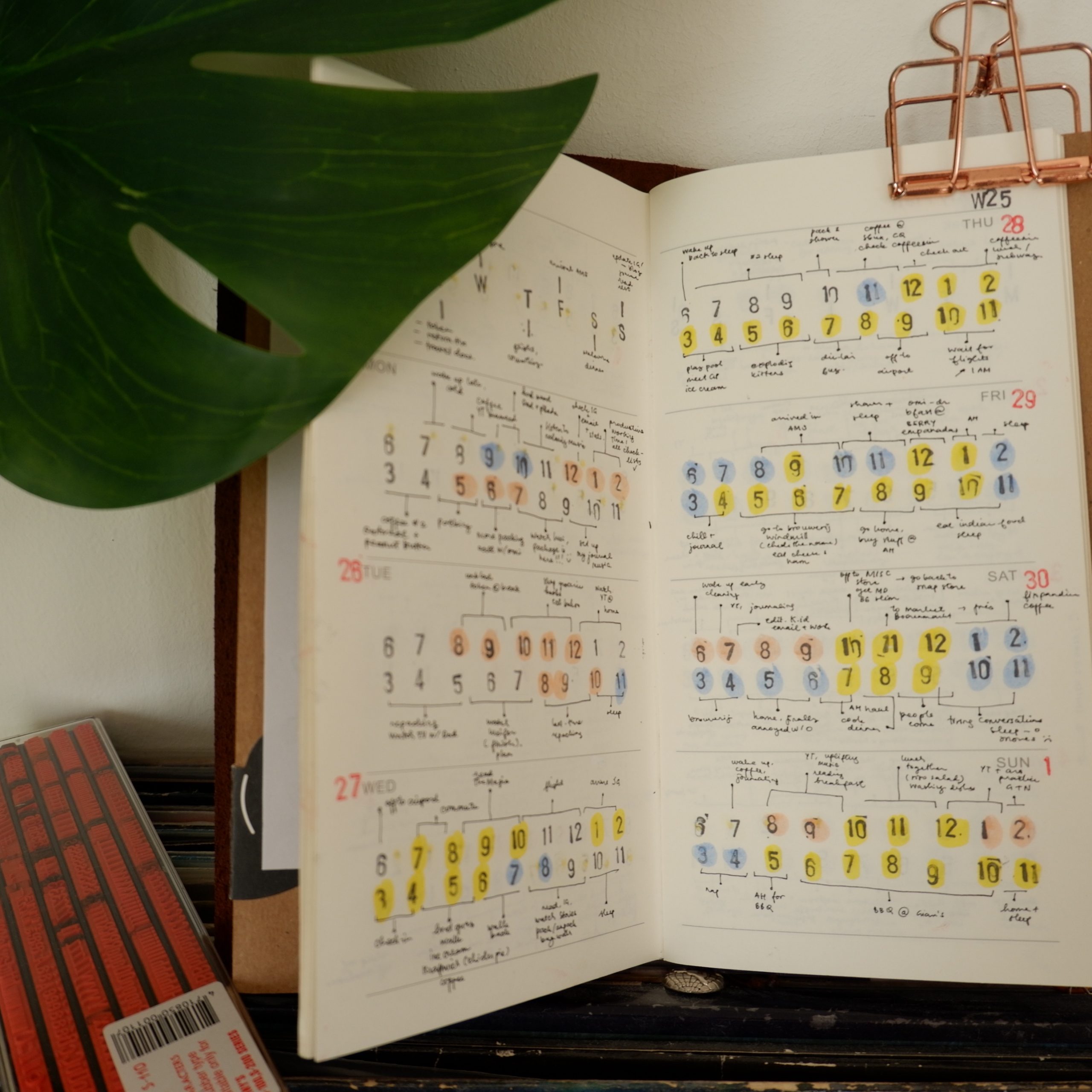
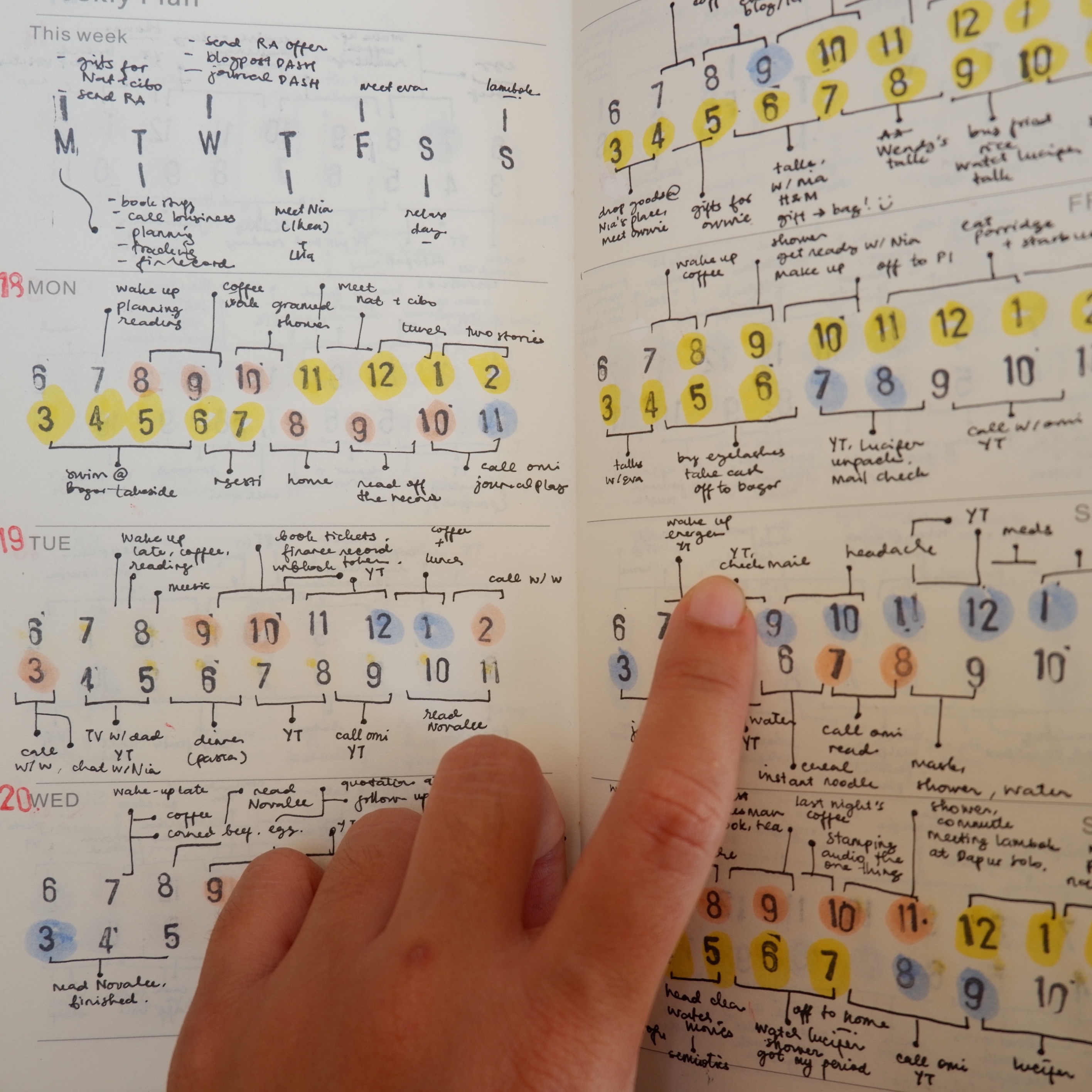
I created my time-tracker journal on a weekly insert I bought here and stamped the hours with this stamp set. Because I wanted to measure the correlation between how I spend my time and how it affects my mood and energy level, I decided to color-code my time-tracker with my KOI coloring brush pen.

  • Pink is for a productive time when I feel creative and energetic. This includes the time when I work, replying to business emails, reading a non-fiction book, learning languages, drawing, exercising, writing, or doing other creative stuff. My creative time is counted as a productive time.
  • Blue is for my non-productive time when I feel tired, sleepy, or lethargic. This includes the time of scrolling social media feed mindlessly, following threads and comments on a controversial Facebook status, taking a long nap, or feeling down, miserable, uninspired, or sick.
  • Yellow is for my social & commuting time when I meet people, get on a bus, hop on a red-eye flight, attend a dinner party, have a catch-up lunch with friends, or delivering training and workshops.
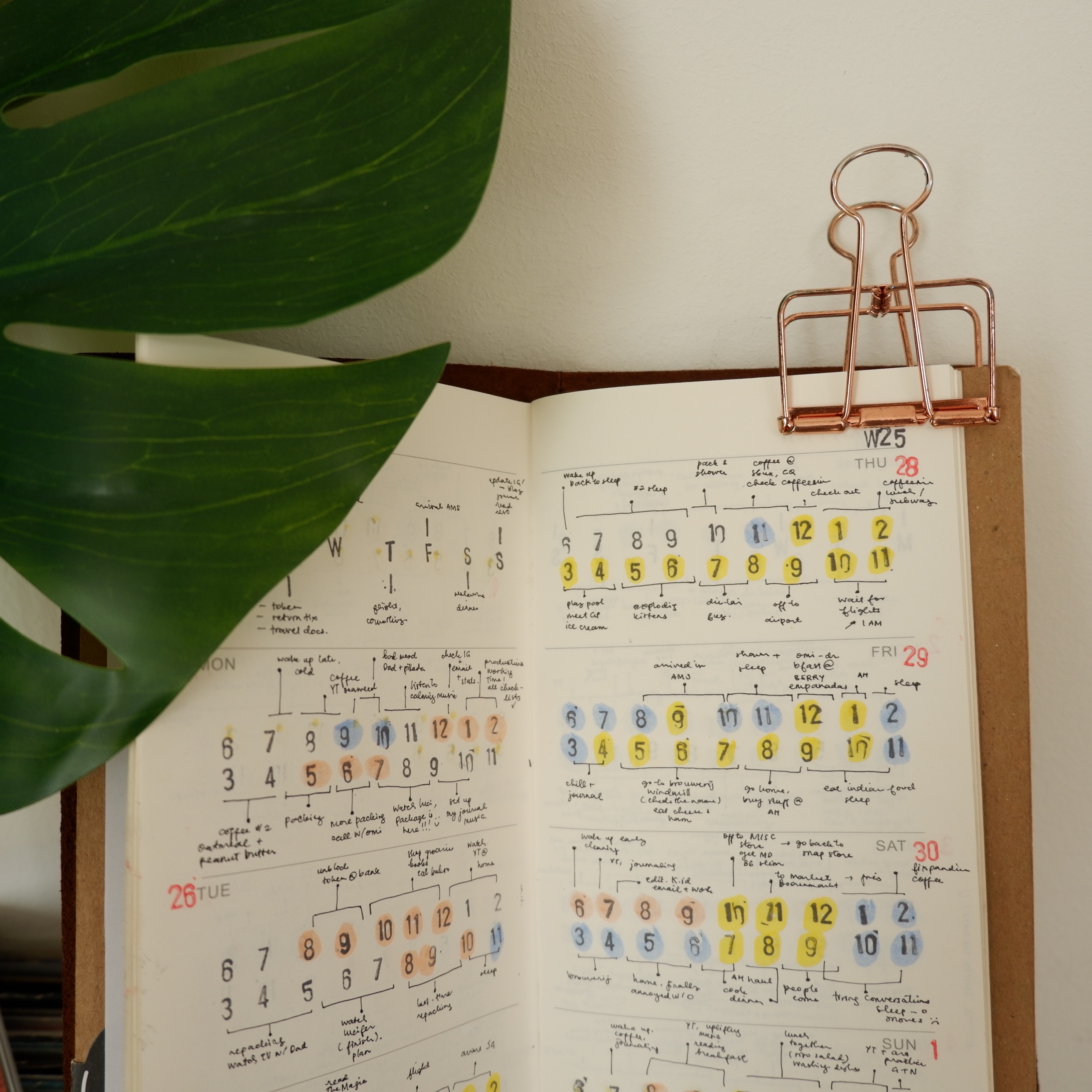
This is how I formatted my time-tracker journal, but of course, you can do it however you like and adjust it to your needs. For instance, you can choose a different layout using a normal notebook, list down the hours from top to bottom, and write down the things you do next to it. You can also use color-coding to track other things you want to track in your life. It just happens that I want to track my energy level, so I decided to go with this tracking system.

Then, basically what I do with my time-tracker journal is as simple as writing down the things I do at a particular time of the day, and color code the hours with pink, blue, or yellow.

After keeping the time-tracker journal for more than 2 months, I can already see some patterns, such as:

  1. When my morning starts with a blue (i.e. I woke up feeling sluggish/tired/grumpy), 80% of the time, it will lead to more blues in the afternoon/evening. Knowing this, when I woke up with a blue, I put extra efforts to fix it: maybe treating myself to an extra hour of drawing instead of immediately replying to business emails, listening to cheerful songs to lift up my mood, or making pretty-looking oatmeal for breakfast.
  2. When I have a big lunch followed by a passive activity (reading, watching videos, etc.), I would also get blues between 2 pm – 4 pm. However, when I have a light lunch followed by hours of doing things (working, washing dishes, tidying my drawer, planning my to-do lists for the next day, journaling, etc.) I would not hit the blues.
  3. When I have loads of yellows on my day, 90% of the time, it will lead to a few hours of blues the next day. When I had to deliver a 3-day workshop a month back, I found out that the next 2 days following that 3-day workshop was filled with blues. I have always known, instinctively, that although I love meeting people, those interactions drained me up. I always feel the need to clam up and recharge before being able to be a social butterfly once more. The time-tracker journal confirmed this need. Thus, when I know I will have a big day full of work deadlines, I would decline any social get-together the day before. Or if I know I will have a full social calendar on the weekend, I would not set up a project deadline on the following Monday or Tuesday; knowing full-well that I would need to recuperate.
  4. When I work on a creative project from around 6 pm onwards, I would not feel hungry or crave a big dinner. Most of the time, I forgot about dinner altogether because I was too absorbed in the activity.
  5. When I go to bed after 11 pm, 80% of the time, I would wake up with blues the next morning.
  6. When I spend a lot of time mindlessly scrolling on social media (more than half an hour), the following hours will be blue.
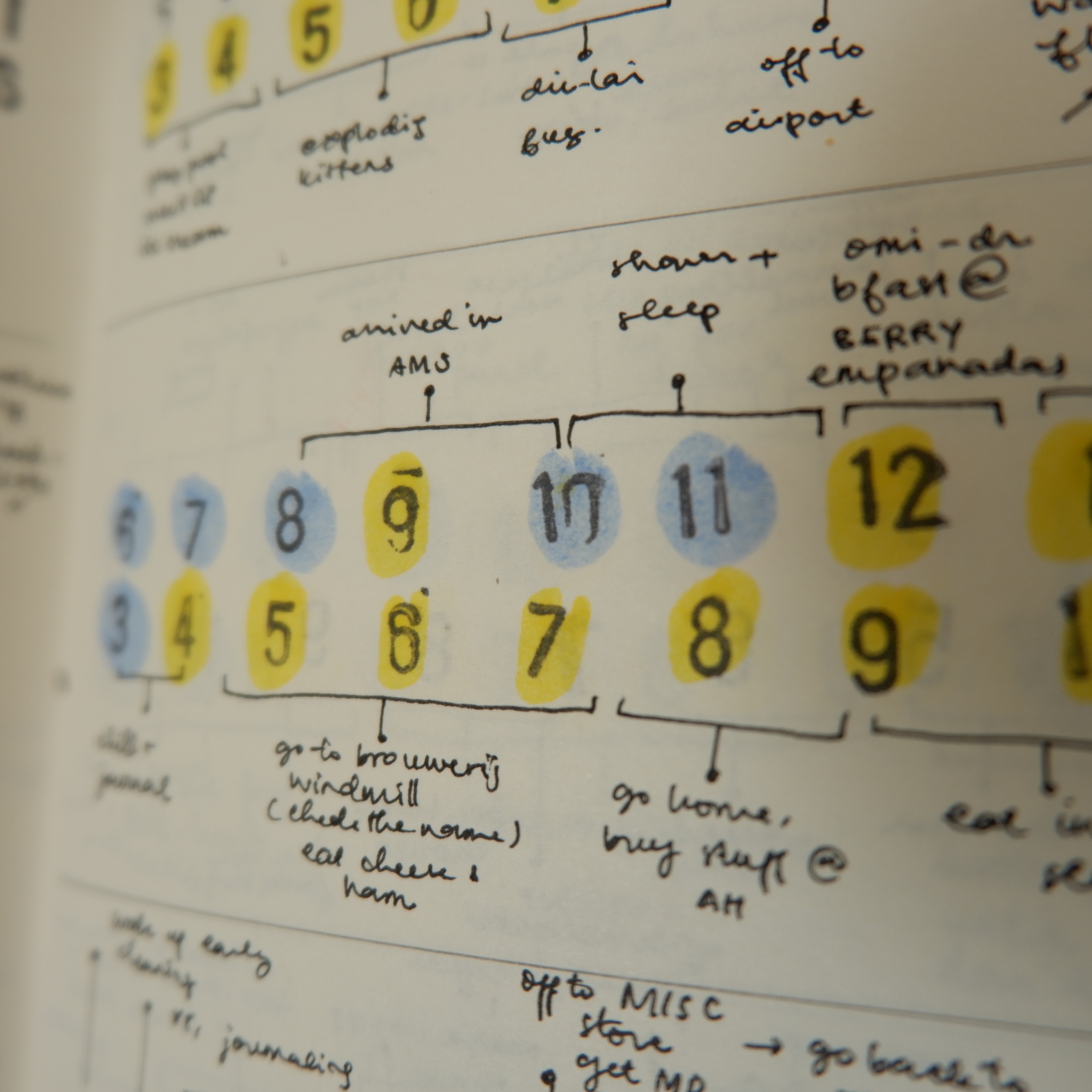
I found it interesting (but would also understand if this sounds boring to some of you!), and couldn’t wait to see what other ‘revelations’ I could get in the next 2-3 months of keeping my time-tracker journal. For me, the journal also serves as an activity tracker, a mood tracker, a productivity tracker, and a tiny summary of my days.

Are you thinking of starting a time-tracker journal of your own? Why do you think you would need one? What are the things you want to track? How do you think you can get to know yourself better if you can track the way you spend your time every day? I would love to hear from you!

hanny
WANT TO SHARE WITH SOMEONE WHO NEED THIS?

How to use intuitive journaling for closure & forgiveness

Some refer to it as freewriting or automatic writing. The idea is to set a timer for a certain period of time: one minute, three minutes, five minutes, up to you. As the timer starts, begin writing (with pen and paper) in your journal, without really thinking, without really stopping.

Write whatever crossed your mind.

It doesn’t matter if things appear to sound weird, funny, or senseless. The idea is to translate your tangled and busy mind into the paper.

Here’s the secret: DO NOT stop as you write, not even for a split second. Do not think. Just write until your time is up. Follow the chaos of your mind and write everything down. Everything.

You could even write something like, “I don’t know why I am doing this, oh, I’m so hungry, like so, hungry and my foot itches and what should I write this is strange really…”

It’s OK.

Keep writing.

I like to call this technique ‘intuitive writing’ or ‘intuitive journaling’ because after doing this practice for a while, you will notice the magical moment when your intuition starts talking to you from the chaos of the page.

The Steps

Here’s the thing: closure is not about something we need to resolve with another person, but something we need to resolve with ourselves. We need a closure not to bridge the gap between our significant other and us, but to close the gap between our beliefs, our values, our inner guidance—and us.

Thus, we can create our own moments of closure, and—hopefully, in time, forgive:

  1. Prepare a piece of pen and paper (or you can use your journal pages if you like)
  2. Prepare a timer and set it to 5 minutes
  3. Now think of a moment/hurtful experience you want to have a closure upon. While doing this and letting your feelings being stirred up, bring to your mind the image of the person who caused you this hurtful experience, imagine this person as a 4-year-old kid and then as an 80-year-old.
  4. Next, get ready with your pen and paper to do your intuitive journaling. Activate your timer, and for 5 minutes, without stopping, without thinking too much, write a letter of apology from that person to you. It may sound weird at first, but just trust your intuition and write loosely, not stopping at all—and if you’re true to the rules, at the end of the exercise, you’ll find a letter with a voice that is a bit foreign to you: the voice of the other person. Just write whatever crossed your mind. Do not try to think or analyze the person, do not try to correct or edit yourself by saying, “No, he or she won’t be saying this.” If you find it difficult, start the letter with Dear ___(your name), I am sorry for _________ and let your intuition roam free from there.
  5. Trust, and write as fast as you can without thinking until the time is up.
  6. When the timer rings, you can stop writing. Or if you feel the push to keep writing mindlessly, continue for another 2-3 minutes.
  7. When you’re done, you can: 1) mail this letter to yourself or 2) read this letter whenever you feel hurt/emotional as you remember a painful moment/incident involving this particular person.

I don’t believe in the saying that we should forgive.

I don’t think that the word should and forgiving go hand in hand together.

Of course, we could always say, “I forgive you,” or “I accept your apology.”

But does saying it means we have truly forgiven someone—or even ourselves?

When we try so hard to forgive, it feels even more difficult. Because when we are thinking about forgiving, automatically, we are thinking about the things that need to be forgiven. We’re thinking about what our significant other (or ourselves) has done that needs to be forgiven. Those thoughts are not necessarily beautiful.

Thus, it feels contradictory.

Saying I-forgive-you is easy.
Forgiving is not.

Many said that forgiveness is the key to closure. And it’s true.

However, we should not push ourselves to forgive when we are not yet ready. To forgive, we need to go through a process of understanding our heartaches, our feelings, and ourselves.

Most of the time, forgiveness doesn’t come the moment we say I-forgive-you.
Forgiveness, often, arrives when we least expect it.

There will be a day when we feel light, happy, and carefree. The day when we’re doing the things we love, having fun with the people we adore, and feeling good about ourselves. And right there and then, we will experience a flashback of an uncomfortable moment we had with someone who (either knowingly or unknowingly) hurt us.

And when that moment comes, we will feel fine. The memory stays, but it doesn’t affect us. It doesn’t bring us down. It doesn’t make us doubt ourselves. It is only a memory.

That is the moment when we experience forgiveness.

We forgive when we can access the memory of something unfavorable that once happened to us—and feel okay with that. We know it’s a part of our lives, but we don’t feel the rush of feelings or emotions associated with that particular memory any longer.

We don’t forget. We remember.

But we remember the memory as a moment, not as a feeling.

So, say I-forgive-you if it feels right. However, there’s no need to push ourselves to forgive and forget when we are not ready. For the time being, feel the feeling we need to feel. Take good care of ourselves. Build an intimate relationship with ourselves and our closest ones. Focus on improving ourselves. Focus on our growth.

And bloom.

When the time comes, we know that all that needs to be forgiven has been forgiven.

Happy journaling,

hanny
WANT TO SHARE WITH SOMEONE WHO NEED THIS?

Do you have that one friend you haven’t seen in years—but somehow you know that both of you still consider one another as trusted friends?

I guess that’s how I would describe my friendship with Chika (hope that feeling is mutual!). We knew each other through our blogs, became friends, randomly went to Singapore together, and saw each other at irregular intervals. I couldn’t remember the last time I saw her, really—must have been more than 2-3 years ago. So, of course, when she messaged me out of the blue and invited me to come along with her to Bali for a 3-day trip, I said YES.

MY DASHING ‘BELATED’ BIRTHDAY

When we arrived at our hotel, Chika, being the sweet thing that she is, surprised me with a chocolate cake with a candle on top. “Happy belated birthday!” she shouted, and we laughed, and we screamed, and we hugged, and then I blew the candle.

“Why are you so romantic?”
“I know. I should be a guy,” Chika laughed. “I think I’ll be a romantic boyfriend.”

And of course, soon after, conversations about love, heartbreak, guys, and relationships ensued: over a plate of chocolate cake.

I guess this was how we set the tone for the rest of our Bali getaway. For Chika, this would be her well-deserved vacation to take some rest from work. For me, as Bali has been my second home, I don’t have any plans for sightseeing or exploring. We just wanted to stay in, watch movies, order room service, and catch-up.

DASH HOTEL, SEMINYAK: OUR QUIRKY RABBIT NEST IN BALI

Chika invited me to stay at Dash Hotel in Petitenget, Seminyak, during our getaway. I didn’t think I’ve ever heard about the hotel before; but when I saw the facade, I realized that I have been passing this hotel many times!

Why, it is located near some of Seminyak’s beach-hangout places like Potato Head and Ku De Ta. And it is also only a walking distance from some of my favorite spots, like Biku and Cafe Organic.

I have always found this particular hotel intriguing, as it looks so bold and ‘out of place’ in the midst of Seminyak’s signature style; just like a rebellious teenager. Every time I passed this hotel, I always told myself that I wanted to see what it’s all about one day.

And finally, I got a chance to do it! (thanks, Chika!)

Inside, the hotel’s playful design screams fun, young, and vibrant. It’s so bold in a way that you might love it or hate it (like you would a durian!). I happened to like it simply because being there, looking at those vibrant colors, made me feel happy and energized. The hotel is so unique in its own way, that I would definitely tell a story about the quirkiness of it and my fun experience staying here in some dinner parties.

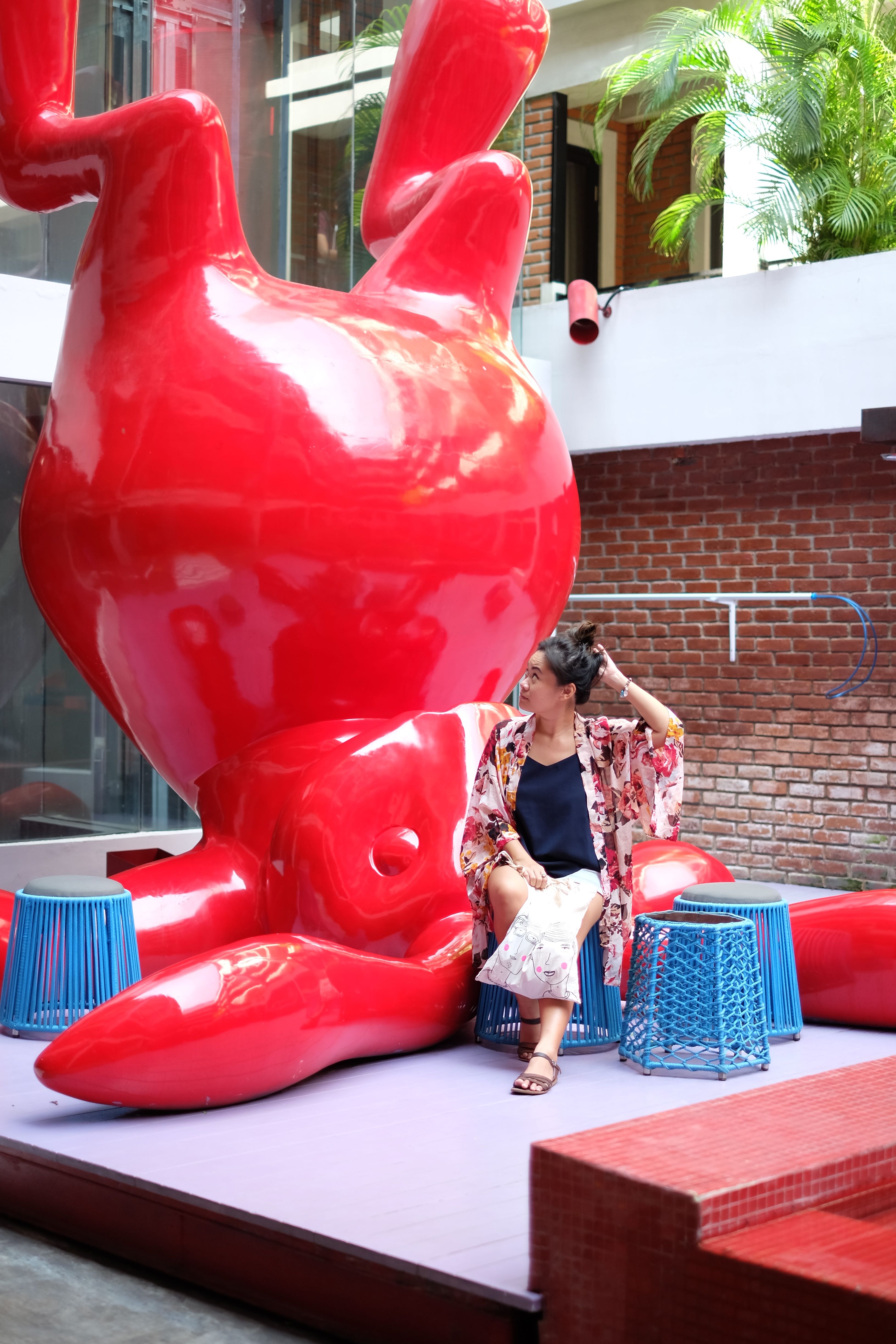
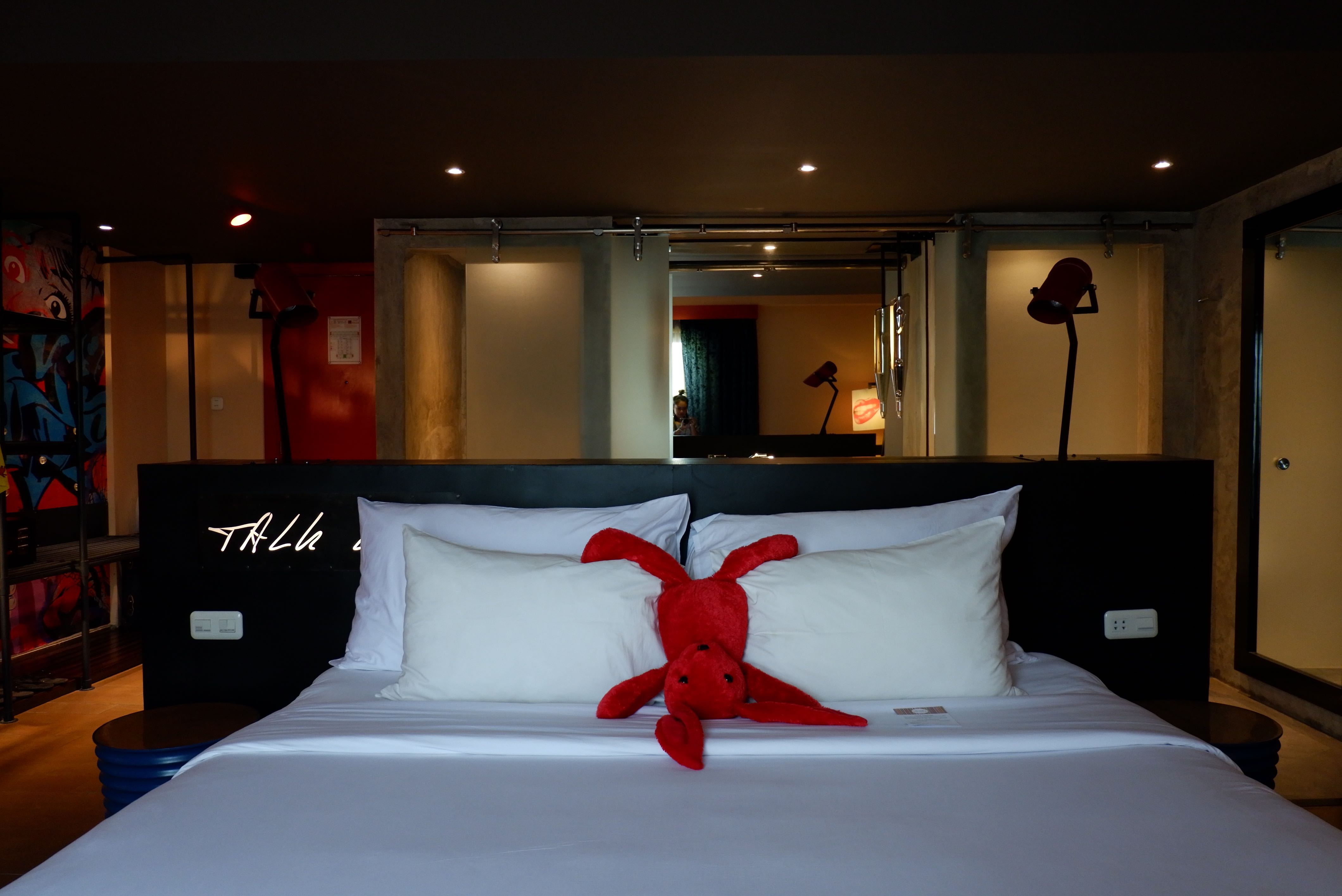
I instantly fell in love with ‘the Red Bunny’—which turned out to be… everywhere.

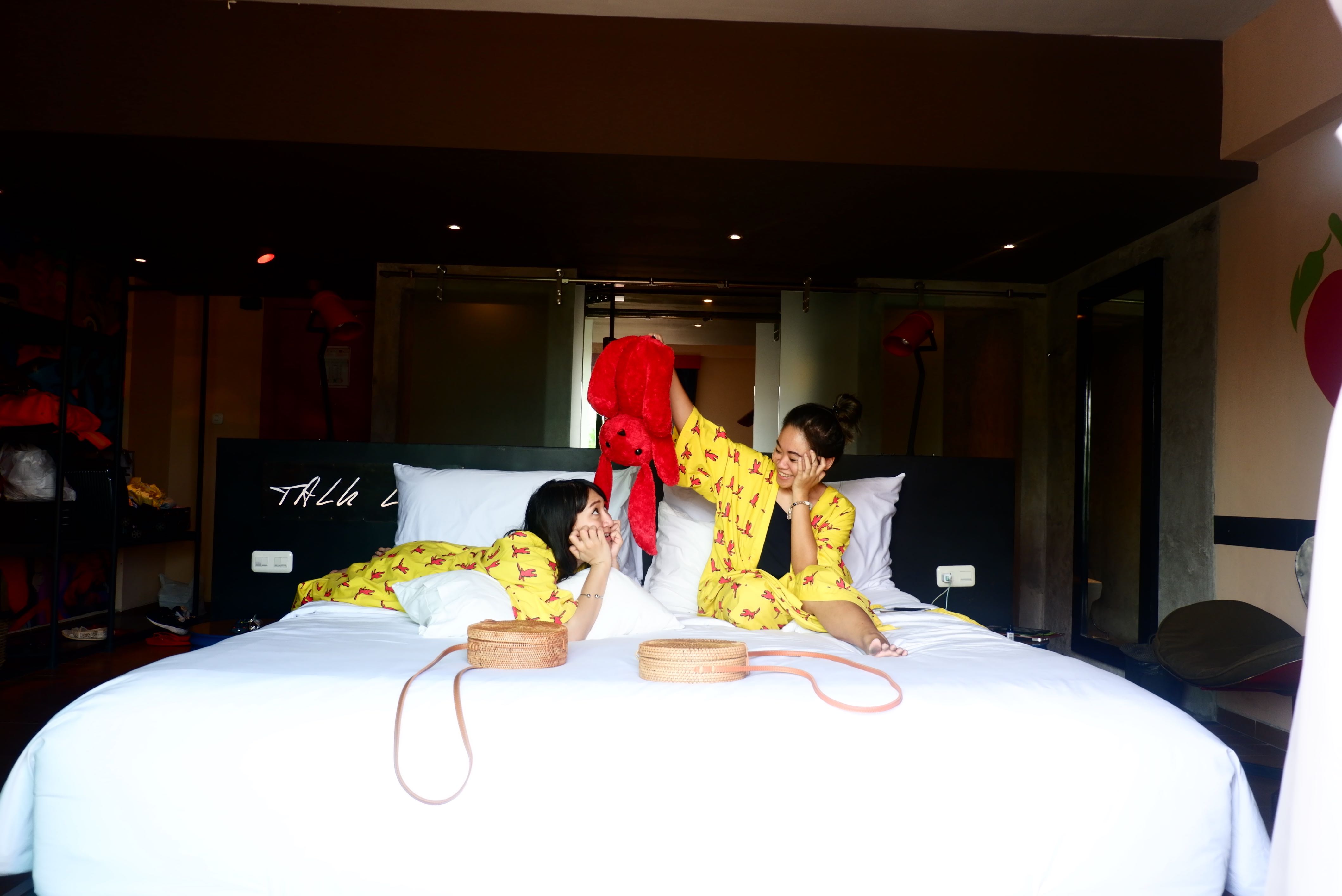
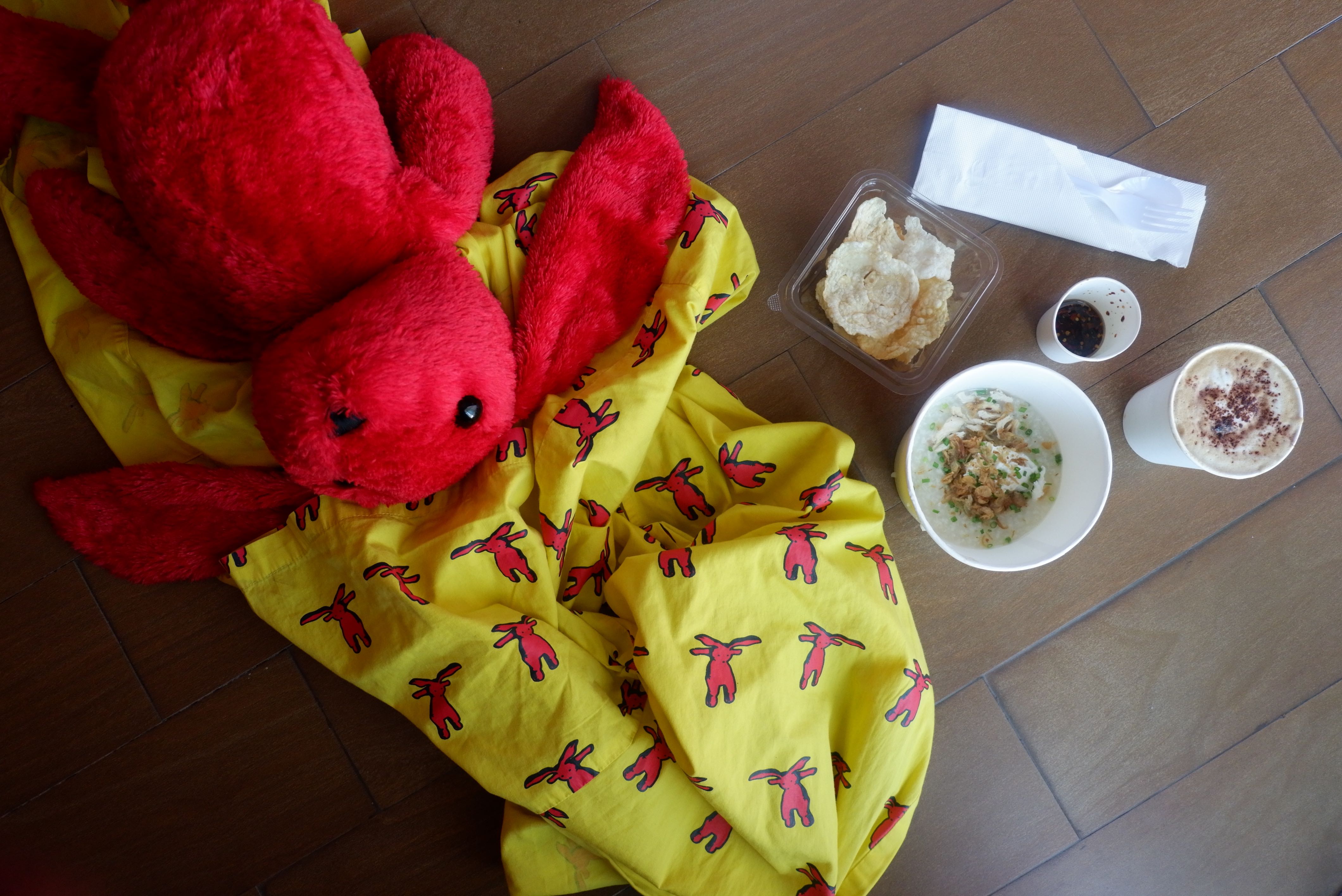
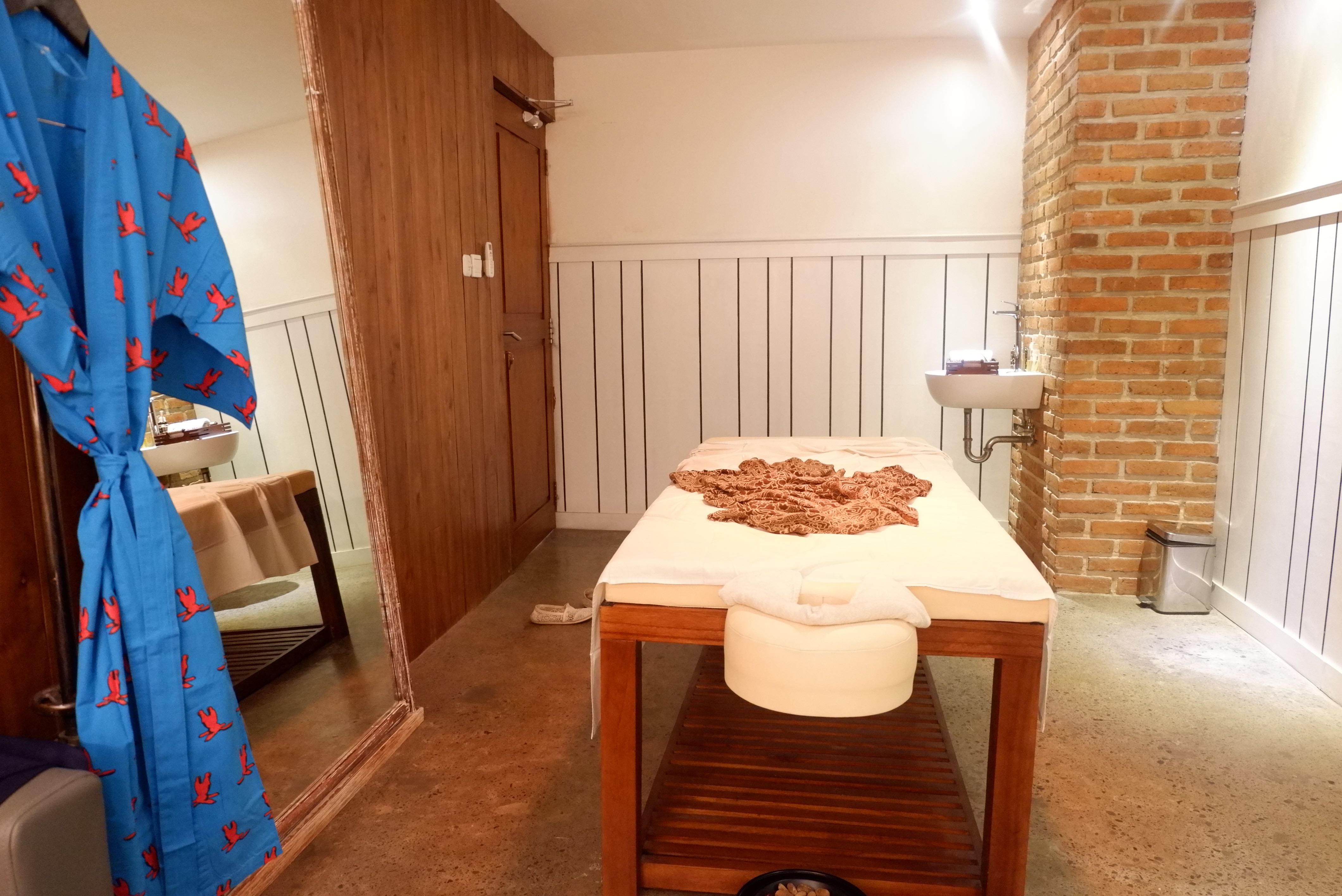
There’s a giant upside-down Red Bunny by the red poolside (yes, the pool is red!), a big Red Bunny plushie on the bed (place upside-down), a smaller upside-down Red Bunny on the table, and little Red Bunnies on our yellow bathrobe! (I still regretted my decision for not buying the smaller Red Bunny… it’s so soft and cute!)

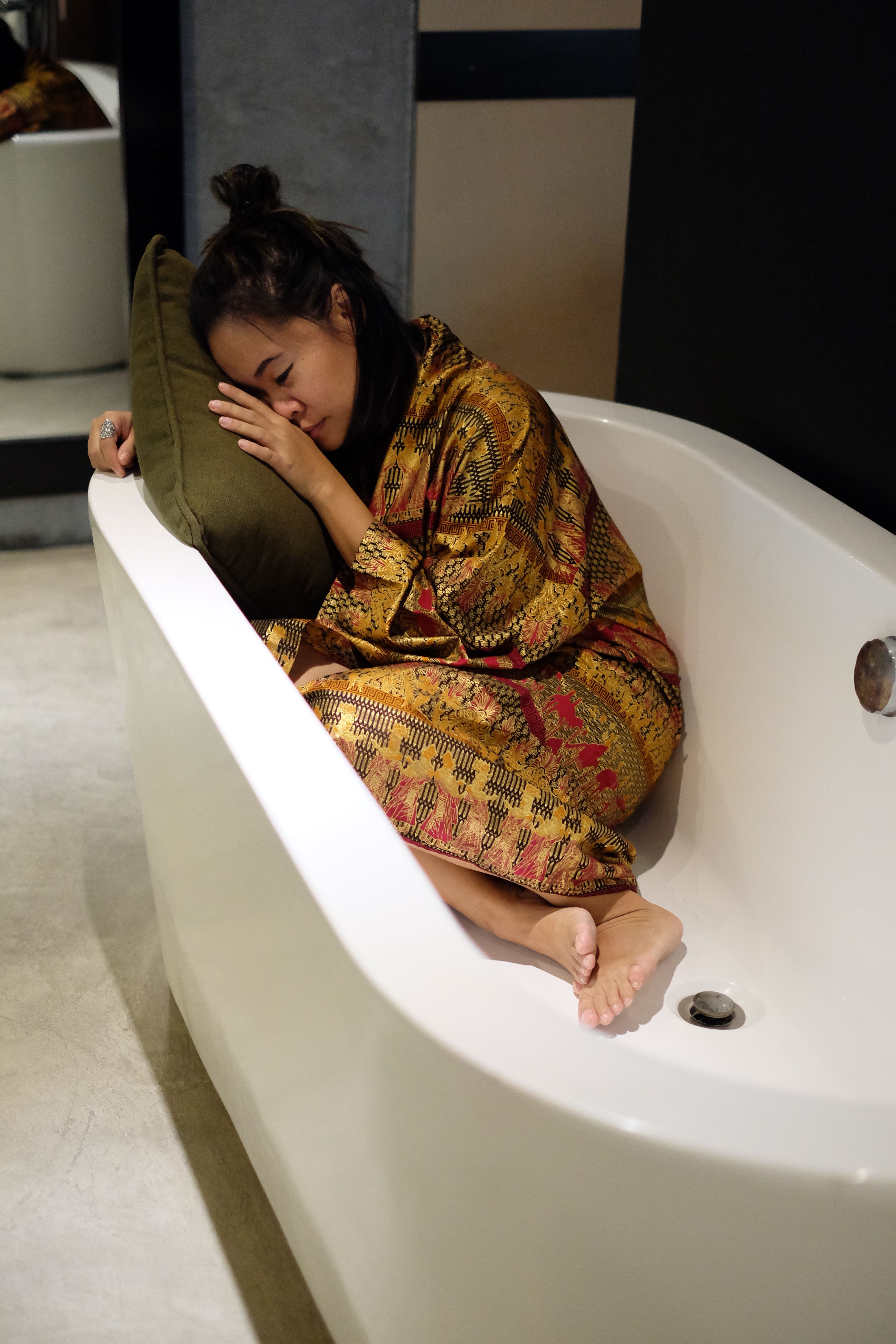
The room (including its walls and ceiling) is vibrant with industrial/urban street style. Chika and I found it so intriguing that we started snapping pictures, to see which side of the walls would appear to be more photogenic. We laughed when we realized that we have a big bathtub in the middle of the room, right behind our huge bed: it’s sitting there in the open.

“This place could be such a fun place for adventurous young couples in honeymoon!” I climbed into the bathtub, fully-clothed. “It’s so big; I could even sleep here!”

But I guess our favorite spot in the room was our bed: it was so soft and comfortable; the perfect place from where we can watch movies, browse the Internet (yes, wi-fi is really fast!), and of course: having our girl’s talk.

So, that was how most of our days went by. Swimming in the red pool, lounging on its pool chair, climbing up the stairs to The Shack (where they have a pretty rooftop bar and jacuzzi), and lazying in bed watching HBO movies from the TV set, wrapped in our Red Bunny bathrobe.

Of course, with their playful and quirky approach, I would assume that the hotel would be wild and noisy: full of young people celebrating their summer or spring breaks. But, turned out, during my stay (even in the evening), I wasn’t bothered by any loud noises at all! There were also some couples and families staying here. Chika and I even talked to an old Italian couple on vacation during breakfast.

DINING IN AT MYA KITCHEN

When we’re hungry, we dragged ourselves to the hotel’s restaurant because we didn’t feel like going out. Luckily, the food was surprisingly tasty (were you, like me, skeptical towards hotel’s restaurants sometimes?), so we kept coming back to Mya Kitchen, ordering so much food every time (but our plates were always clean!), switching between comforting Asian and Western food.

My comfort lies in savory dishes like chicken wings, pasta, and porridge, while Chika’s is in sweet drinks like this one (Chika said it was sinfully delicious, but I would leave it to her to explain):

Our favorite time at the restaurant, though, was breakfast time.

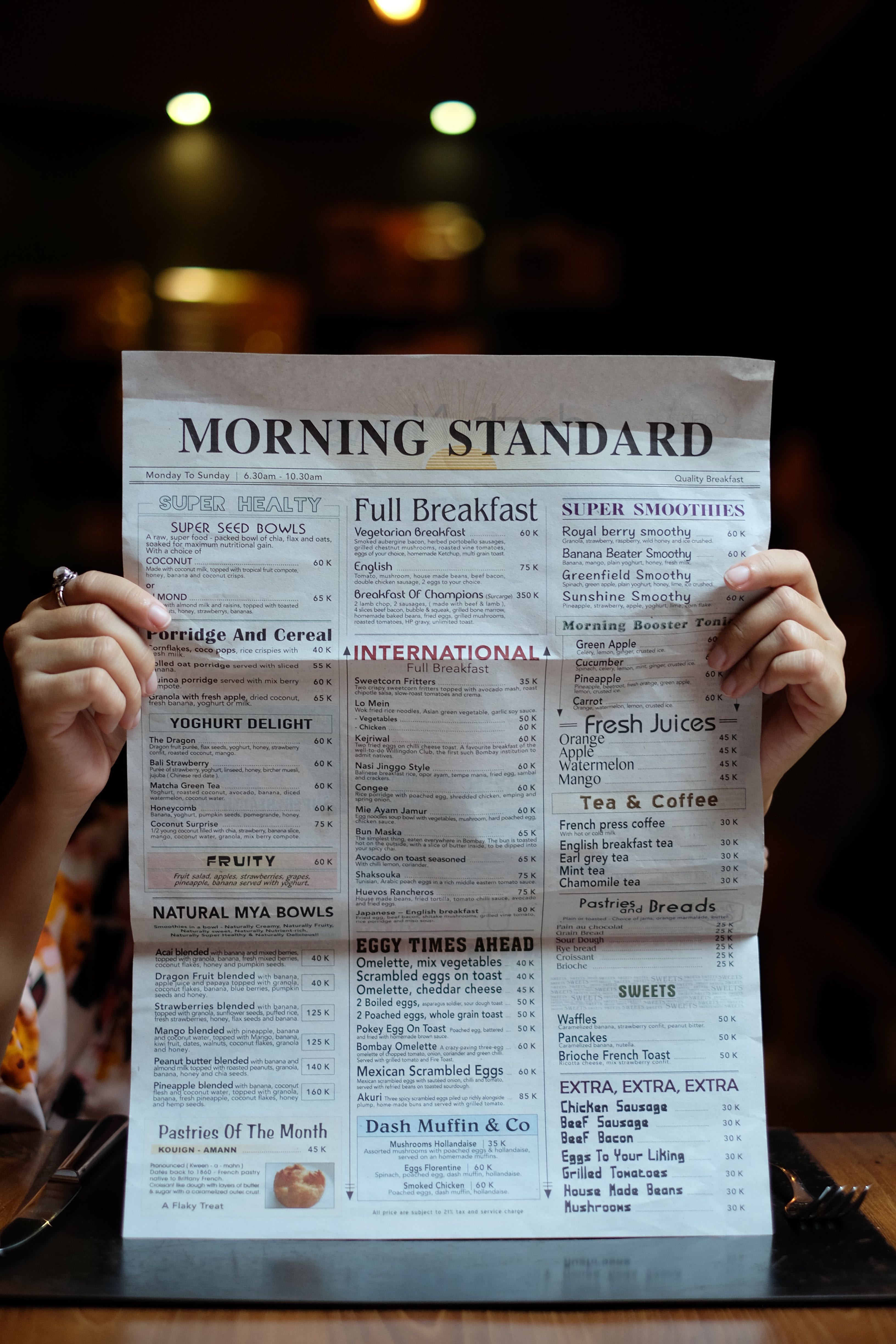
We were surprised when we got a menu with so many options! The staff told us that they didn’t serve breakfast buffet, but we could order anything from the menu, as much as we wanted, and they were all included in our breakfast package!

Upon hearing this, Chika and I ordered a bunch of food and drinks; we ended up having our breakfast in 2 rounds. We were laughing when the table was so cramped with our plates and bowls; but again, we finished them all. Very impressive, indeed! (or we’re just that hungry).

WHEN CHIKA WAS GONE.

On our last day, Chika left for the airport very early in the morning, as she needed to catch a meeting in Jakarta. When she was gone, the room suddenly felt so empty and quiet.

I hugged the Red Bunny and tried to sleep some more, but I couldn’t seem to do it, so I just turned on the TV and watched some movies. I found out that I also got a mild fever and a cold, so rather than going down for breakfast, I decided to order room service. The chicken porridge was warm and tasty, and after a while, it gave me the push to finally leave the bed and hit the shower.

At around 10, I went up to the gym, thinking that I would do some morning yoga (they have yoga mats!), but as I passed the Rabbit Hole (their spa), I changed my mind. What’s better than having a massage when you have a cold?

I entered the spa, and the lady told me that they were free, so I could get my massage right away if I wanted to. I said yes immediately and decided on a back and shoulder massage; as I started to feel some tension developing in my head and shoulders.

To be honest, I did not expect much from the massage. I thought it would just be an excellent way to relax a bit, but turned out the lady who massaged me was very good!

It wasn’t one of those massages when you cringed instead of loosened up. The pressure was good, and the ambiance was so serene. I liked it when my massage room was quiet; with a faint smell of aromatherapy. I could feel some of my tight muscles unfurled; especially around my shoulders; and when I was putting my clothes back on after the massage, my mild headache (that came with the cold in the morning) had disappeared.

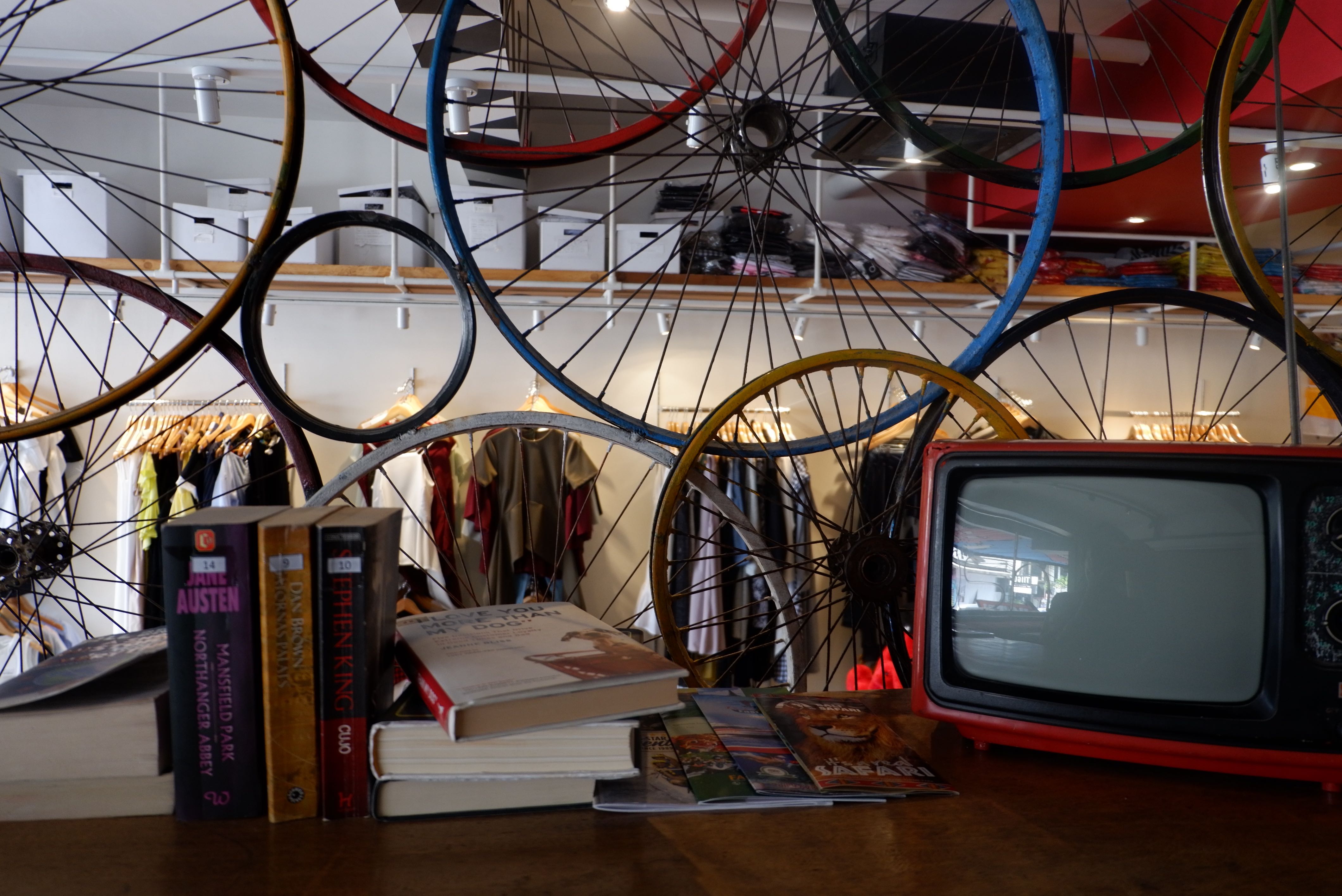
I went down to the lobby area afterward, where they have a sun-bathed seating area/library to do some journaling before I checked out (follow my Instagram to have a look at my Bali travel journal).

I have always loved some quality time with my girls; even when we have nothing better to do but watching movies together or reading books next to each other (or dining in!). With some friends, it seems like no matter how long you haven’t seen each other, you can always catch up so effortlessly; as if there’s no expiry date on your friendship whatsoever.

I felt so lucky and blessed knowing that I have some wonderful girlfriends around me. The ones who support and believe in me. The ones who wish to collaborate instead of competing. The ones who may not have similar views or beliefs about life with me, but mature enough to not let differences get in our way.

Do you have a circle of girlfriends you cherish as well?
How do you spend quality time together when you can’t meet up frequently?

DASH HOTEL SEMINYAK
AddressJl. Petitenget No.148, Kerobokan Kelod,
Kuta Utara, Kabupaten Badung, Bali 80361
***SOME PICTURES ARE COURTESY OF CHIKA NADYA
hanny
WANT TO SHARE WITH SOMEONE WHO NEED THIS?

Me and my vision board(s)

I read too many self-help books growing up (I read self-help books of Canfield & Carnegie since high school—maybe that explains why I grow up like this!). And it was from those books that I absorbed the ideas of a vision board and the power of thoughts.

I created my first vision board in my first year in college. I did it on an A4 page that I inserted into a clear envelope inside my ring binder.

It was pretty straightforward and there was nothing aesthetic about it: basically, I just cut out some pictures from old magazines—pictures that represent the things I want in life. At the time, these are pictures of handsome guys, lovey-dovey romantic scenes, and branded goods (plenty of them in the magazine’s ads!). I scribbled some affirmations on top of it with a gel pen. Something along the lines of ‘You’re Beautiful’ or ‘Guys Like You!’.

I guess you could see where my priority lies back then.

What is a vision board?

A Wikipedia entry describes a vision board as:

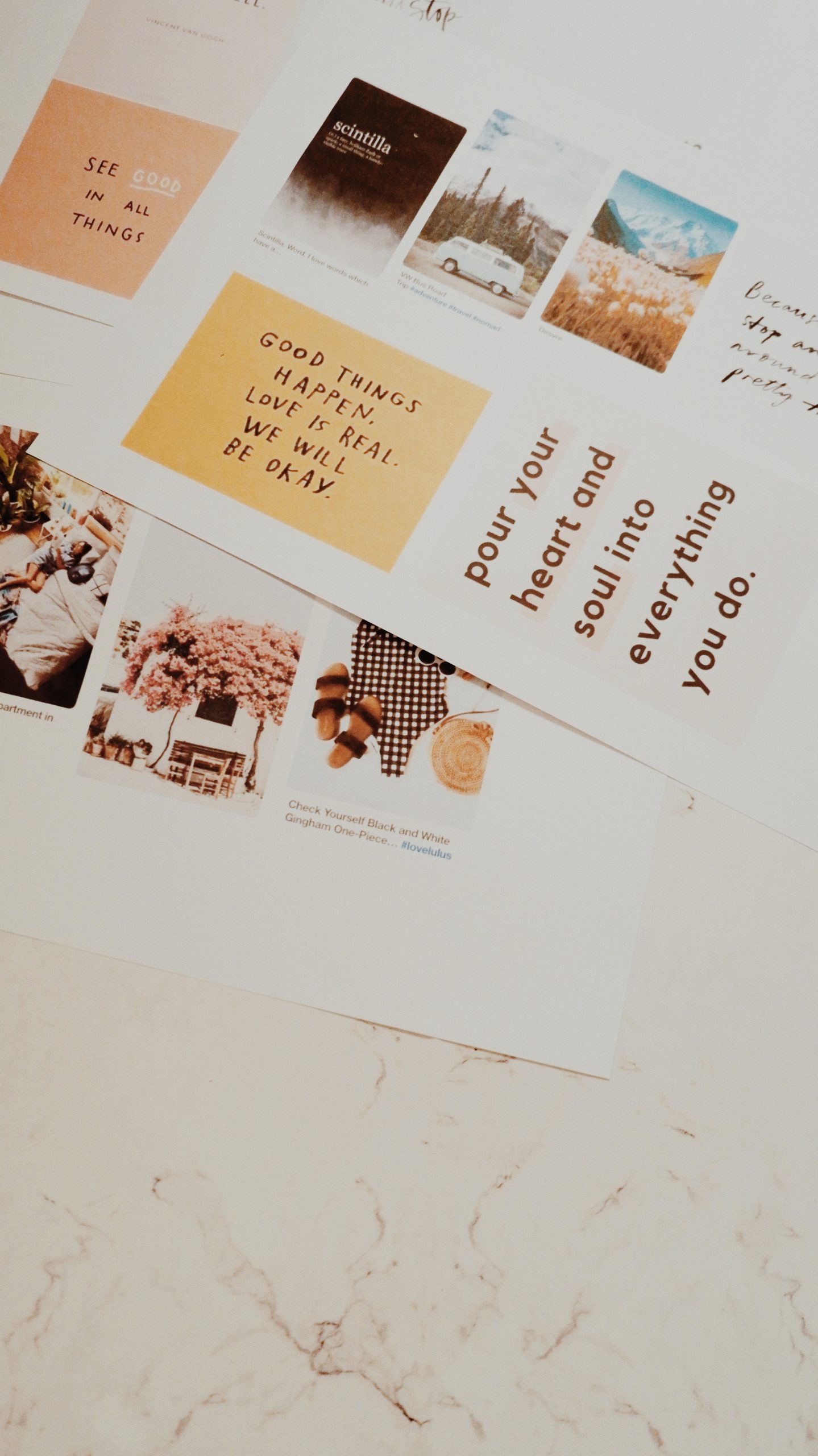
“A collage of images, pictures, and affirmations of your dreams, goals, and things that make you happy. It can also be called a dream board, treasure map, or vision map. Creating a vision board can be a useful tool to help you conceptualize your goals and can serve as a source of motivation as you work towards achieving your dreams.

After my college days, I kept on creating vision boards, at least once every 1-2 year(s). I no longer made it in my ring binder, though. Sometimes I made a spread of my vision board inside my journal. Other times I created my vision board as a desktop wallpaper so I can see it every time I open my laptop. And about 10 years ago I bought a writing board in a bookstore: half of it is a corkboard and the other half is a whiteboard. I used it to create my vision board ever since.

To me, apart from trying to figure out what kind of life I want for myself, making a vision board is simply a fun activity—especially when I am stuck at home with nothing better to do. It’s a bit like daydreaming (or hallucinating), but this time you could actually see what you’ve been daydreaming about right there, on the board (or paper, or whatever medium you choose).

Collect words, images, and pictures for your vision board.

Because I have stopped hoarding magazines, these days I go to the Internet to find pictures and images for my vision board. My favorite go-to places are Unsplash, Storyblocks, and Pinterest. However, when it comes to selecting words, pictures, or images, there is one thing I learned from my previous mistakes in creating a vision board(s).

Previously, I was very literal when it comes to my vision boards. If I wanted to lose weight, I would find a picture of a girl with a fit and well-toned body. If I wanted to be in a relationship, I would find a picture of a happy couple. If I wanted a house, I tried to find a picture of a beautiful house. If I wanted more money? Exactly. I would find a picture of a huge pile of money.

I did this for quite some time only to realize that I usually lost my interest in my vision board after 2-3 weeks (which means I would take down my vision board from the wall and hide it behind my cupboard). Somehow, seeing those things on my vision board weighed me down with the realization that I do not have them. Every time I looked at my vision board, I felt a bit stressed out, as if I was forced to work hard to make them a reality; or else I would end up a failure.

So, here’s how I created my vision board today: instead of focusing on finding the images of the things I want, I am focusing on finding pictures, quotes, or images that stir a happy and comfortable feeling inside of me. That’s it. No more images of a bunch of branded goods, a pile of money, or a first-class cabin–if seeing them don’t make me feel happy or comfortable.

The same goes for finding a quote. If my heart melts when I read the quote, the quote ends up on my vision board.

I realized that this is the approach that works best for me: to concentrate on feelings instead of things.

I want to be able to look at my vision board and feel happy instead of stressed out from thinking about how I would get all those things I didn’t have. I want to look at my vision board and be reminded of the feeling I have always wanted to feel in life: happy, content, peaceful, creative, free, loving, safe.

A vision board works best for me when it focuses on feelings instead of things.

If you think you’re someone like me, you might want to try this approach for your vision board. However, if you think you’re more motivated, driven, and inspired when you know you’re chasing things instead of feelings, by all means, create your vision board that way!

The bottom line is to create the vision board you’ll love, that will make you feel happy and inspired after seeing it instead of stressed out and demotivated. Find out which type of person you are, and create a vision board that will serve you best!

Using your vision board.

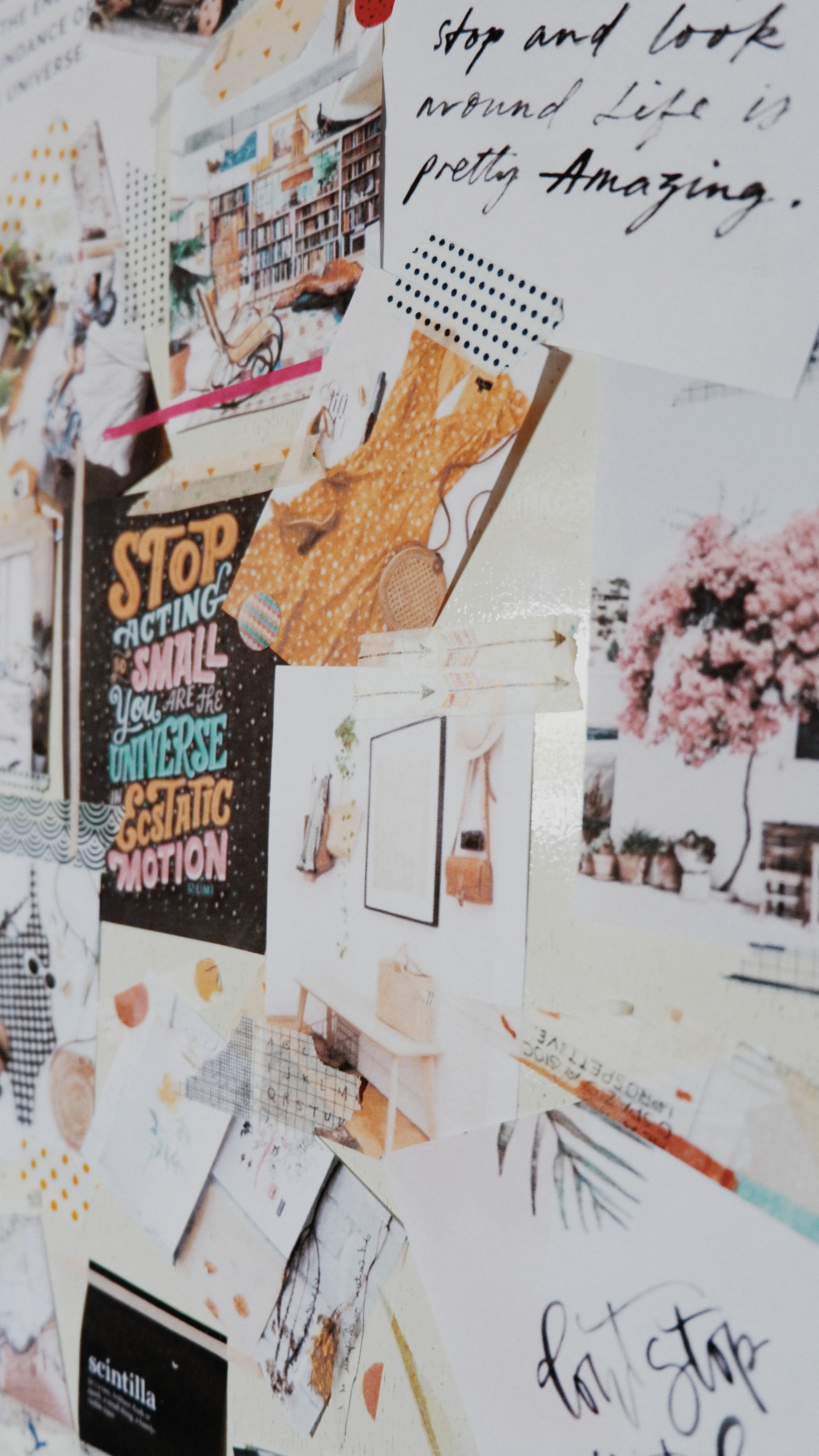
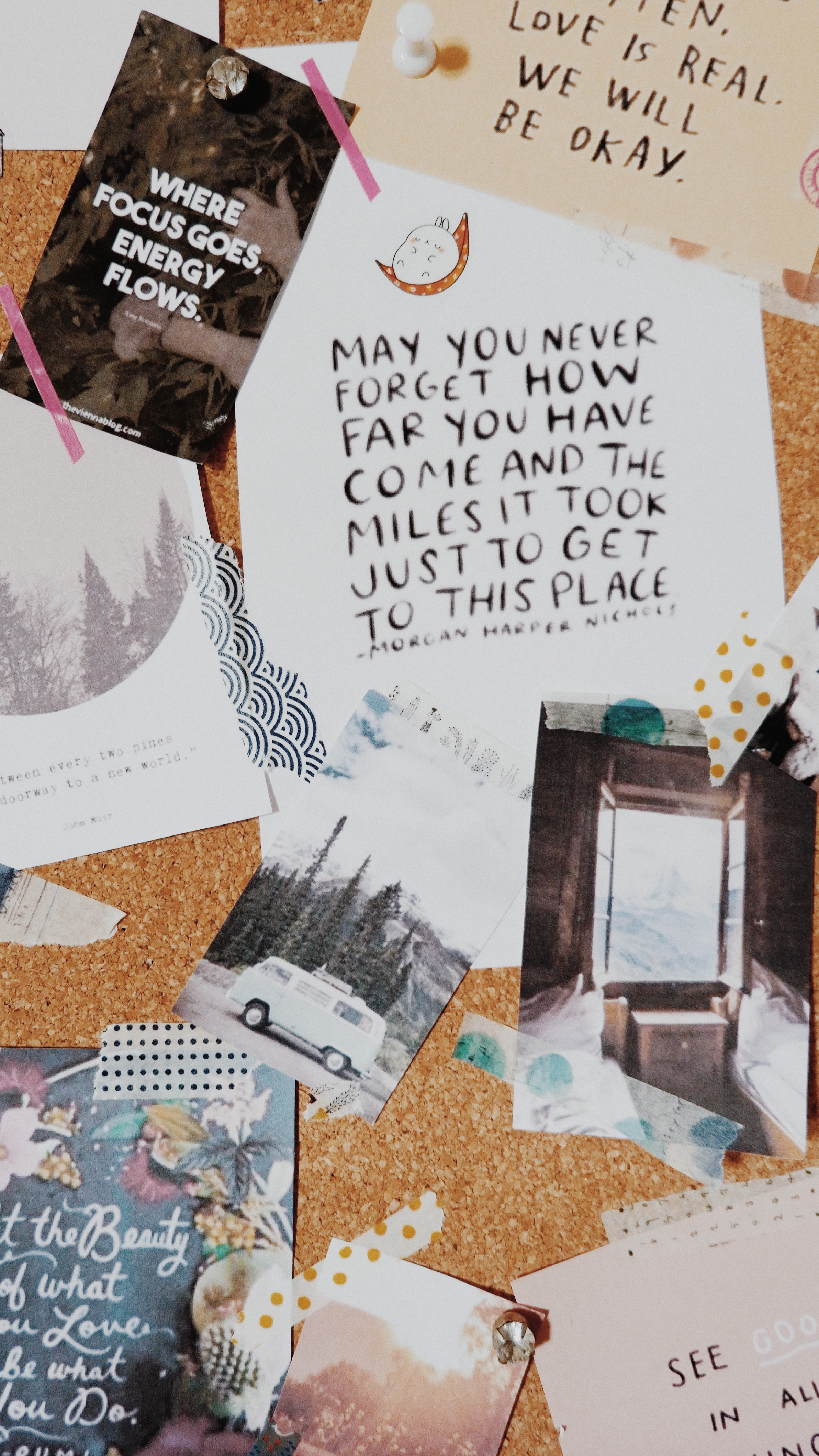
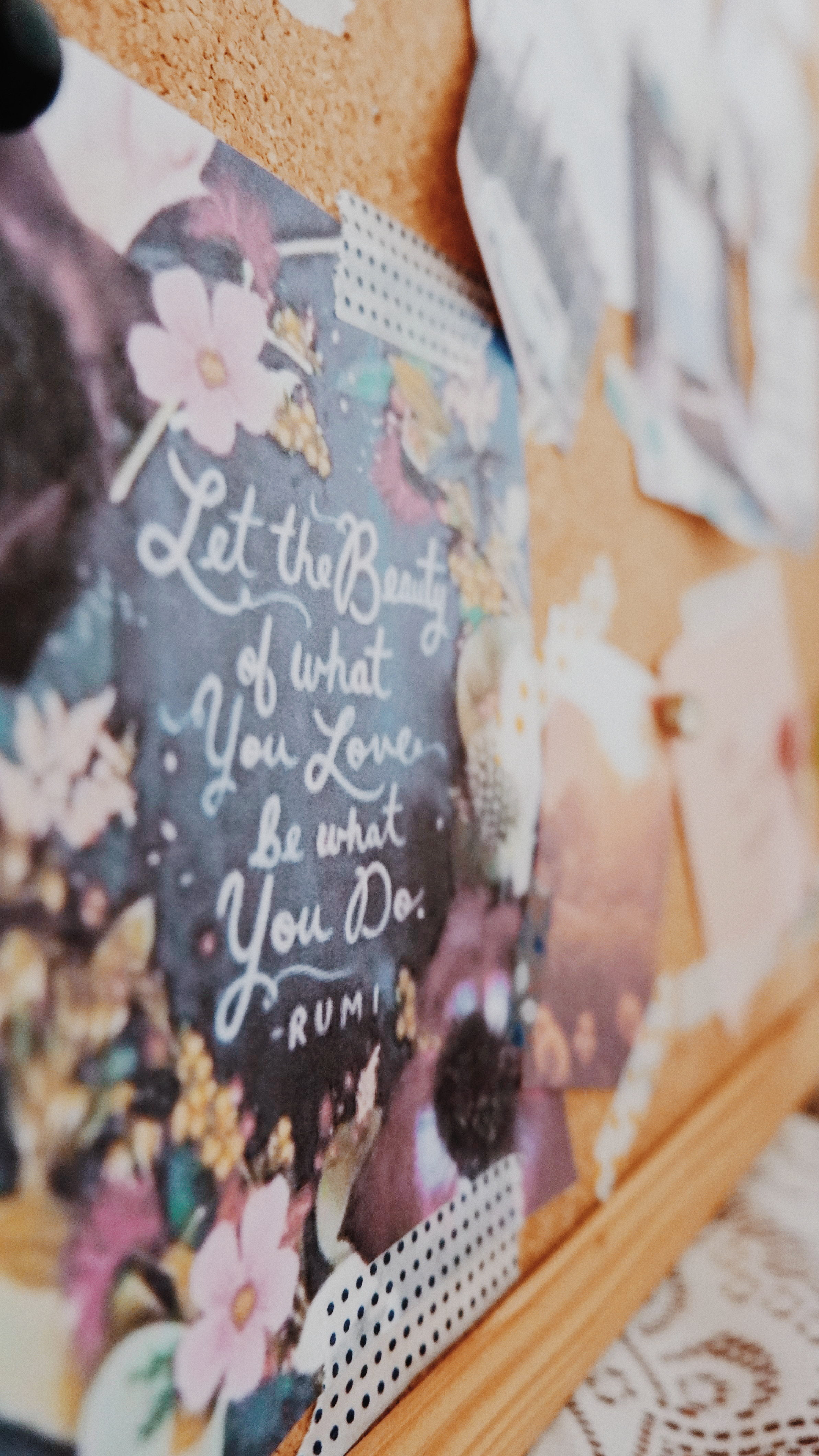
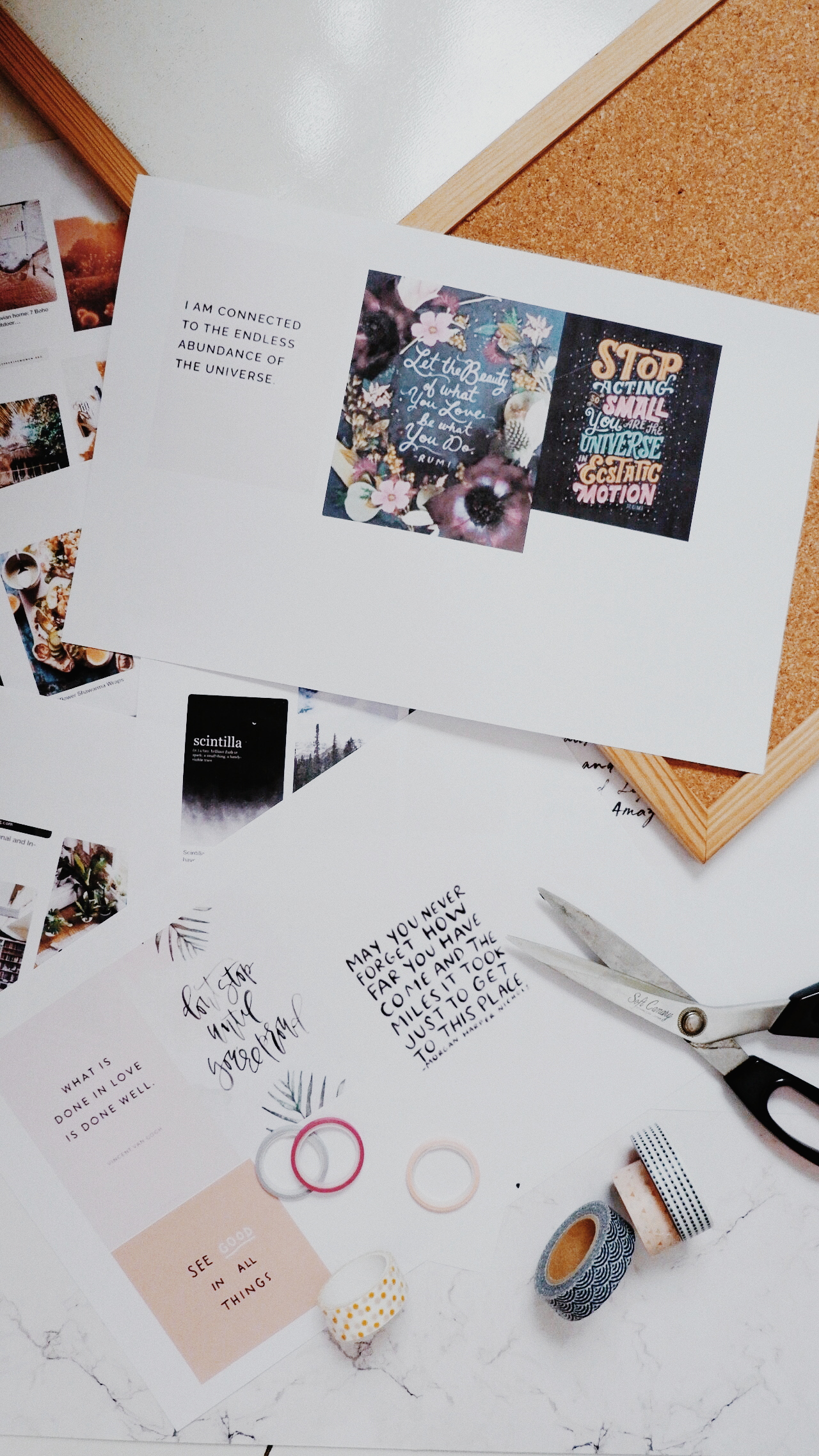
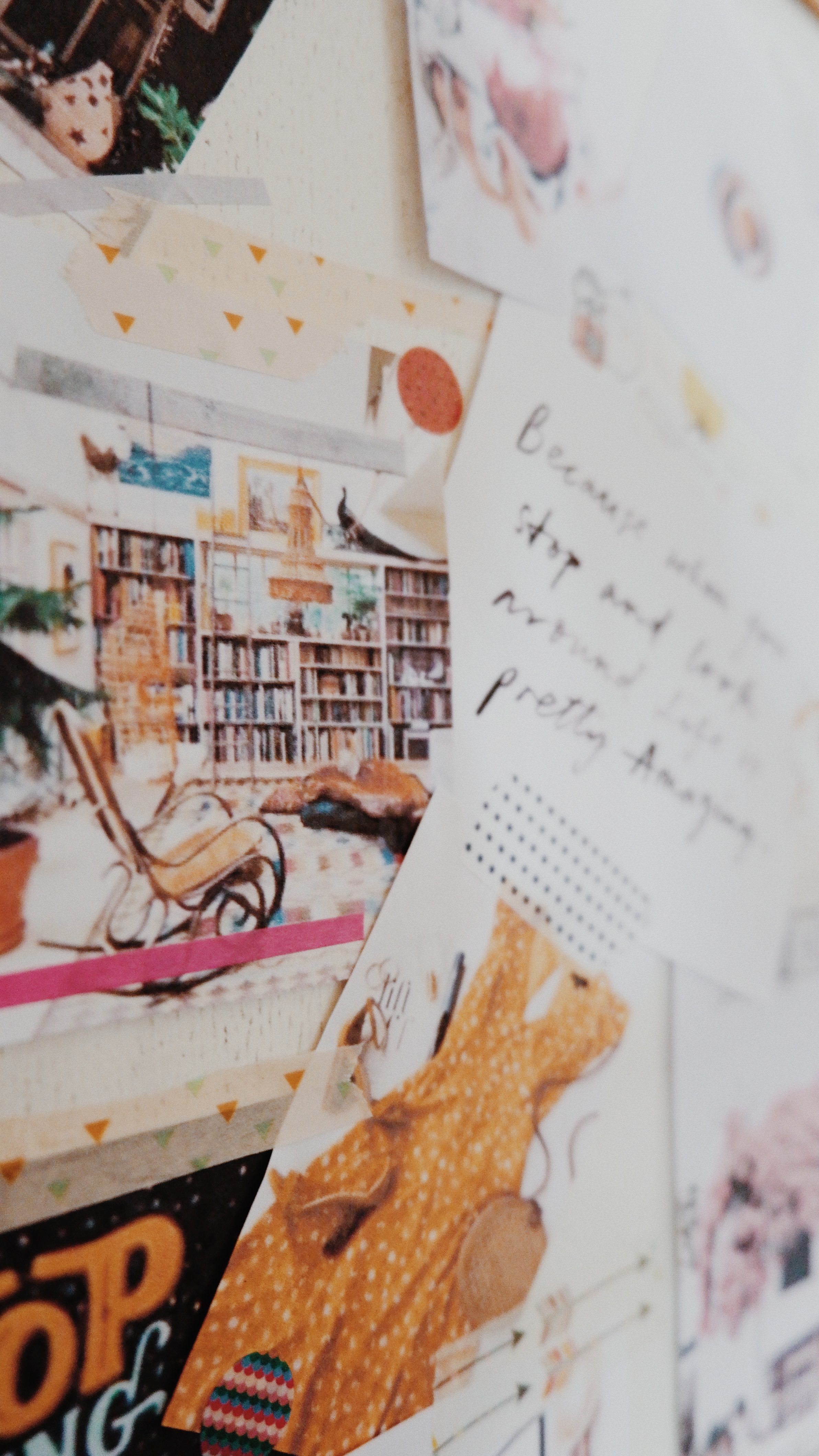
After finding all the pictures, images, and words or quotes I want to use on my vision board, I usually print them all (I use usual photocopy paper) and then cut them out. Then, I will try to find the best layout for the cut-outs to be displayed on the board. I mostly use washi tapes and cardboard pins to do this (instead of glues or double-sided tape). I want to make sure that I can reuse the board again the following year.

Once I’m done with my vision board, I display it in a spot where I can see it often, on a daily basis. If I find some particular pictures or quotes that annoy me somehow, I take them down or replace them with something else.

I like to see my vision board as a living organism that grows with my state of mind and my state of being. So, I allow myself to change things here and there when I feel the urge to do so. Plus, the idea of having this vision board is to lift up my mood! So, I want to make sure that I like what I see and can feel an instant boost of happiness just by looking at it.

Keeping a vision journal as a company.

Whenever I feel inspired (usually on a relaxing Sunday evening), I will pick an image or a quote from my vision board, look at it, and write down whatever goes through my mind about that particular image or quote. It helps me to access the feeling of each picture or quote evokes in me and clarify what the image/words actually represent.

Here are some questions I use to help me when I’m journaling about my vision board:

  1. Why does this particular image/quote feel good to me?
  2. What does this image/quote remind me of?
  3. What does this image/quote represent in my life?
  4. What can I do, daily, to recreate the feeling this image/quote evoke in me?
  5. What would my days look like if I have experienced everything that is represented by this image/quote?
  6. How would I be a different person if I have experienced everything that is represented by this image/quote?
  7. How would my outlook on life change if I have experienced everything that is represented by this image/quote?

To me, answering those questions help to gain clarity on the kind of life I aspire to have and the kind of person I’d like to be. It feels easier because I don’t have to start writing from nothing: I have a picture I want to write about and some questions related to the picture! Now, all I need to do is answer those questions honestly.

I actually find this journaling activity relaxing. It really helps me to bring something abstract into a more concrete pen-on-paper kind of thing. Whenever I reread the journal, I was reminded again of the feelings I want to invite into my life.

It serves as a compass that keeps on pointing to the North whenever I feel like I’m disoriented or about to get lost.

Creating a vision board together.

Creating a vision board doesn’t have to be a solitary activity. If you like, you can also work on a shared vision board with a group of friends, with your spouse, or even with your colleagues.

When I was still working full-time, I created a ‘professional’ vision board together with everyone else from my division. The end result was our division’s vision board, representing everyone’s professional wishes and dreams. Once we completed the board, we took turns to point out the images or quotes we’ve pasted. Each person told everyone else what their images/quotes represent; both for the division and for his/her professional development.

It was a really interesting exercise because it stirred fun and relaxed conversations about things that are not usually talked about! Professionally, we’re usually talking about what we want (promotion, opportunities, flexible office hours, payrise) instead of why we want them. Discussing the images and quotes in the vision board by answering some of the journaling questions listed above can really help us to understand others better: to know what’s important for them and find out what really moves or motivates them in life.

So, feel free to work on your vision board as a group or a pair!

Anyway, I’ll be very happy to hear your stories about creating a vision board or keeping a vision journal. Let me know if you’ve tried this and what kind of vision board works best for you!

Until then,

hanny
WANT TO SHARE WITH SOMEONE WHO NEED THIS?

DIY Dangling Bookmark: For A Leisurely Weekend at Home

Hi, Lovelies!

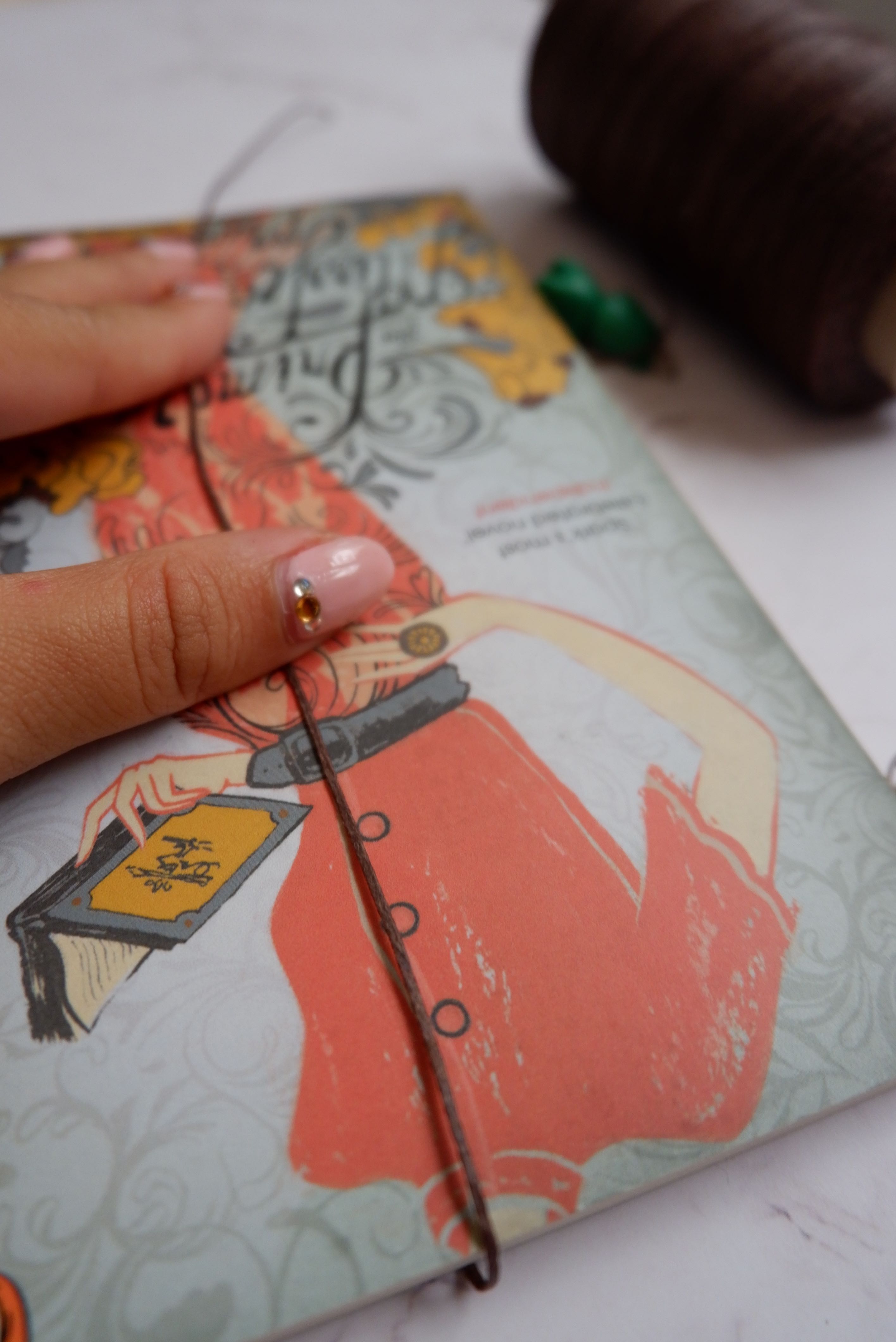
If you’re thinking of spending a leisurely weekend at home reading books, I hope you’ll love this easy DIY dangling bookmark project as much as I do!

A few days ago, I was binge-watching some YouTube videos from Traveler’s Notebook community and ended up in Ali Brown‘s channel—where she made a tutorial on making dangling bookmarks for her journals.

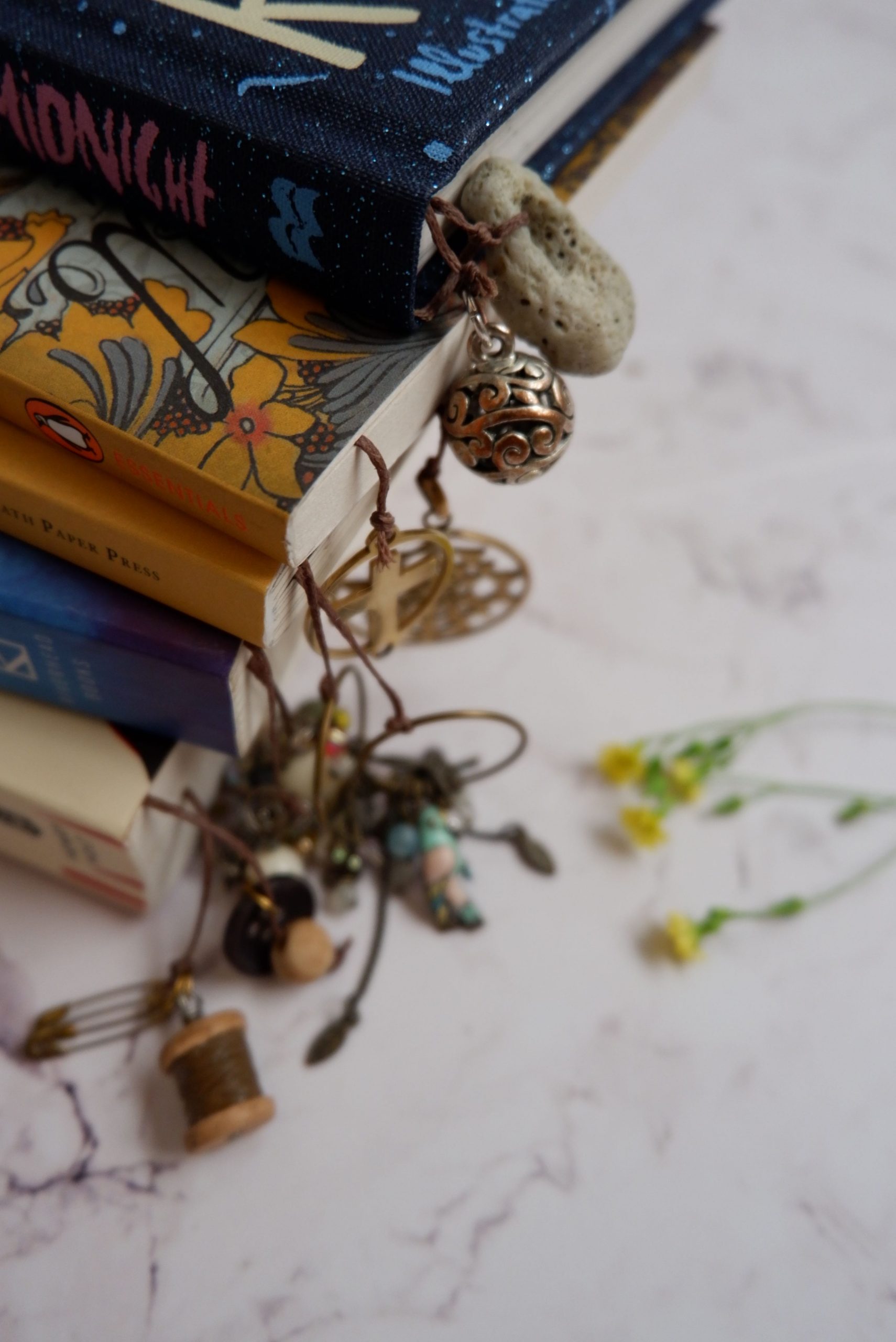
After creating mine (which I loved), I realized that this can actually be a great bookmark not only for my journal, but also for the books I’m reading! I’m the kind of person who reads multiple books at a time, so a bookmark always comes in handy.

However, regular bookmarks frustrate me because: 1) they slip and fall easily from the book inside my bag; 2) slipping the bookmarks in and out when I travel caused me to misplace the bookmarks or end up losing them; and 3) sometimes when I finished reading a book, I accidentally left a bookmark between the pages, and couldn’t find this bookmark until one day I reread the book again and voila—my ‘missing’ bookmark was there!

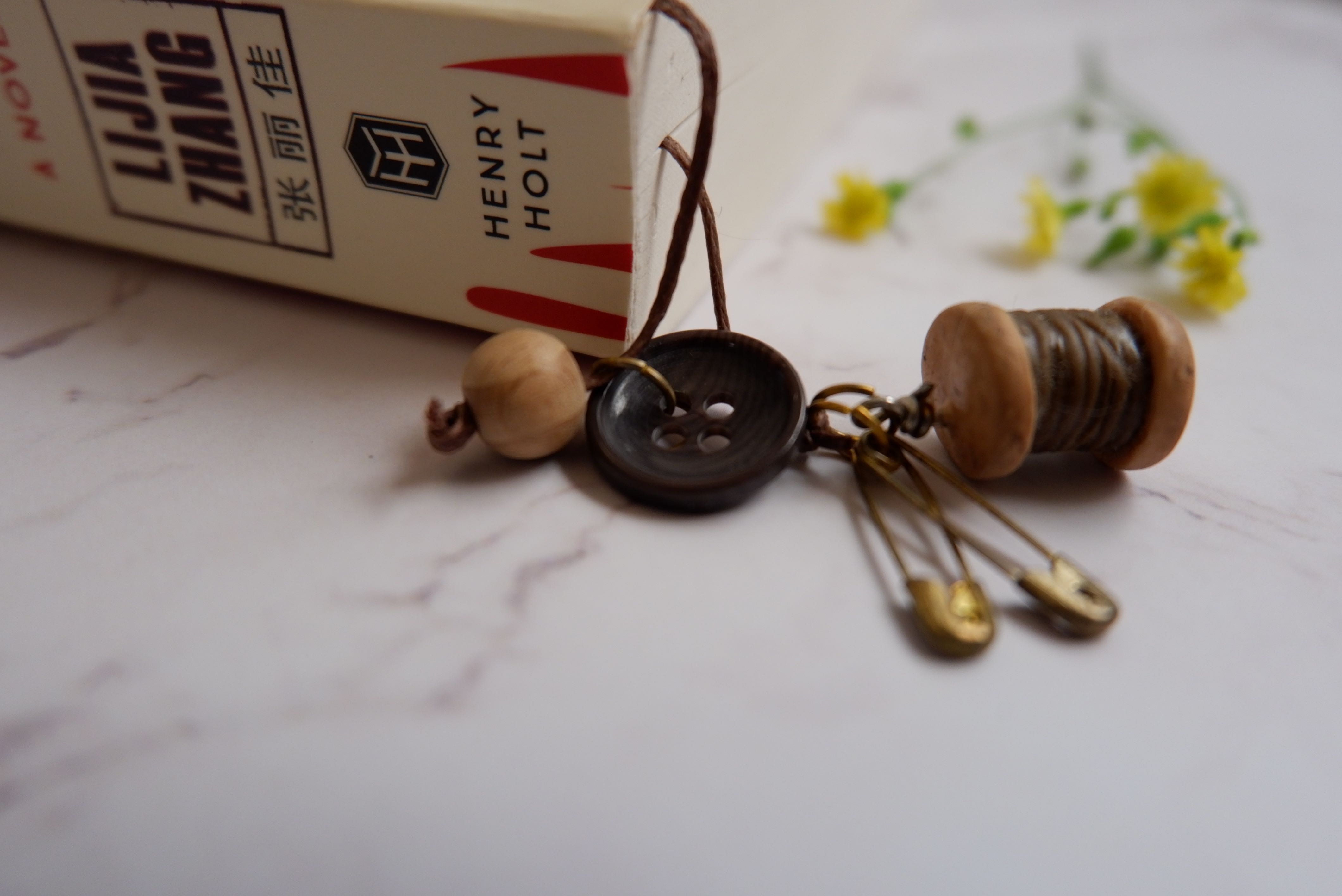
I realized that dangling bookmarks solve those problems: 1) they don’t slip and fall easily; 2) I don’t have to slip the bookmark in and out because I can just read the book while the bookmark is dangling right there, looking pretty; and 3) because the bookmark is dangling from the page, I would definitely notice it and take it out before storing the finished book—no more ‘missing’ bookmark hidden between the pages of a long-forgotten book!

So, I decided to create several dangling bookmarks for the books I’m reading this month (will add the list down below). They are so easy to make, and I even make some as gifts for my fellow bookworms!

Dangling Bookmark: Tools + Supplies + How-to

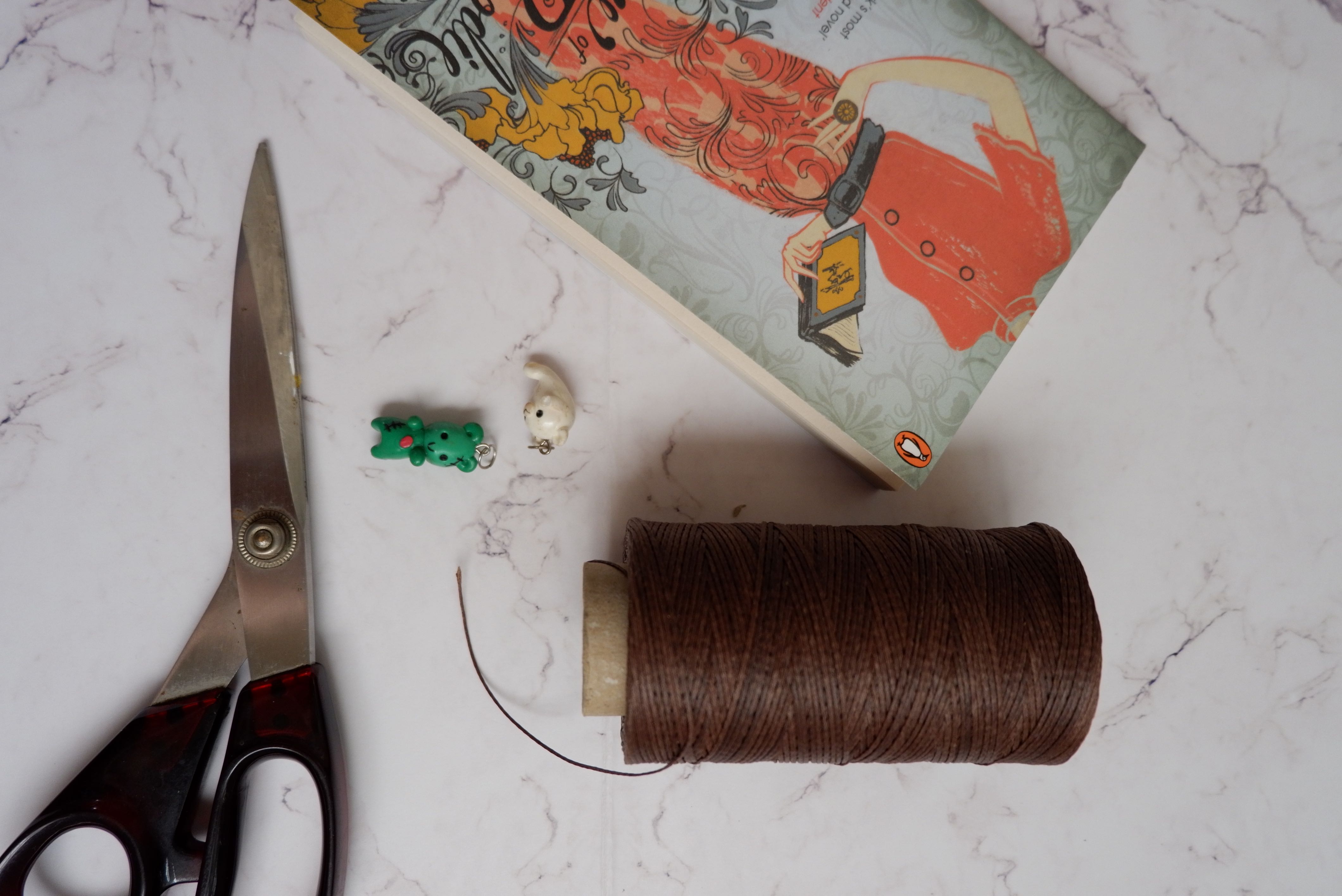
Basically, you only need:

  • a  string (this is the one I use; I love it because the knot is very tight and it has been treated with wax)
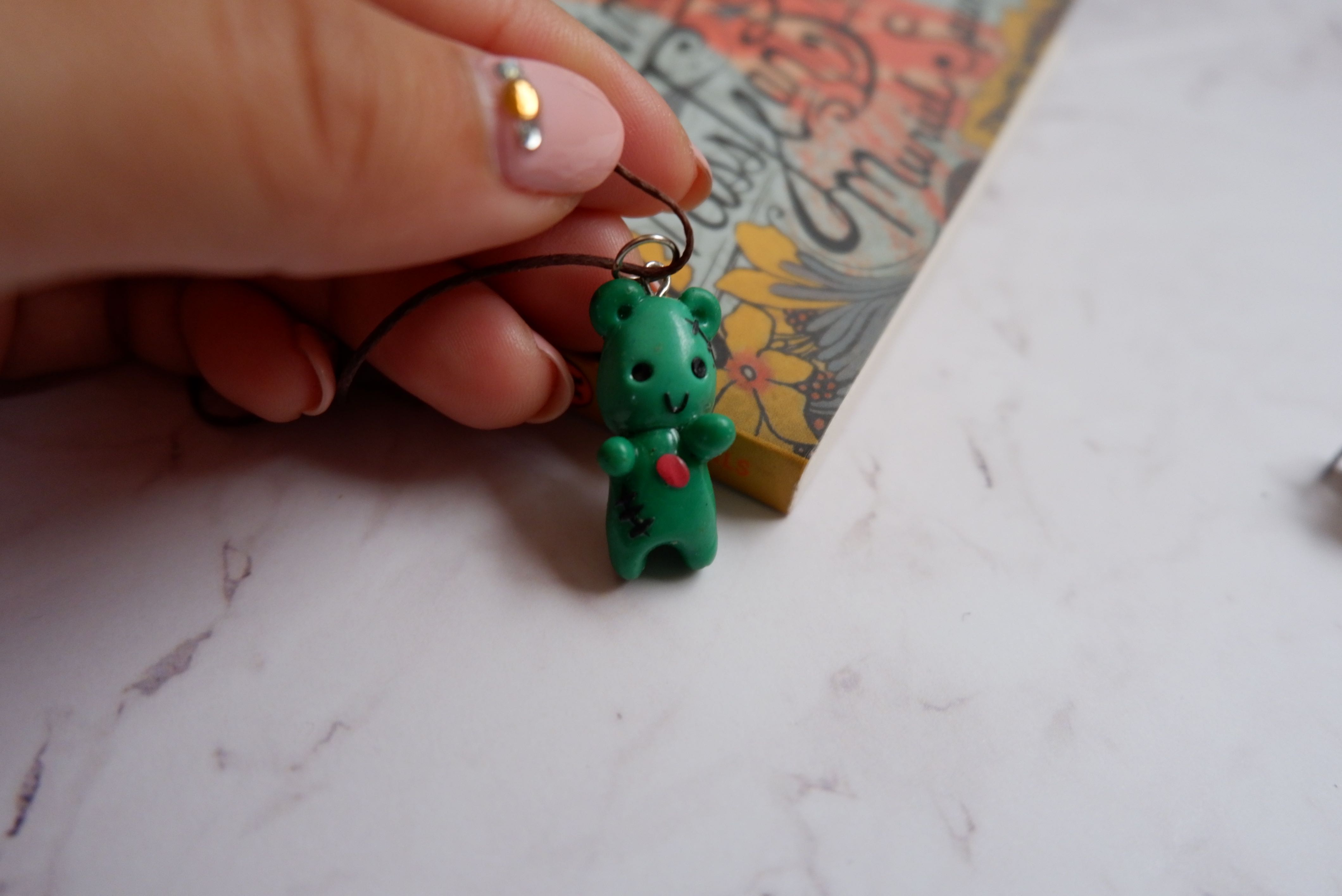
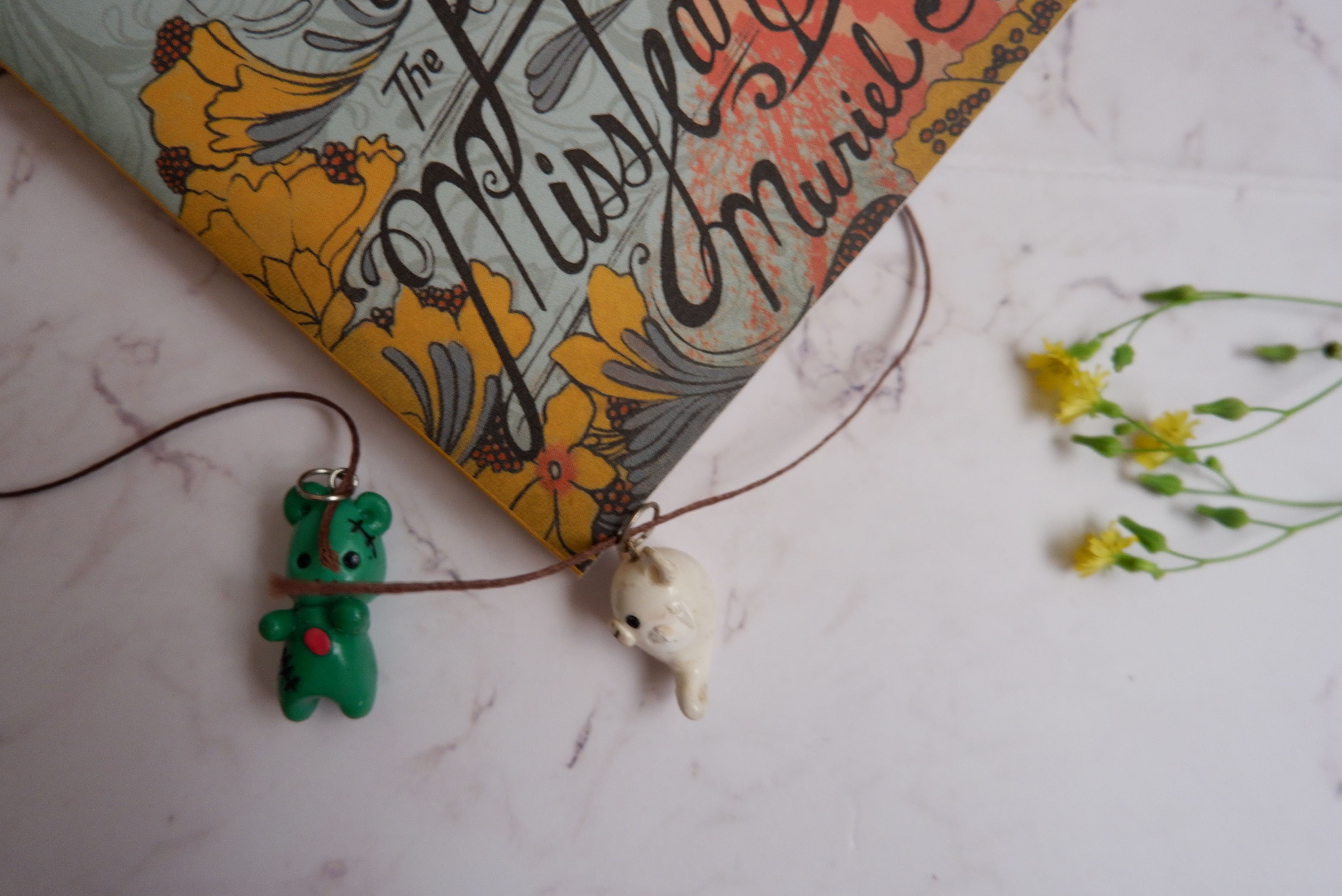
  • some charms, beads, or broken accessories you can upcycle
  • a pair of scissors

That’s it!

So, basically, what you need to do is measure the length of your bookmark. Sure, there are different sizes of books; but usually, I only make two different lengths: for the paperback size and the hardcover size. These are the two sizes of books I mostly read anyway.

Just measure the length so you can have the desired dangling effect once the bookmark is slipped between the pages.

After that, add some charms or beads to the end of each string, and tie a loose knot. Insert the dangling bookmark between your book’s pages and adjust the length when necessary. When you’re happy, tighten the knot. And just like that, you have your dangling bookmark.

Now, you can slip the string between the first page of the book and the page you’re currently reading. Bring the string close to the binding of your book, and it will rest there nicely while you’re reading; and it won’t bother you at all.

Dangling Bookmark: Use What You Have!

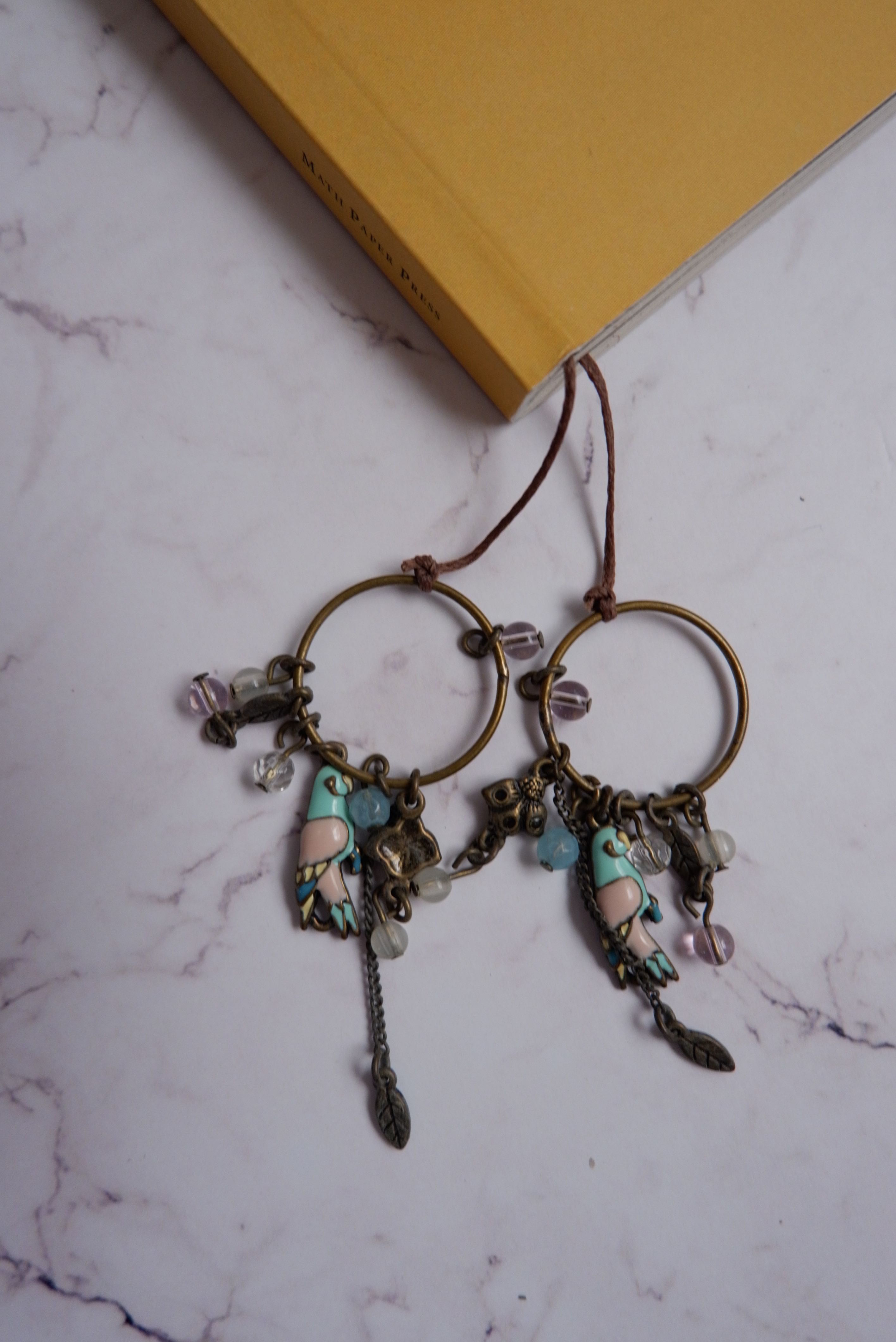
I didn’t buy the charms on my dangling bookmarks. Most of them came from broken accessories that I liked so much, but because they were broken, I couldn’t wear them anymore. I kept them in my drawer thinking that one day I would fix them, but of course, it never happened.

So, I’m happy that they can get a second life!

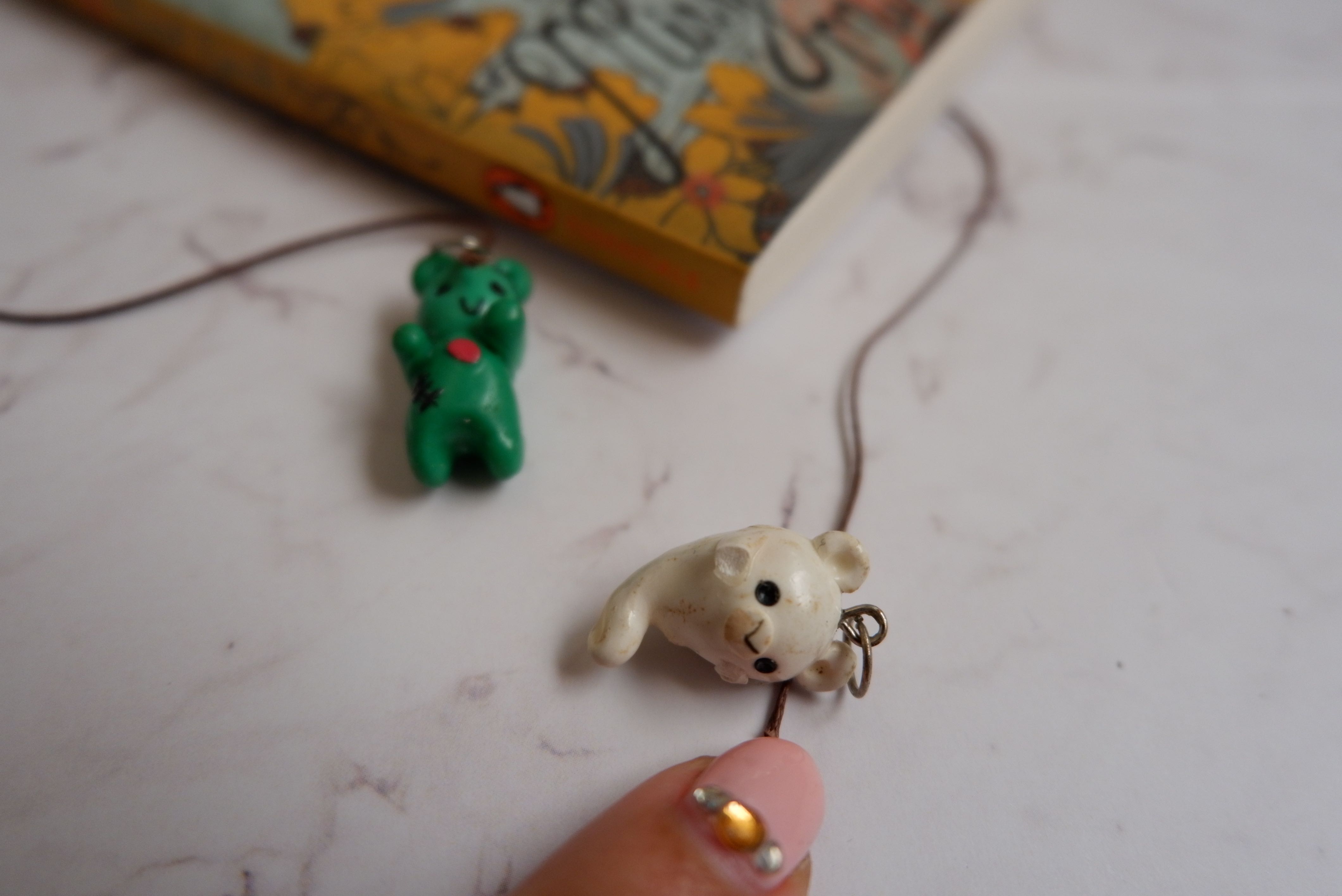
This bird bookmark, for instance, came from a broken earring I got years ago. Some others came from broken bracelets and from my mother’s beads collection.

So, why don’t you check your drawer and see what kind of charms or beads you can use to make your own dangling bookmark? (If you don’t have any, you can also get some charms from here.)

Let me know if you tried to make a dangling bookmark this weekend! Feel free to share some pictures of your dangling bookmark and tag me if you like!

I assure you that you’ll have a pleasant weekend making your own dangling bookmark, and read your book while the bookmark is dangling pretty between the pages!

PS:

The books I’m currently reading:

  • After Midnight by Rainbow Rowell (just finished it today!)
  • Balik Kampung 
  • Lotus by Lijia Zhang
  • Kebaya Tales by Lee Su Kim
  • Sales Mind: 48 Tools to Help You Sell by Helen Kensett
  • Big Magic by Elizabeth Gilbert (reread)
  • Not That Kind of Girl by Lena Dunham (reread)
  • The Prime of Miss Jean Brodie by Muriel Spark
  • A Journey Through the Heart of A Pig by Johnny Lloyd (reread)
You might have noticed some links to Tokopedia e-commerce site in this post, but this is NOT a sponsored post. Personally, I love using the site to get my craft supplies for a bargain, so maybe you want to check it out.
hanny
WANT TO SHARE WITH SOMEONE WHO NEED THIS?

Hello, there.

If you are following me on Instagram, you might have known that this year, I’ve been picking up a lot of creative projects in my spare time. Or maybe, I have really positioned my creative life on the top of my priority list. I started to pick up some of the things I have abandoned before, including painting, crafting, creating art, and journaling. Interestingly, these are the things I have always enjoyed doing when I was little.

ON JOURNALING IN A PHYSICAL NOTEBOOK

I have filled in several journals (from cover to cover, around 15 books all in all) in my life, especially during my teenage years. I always believed that writing keeps me sane, and journaling helps me navigating my chaotic life during many of my coming-of-age episodes.

When blogging came into the picture, I started using it as a platform for me to post my chaotic thoughts, building what might later turn out to be a ‘digital journal’. However, I have to admit that I miss the act of journaling on a physical notebook: seeing the way my handwriting changes, seeing the tear-stained pages, or festive fonts on celebratory days. There are certain emotions that digital platform—like blogs, or even Facebook Memories—could not evoke in me; the way a physical journal could.

These days, when I flipped some of my teenage journals, I could also remember those happy days of going to a stationery store with my mother to pick a new book. I could still feel the giddy feeling, the excitement, and the confusion of having to make decisions upon seeing those beautiful books and diaries. In the end, I could only pick one—the one that ended up coming home with me: becoming the source of my anger, sadness, happiness, and frustrations.

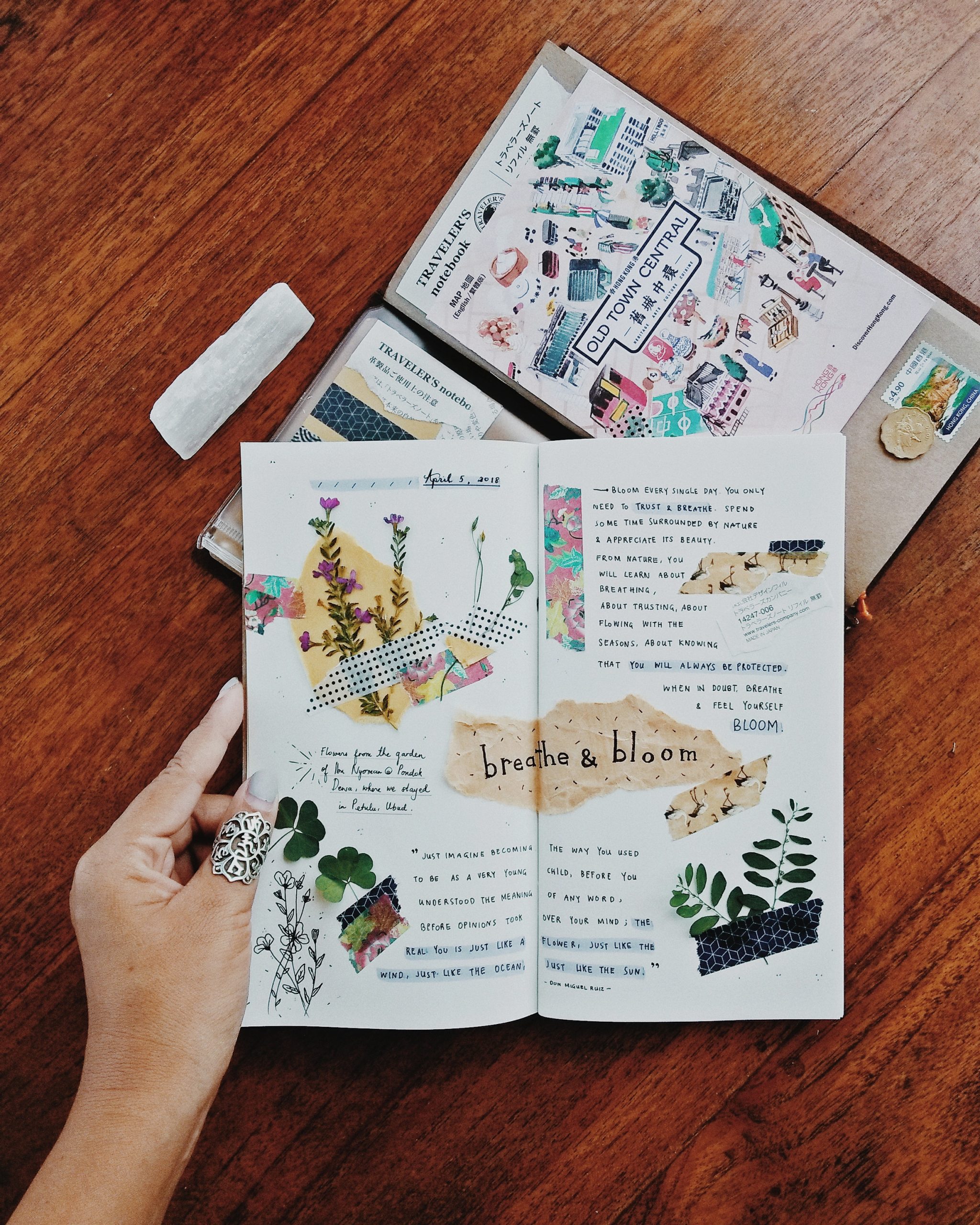
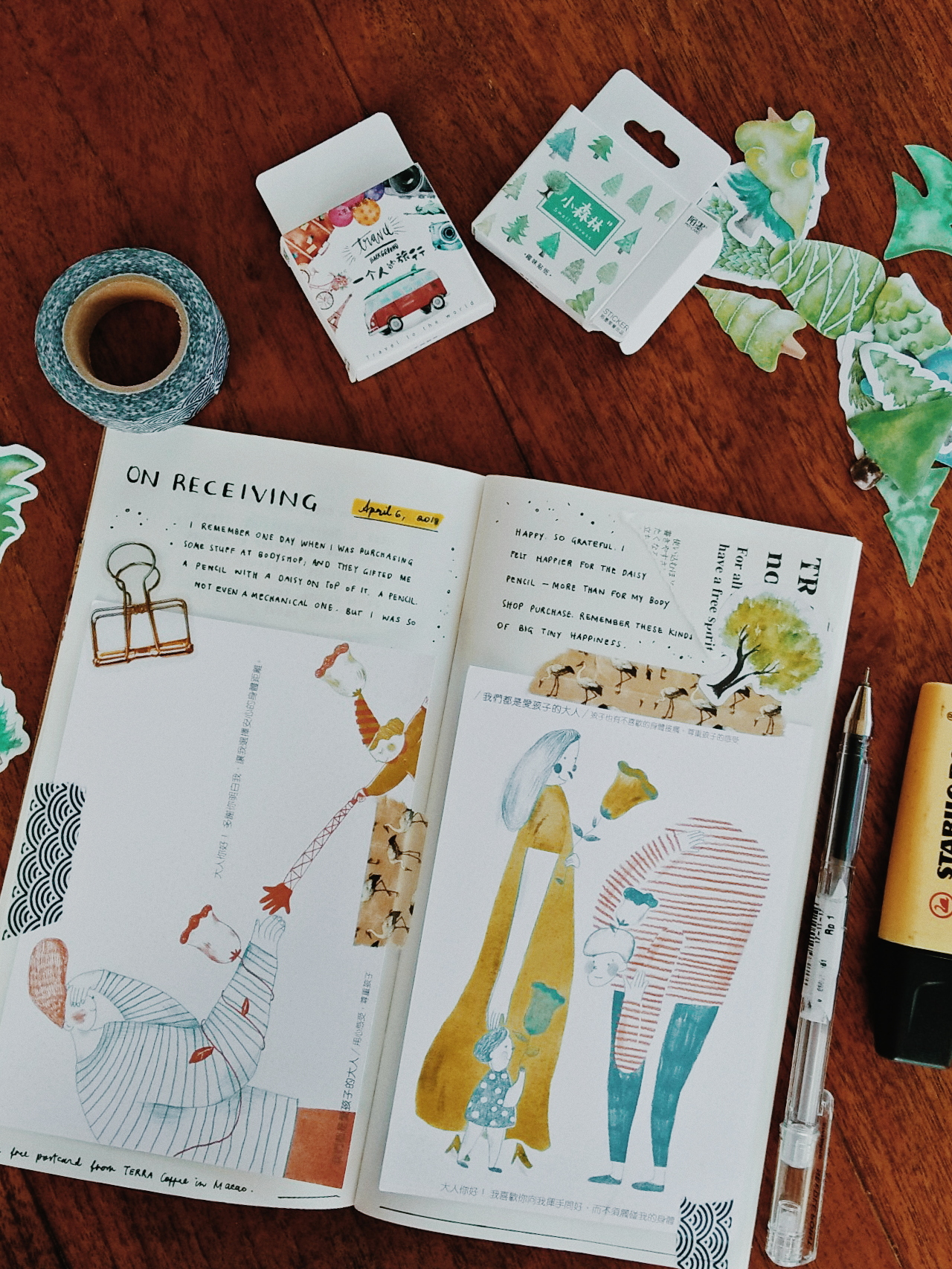
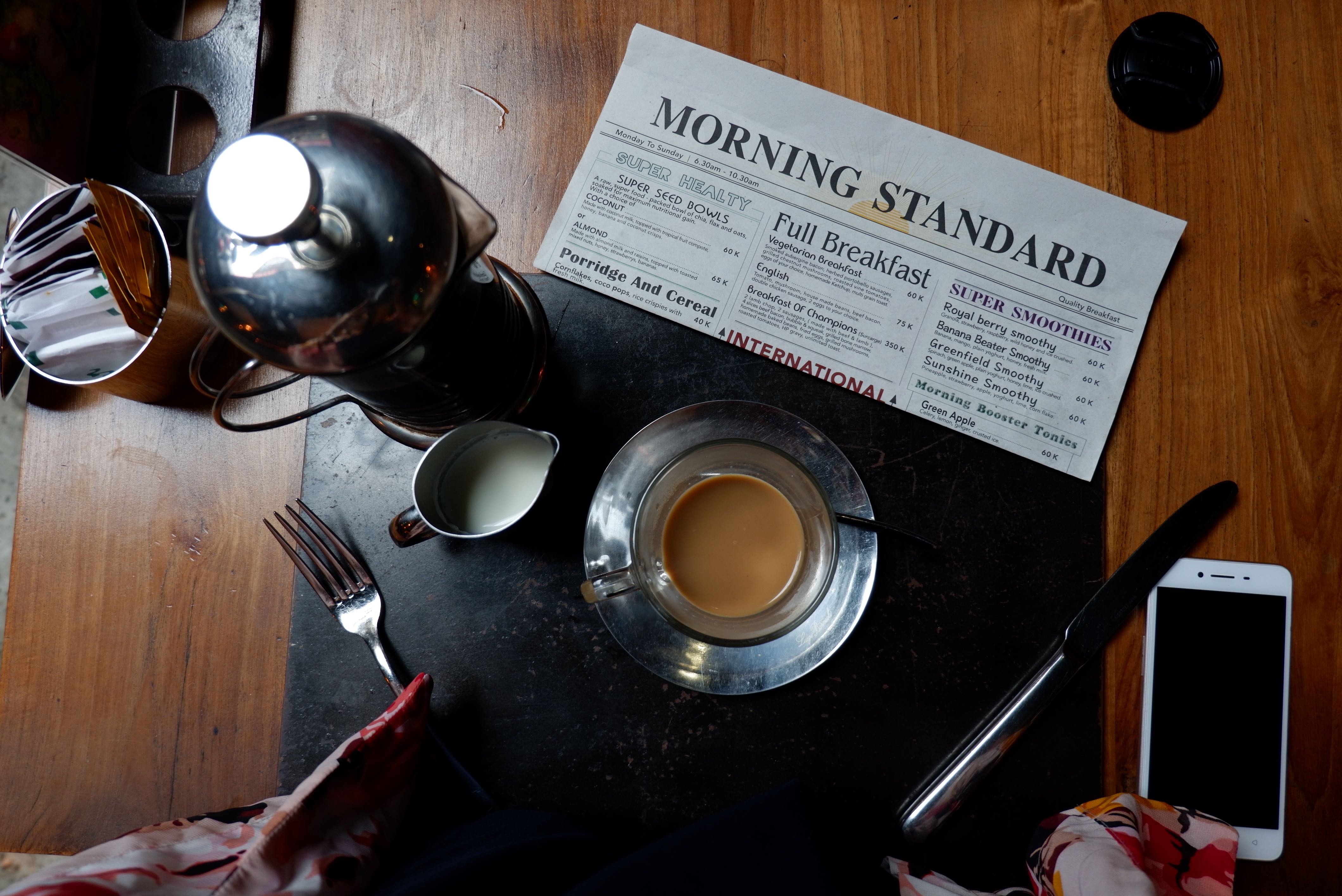
This month, I picked up journaling again, diligently. I got myself a Midori Traveler’s Notebook that I had been eyeing for more than 3 years now (always postpone yourself from buying things immediately; this is how you know if you really want something!); and started writing. I also have my daily bullet journal on the side (a cheap notebook I bought at Miniso), but the Traveler’s Notebook soon becomes my mood-lifter journal (the one you see in this post, where I collect things that can lift up my mood) and my travel journal (because those pictures and mementos got lost in the digital world).

I also started journaling while scrapbooking and making collages; then learning how to press flowers to be pasted on my mood-lifter journal. It feels so good to finish a spread and re-reading my life as I flipped through the pages.

Do you think you’d like to start a habit of journaling as well?

JOURNALING 101: SO YOU WANT TO START JOURNALING?

If you’re thinking of starting a journal or documenting your life in a creative way, here are some tips I have for you:

1. Start with a thin + cheap journal/notebook, and fill it in from cover to cover.

Don’t make a mistake of investing too much before picking up a new hobby. Try it out first. Who knows, maybe you don’t like it, maybe it’s not for you, maybe you lose interest quickly. If you want to start journaling, just pick up a notebook you already have (you can redecorate the cover and the pages) or get a cheap and thin notebook (around 48 pages).

Once you have this book, fill it in from cover to cover with anything: words, quotes, pictures, thoughts, candy wrappers… anything. But, finish the book. It may take you one day, one week, or one year. It doesn’t matter. The goal is to finish it. If you can fill it in from cover to cover, it’s a sign that you’re in for the journaling journey.

Only then, allow yourself to get a new journal you’ve been in love with.

2. Start with anything but a bullet/daily journal.

Keeping a bullet/daily journal can be a daunting task because you feel as if you need to write on it every single day (actually, you don’t have to—but I’ll talk about my own bullet journal style another day).

The original system, however, works beautifully when we are committed to logging in our notes on a daily basis. For me, the downside was the feeling of ‘failure’ when I missed a few days—leaving a gaping hole in my bullet journal. Somehow, there is a feeling of ‘ruining it’ and the feeling can linger for quite some time, making me feel somehow demotivated.

Or maybe that’s just me.

But if you’re also the kind of person who would feel that way, don’t start with a bullet/daily journal. Try to keep a journal that you can fill in whenever you feel inspired; something that won’t burden you with daily commitment.

I would suggest turning your 48-page journal/book into:

  • A gratitude journal. Where you list down all the things that make you feel grateful. You can also paste gift wrappers from a gift you received, pictures of your friends and families, as well as writing down happy events/moments in your life.
  • A mood-lifter journal. Where you can collect things that lift up your mood, like your favorite songs, quotes from a book you love, pictures that evoke a happy feeling inside of you, a letter from a lover, pictures from your last traveling journeys… anything. The idea is to have a collection of things that will make you smile when you see it again in years to come.
  • A dream journal. Where you can dream and design your ideal life. What would you be like? What would you do? Who are you with? Where would you be? How would you feel? It’s amusing to play this game and start filling the journal with your vision of an ‘ideal life’. Don’t forget to include every aspect of your life: family and friends, career and study, spirituality, health, and many more. Isn’t it nice to flip the pages of this journal every morning, to remind you of where you’re heading in life?
  • A learning journal. Where you can write down the lessons you’ve learned in life. These lessons can be an experience you’ve been through, an advice from someone you respect, a quote that speaks to you from a book, a movie with a certain message that is relevant to your situation, or simply new things you learned from the Internet.
  • A letter journal. Where you can write unsent letters to different people in your life. If you tend to avoid confrontations and like to repress your feelings, writing an unsent letter is a great way to channel your feelings and say the things you wish you could say. Or, you could also write a letter to a singer you like, a movie star you adore, a random guy you’ve seen at a coffee shop, a great-great-great grandmother you’ve never known. Let your imagination go wild.

Surely, the ideas are endless. But you got the point. Start a journal that doesn’t need your daily commitment, yet. At least, not until you’re ready to commit. The goal is, again, to fill in your book from cover to cover! The feeling of completion is a great feeling that will get your confidence-level up when you want to take up daily journaling later on.

3. Find a friend or a community.

Picking up journaling as a (potential) hobby doesn’t have to be a lonely feat. You can find some friends who love journaling and organize a Journaling Day-out where you compete to fill in your 48-page journal as fast as you can. Or find some videos on YouTube to get your dose of inspiration; and follow people who journal—just like you. Being surrounded by people who share the same interests with you (even online) can make you feel motivated and inspired.

START WITH WHATEVER FEELS NICE TO YOU

Fill in that 48-page journal however you like it. Don’t think too much. Take it as a personal project, as a practicing canvas. You don’t need to show it to anyone. Treat it as your experimental journal, to see how you’re approaching the art of journaling.

Get yourself used to making mistakes. Don’t worry about smeared pages, crumpled edges, blotted ink… remember, your task is only to fill in your journal from cover to cover. Just let yourself loose, and be honest. Pour your thoughts and feelings on the pages. The more you journal and make mistakes, strangely, you will gain more confidence. The more you hate the spread or the pages you’re working on, the more you’ll know what you like.

One day, there will be a time when you’re working on a spread in your journal and love it. Maybe it’s not perfect, but you feel like: this is it. And that’s usually the day when you know that you’re ready to take journaling as a new hobby.

Until then, your life is a story.
Write it down.

PS: I am conducting a reader’s survey on this blog here. If you have time, would you kindly help me to fill it in? I need to hear from you! :*
hanny
WANT TO SHARE WITH SOMEONE WHO NEED THIS?

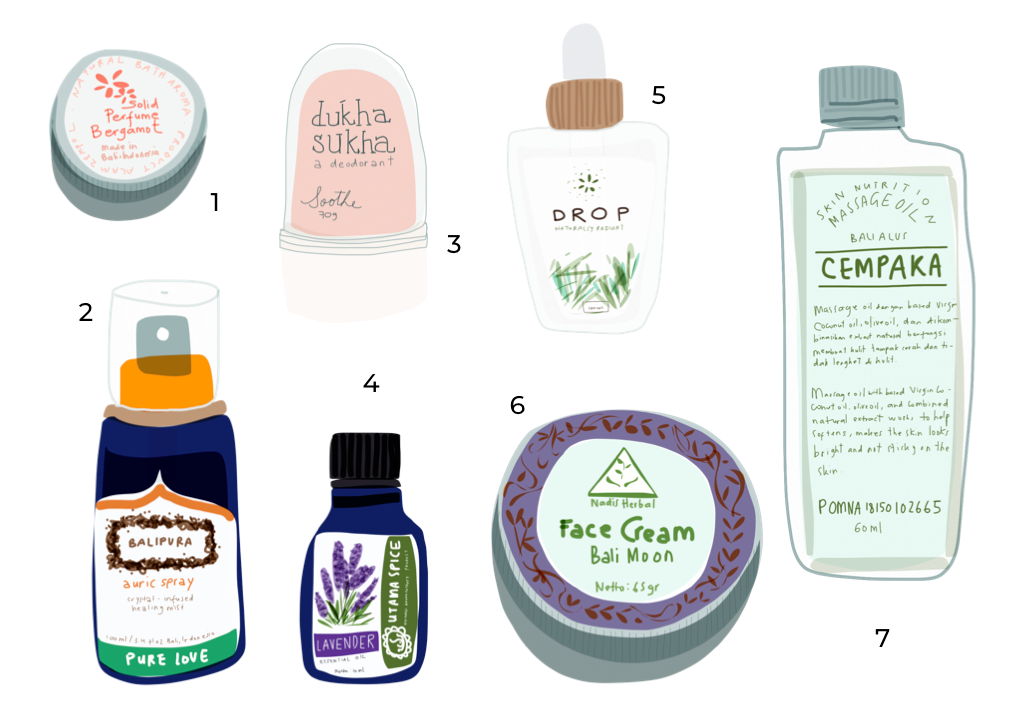
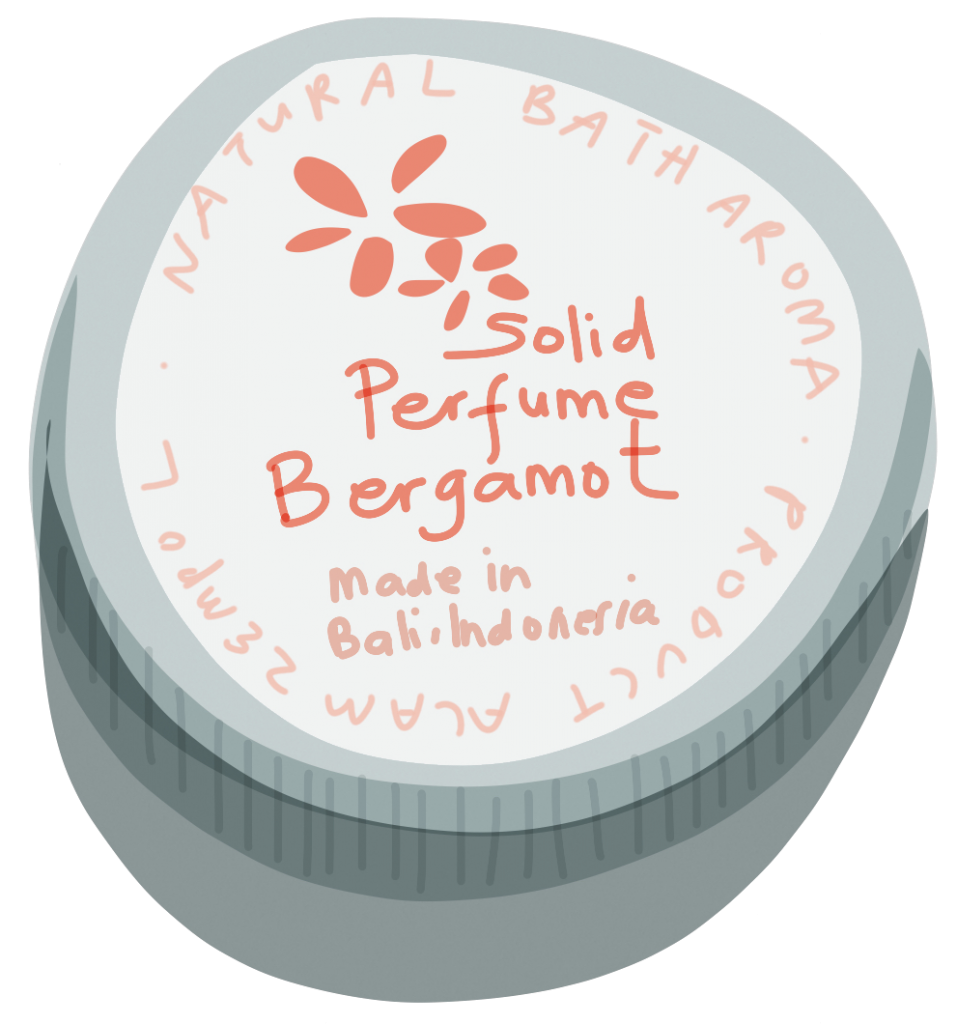
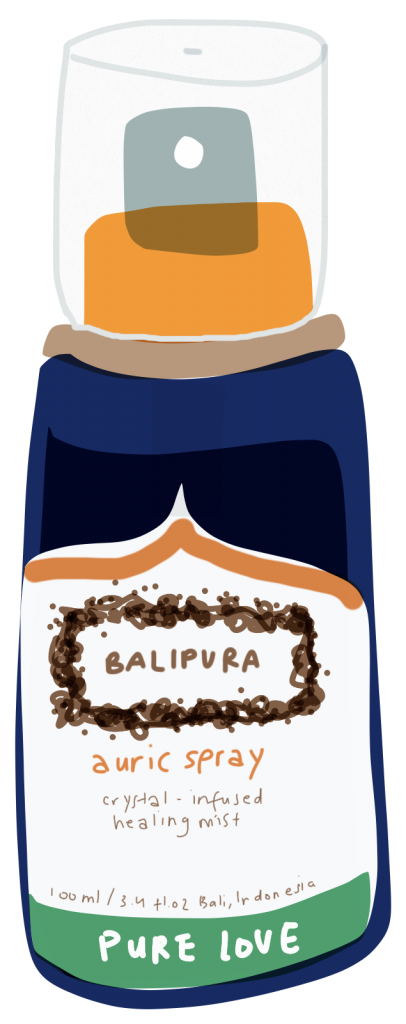
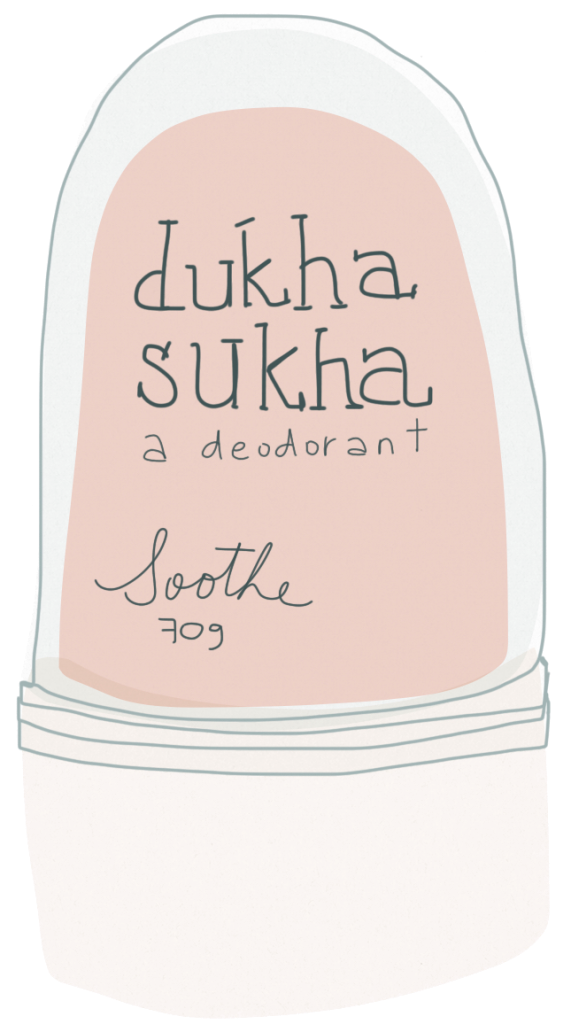
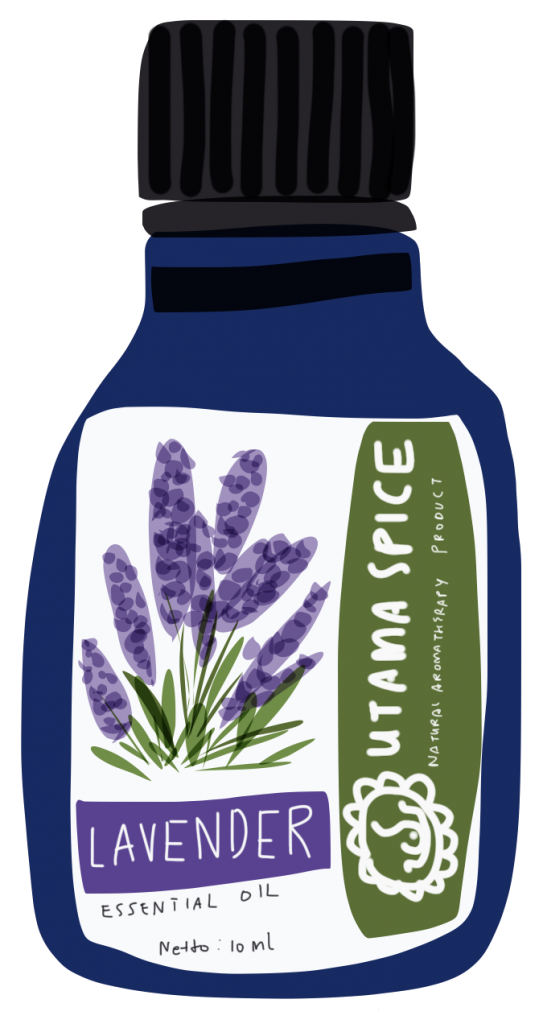
After spending more than 5 years going back and forth to Bali (well, Ubud, to be exact), I have finally found some of my most favorite body care products that are made in Bali. I had a great amount of time illustrating them as well, so here are 7 of Bali body care products I personally love!
1. ALAM ZEMPOL SOLID PERFUME: BERGAMOT

I have been a fan of their solid perfumes for years! Each one comes in a small tin can that can be easily slipped into my wallet, jeans’ pocket, or handbag. I always bring one with me during international flights as well (due to security checking, it’s too much of a hassle to have liquid perfume in my bag).

However, what I love the most about their series of solid perfume is the soft, faint, and fresh fragrance. Every time I smell it, I feel as if I have just gotten out of a shower. Rose, Jasmine, and Frangipani are also some of my favorite fragrance from their collections. However, the Bergamot is currently my favorite!

2. BALIPURA AURIC SPRAY: PURE LOVE

I love spraying Balipura Auric Spray as face/body mist after exposing myself to the hot Balinese sun. Well, actually, this one is ‘marketed’ as a ‘healing spray’: made from holy water, blessed by a Balinese priest, and infused with crystals. Thus it helps to ‘cleanse’ your aura.

Despite this backstory, I simply love the way this spray feels on my skin; as well as its muted fragrance. Pure Love has always been my favorite fragrance. Besides, who doesn’t need a bit of pure love every now and then?

3. DUKHA SUKHA MINERAL DEODORANT: SOOTHE

This mineral deodorant has been my life-saver! In principle, I do not like gelly/liquidy deodorant with fragrances. I prefer the powdery ones, but most of the times, they stain my clothes. Dukha Sukha is a mineral deodorant without fragrance (although they come in three types: pale pink-Soothe, pale yellow-Glow, and pale green-Fresh).

To use it, simply wet the mineral with water, and use it like you would use a usual roll-on deodorant. And I have to tell you that this deodorant has helped me to clear the dark skin underneath my armpit; due to shaving. After a year of using it, I was surprised to see that my armpit’s skin has returned to its original shade! This deodorant is quite expensive but it can actually last for about a year.

4. UTAMA SPICE ESSENTIAL OIL: LAVENDER

Utama Spice has always been my go-to brand for essential oils. First, because they are working with local farmers. Second, because their price is quite reasonable. Third, because their oil is not too thick or more diluted than the more expensive (or serious) brands. For me, these reasons are enough to choose their essential oils for casual use.

If I have to choose one essential oil, Lavender would be it! I can use it to cure acne/pimples, repel mosquitoes, make a body spray, or put a few drops of it on my pillow for a good night’s sleep. (I also love to use this oil as a vaginal wash!). Don’t forget to dilute your essential oil with other carrier oil/water before using it!

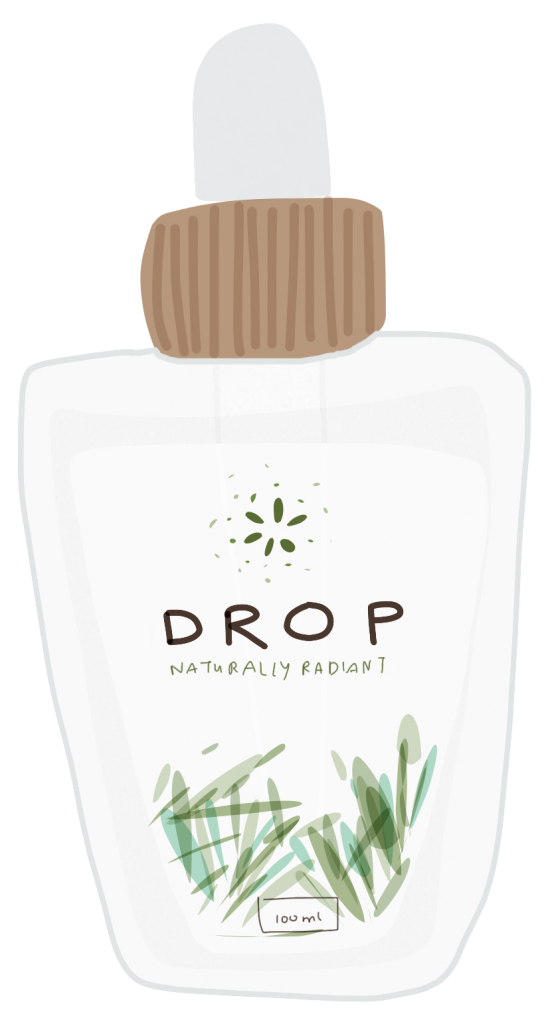
5. DROP BALI VIRGIN COCONUT OIL

I love virgin coconut oil and I am not too picky about it. Most of the times, any brand will do. However, Drop Bali is definitely my favorite. Not only because it comes in a beautiful glass bottle (with a pipette!), but also because of its smooth texture and faint coconut fragrance. It feels as if their coconut oil is being absorbed more quickly when I applied it to my skin.

I use virgin coconut oil as body lotion, toothpaste, face/make-up cleanser, moisturizer, scrub (add some salt or coffee powder), lip balm, hair conditioner, and after-sun lotion. Sometimes, I also use it for oil-pulling. It is very versatile!

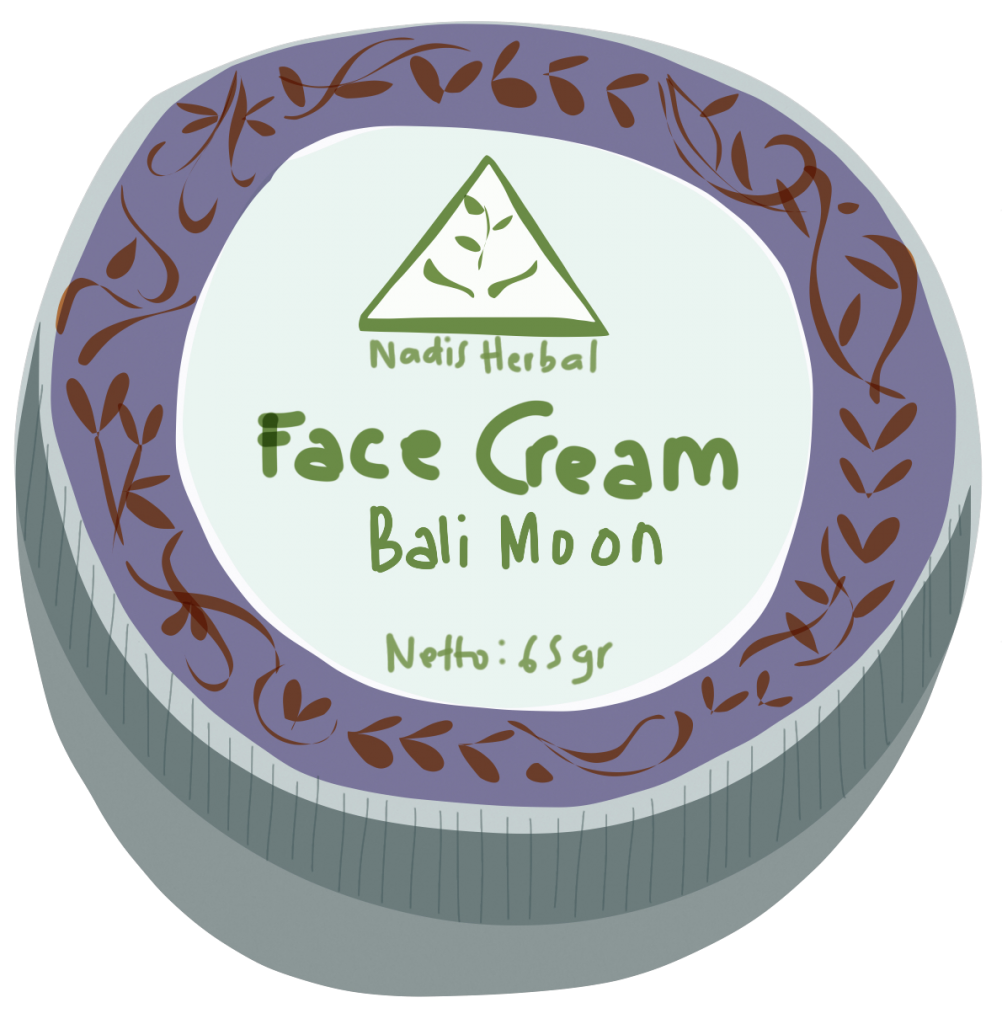
6. NADI’S HERBAL FACE CREAM: BALI MOON

This face cream does magic to my skin! I use it at night, before going to bed–and I always find my skin so supple and moist in the morning upon waking up. True, this face cream is very oily. Truth to be told, the moment after you’re applying it, your face will shine like fries. For this reason, I only use it before bed. But maybe this ‘oily’ feature is what gives the cream its magic?

The face cream contains some Ayurvedic ingredients like Amla and Tulsi oil. Amla (gooseberry) is believed to be rich in antioxidants and vitamin C; thus can help to tone and tighten our skin, make it firm and soft. Tulsi (sweet basil) oil has anti-inflammatory property to deal with skin irritations and acne. It also has a soothing and relaxing effect.
To date, this is the cheapest face cream I’ve ever used in my life. I’ve been using this (and only this, without other products apart from coconut oil and sunblock) for my face for more than 4 years now.

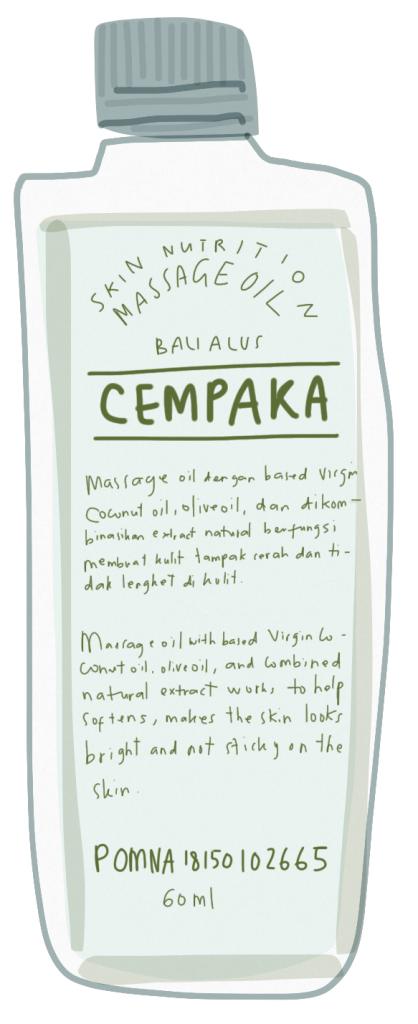
7. BALI ALUS MASSAGE OIL: CEMPAKA (CHAMPACA)

I love Bali Alus’ massage oil because of its faint fragrance and its smooth feeling when applied to the skin. The oil helps my fingers to slide smoothly when I massage my shoulder, arms, or legs early in the morning, or before my evening shower.

Cempaka (champaca) is my favorite fragrance so far because it truly reminds me of the smell of Bali! Sometimes I also use it as a moisturizer before bed, dabbing it a bit on my knee, elbow, and the sole of my feet.

Where can you find these Bali body care products?

Some grocery shops in Bali, like Bali Buda, Coco Supermarket, or Down to Earth Market have it. Or, the best way to get them is by ordering them online via your favorite e-commerce platform!

hanny
WANT TO SHARE WITH SOMEONE WHO NEED THIS?
Hanny illustrator
Hi. I'm HANNY
I am an Indonesian writer/artist/illustrator and stationery web shop owner (Cafe Analog) based in Amsterdam, the Netherlands. I love facilitating writing/creative workshops and retreats, especially when they are tied to self-exploration and self-expression. In Indonesian, 'beradadisini' means being here. So, here I am, documenting life—one word at a time.

hanny

TAKE WHAT YOU NEED
VISIT THE SHOP