It is not so much as love at the first sight (or, these days—at the first swipe). It is more like the other day when I was at the grocery store, pushing the small shopping cart through the narrow alleys (fruits & vegetables, meat & dairy, snacks, chocolate & candies, hair & body, pet) before the shelves burst out into fireworks of memories.

There, exploding into a million little pieces of moments-once-shared: our usual granola, our favorite soy milk, our regular pasta, our instant spices for rendang and nasi goreng, our huge bottle of Pocari. Parading warmth despite the cold air blowing from the meat & dairy freezing units.

beradadisini love stocksnap

It’s beautiful to know that we’ve left traces of ourselves in one another. That despite the distance, the world is now full of them, full of you, full of us, wherever we look. It gives meanings to the most random sightings of daily whatnots.

It makes me feel as if you’re near. And, I guess, in one and other way, you are.

We share the world holding hands—or some other times, holding our mobile phones. Smiles and kisses are popping up from the palm-sized screen; words and voices are flying freely across continents: those days when I look out and see the sunshine, while raindrops fall over the sunroof above your kitchen (that I adore).

Together, we’re off on impulsive adventures: me on the back of the motorcycle, and you at the front with the GPS on. Cooking pasta and fried rice, pig them out directly from the pan. Swearing at each other at the squash court. Sitting next to each other somewhere, not talking, working on our passion projects.

Tens of thousands of feet above the ground, more than a year ago, you wrote me a letter.

You said you’re flying above Gwadar, speculating that it might be located somewhere in Iran. Later on, I found out that it was an area near Pakistan’s Balochistan. An area I once mentioned in my short story that was published years ago, Humsafar.

Isn’t it funny how life keeps on throwing signs your way, teasing you in a humorous way, knowing that you’d never get it until one day you really get it?

If life were a spider web, our stories have been entangled in a heap for many years, many millennia, many centuries… connecting us with millions of lives today, as well as millions of lives before us and beyond us. We might have a long history that we have yet to discover, billions of dots waiting to be connected.

Time, slowly, will spill the secrets of the random things, decisions, and connections that lead us to one another.

But until then, I just want to thank you:
simply, for taking a chance.

hanny
WANT TO SHARE WITH SOMEONE WHO NEED THIS?

Three days after arriving back home, still I haven’t unpacked, haven’t gone out, haven’t met anyone, and haven’t done anything productive—apart from replying to some emails that need to be replied, and meeting deadlines. I am that kind of person. After being surrounded by a lot of people or being on the road for a long time, constantly moving and bumping into others—I need my downtime. I need to recharge. I need a break.

I need to pause.

screen-shot-2016-11-17-at-9-06-22-am

Do you need to be alone to recharge?

I’ve known some friends who can be on the road for what seems like an indefinite period, moving from one city to another every 3-4 days, then coming back home and heading out to see some friends directly from the airport. The next day, they would have had some meetings or meet-ups, attended events, edited pictures, and wrote some articles about their travels, went to the gym, unpacked, plus organized another trip.

I envy them.
I envy people who do not need downtime.

Those who live their lives like an Energizer bunny. They are so energized. So active. So unstoppable. It seems as if they could do so much in the first few days they came back from their traveling journeys, while here I am, still enjoying the feeling of not having to go anywhere or to do anything, savoring the privilege of being alone.

These past few days can be simply summarised into coffee – books – bed – movies – lunch – books – bed – coffee -movies – bed (insert ‘work’ only when really necessary—meaning, deadline is tomorrow).

screen-shot-2016-11-17-at-7-58-28-am

This is how I recharge. To recover from travel-lag. To readjust the pace and pattern of my day. I live best the way I travel best: slowly.

There are 2 places I would dearly call home.

My real hometown in Bogor, and my adopted little town of Ubud.

Both are easy to navigate because each one is a donut: Bogor with the Botanical Garden to fill in the hole, and Ubud with its Monkey Forest.

Both are small towns (my boyfriend still finds it funny whenever I refer to Bogor, with a million people, as a small town) with access to networks, opportunities, and vibrant creative communities trying to make a difference. Only an hour away from Bogor, there’s Jakarta: the capital of all things shiny—while an hour or two away from Ubud, there’s Sanur and Seminyak: the hubs for any kind of jobs imaginable.

Both hometowns host loving friends and families (I once wrote that home is any place where you’ll be missed, while the boyfriend said that home is wherever your wi-fi connects automatically).

They are both small enough for you to bump into old friends (or exes!) in public events, restaurants, and coffee shops, but big enough should you want to exile yourself in the faraway villages or hide in the mountains. Nature provides plenty of breathing spaces not far from the center, and the arrays of mouth-watering street food deserve no such thing as a diet.

Nevertheless, the silent contentment of being home is simply that: being home.

beradadisini being home (stocksnap)To wake up on the same bed where you’ve cried yourself to sleep when you’re still an angsty teenager. To be surrounded by your overloaded bookshelves. To have your dog jumps on you because she wants to play. To talk to your Dad about how you’ve managed to float like a starfish in Raja Ampat.

To walk around the house with that old shirt and pants you’ve had since you were 17. To cook whatever you want because the kitchen utensils are all there, waiting to be put into good use. To create new therapeutic ointments with coconut oil and your growing collections of essential oils. To put your clay mask on and compress your eyes with slices of cucumbers.

To start your day with a set of routines you’ve developed throughout the years. To know what everything is for, where everything is stored, and how everything works.

To feel as if you can go anywhere, but at the same time not wanting to go somewhere else.

Probably, as much as it’s a convenient place, home is more of a feeling: about knowing that no matter how far you go, you’ll always find a place to go back to. About remembering your root and who you truly are. About being you when nobody’s noticing. It’s a feeling of knowing that you are free both to leave or to stay.

It’s about that yearning that keeps tugging on your heartstrings when you’re away.

Whatever that yearning is, it’s home.

______
PS: If reading is one of your favorite down-time, you might want to check Bookmate–a mobile reading app where you could find tons of fiction and non-fiction books. If you’d like to try the premium access for free for a month, insert the code readwithhanny here. I have a shelf there storing some of my favorite books about writing, Writer’s Reads.
hanny
WANT TO SHARE WITH SOMEONE WHO NEED THIS?
Indonesian Coffee Culture

My boyfriend found out that I have sinned. He watched me in mild horror as I disgracefully sipped my well-deserved cup of cappuccino, after attacking some slices of Quattro Formaggi for dinner. An Italian, he knows and adheres the commandments of Italian coffee culture by heart: that cappuccino, as well as other ‘milky’ coffee, can only be consumed in the morning, and never after a meal.

OK, so I have sinned. And from then on, I have sinned continuously by repeatedly breaking the commandments. What can I say? I just enjoy drinking coffee.

***

For some reason, coffee has never had that huge of an impact on me.

I never felt my heart beating faster after gulping down an espresso. I don’t feel suddenly awakened or energized after consuming it. I can drink coffee before bed and sleep soundly for the next 8 hours.

Maybe I am dysfunctional—or somehow, have developed an inherited immunity towards caffeine.

My parents used to be heavy coffee (kopi) drinkers. My memories of a good morning was to wake up to the heavy and acidic smell of kopi tubruk for my Father (tinted with cloves and tobacco from his kretek cigarette) and the sweet and milky kopi susu for my Mother.

It has become a signature morning smell I’ve grown up with. Something to let me know that everything is okay.

The smell of coffee in the morning means it’s a good morning: where I can find my parents in the kitchen, sitting together, talking over their hot cup of coffee—not fighting, or arguing, or a kid’s scariest nightmare: disappearing. Thirty years later, I still find it comforting to wake up to the smell of hot coffee in the morning.

The smell brightens up my day.

***

When I drank my first coffee, it was love at the first sip.

I have always asked Mother for coffee since I was probably 6 years old.

Every week, we would go to a coffee-smelling stall in Pasar Anyar local market where she bought a pack of freshly ground coffee wrapped in brown paper. It could be one of my favorite stalls in the market—apart from the stall where they sell the latest Japanese comics about ballerinas and the one selling MSG-loaded chips.

But every time I asked for coffee, Mother always said no.

“It’s not for children. It’s for adults. If children drink it, they become stupid,” she said while sipping hers.

I had no idea why Mother suddenly decided to let me drink half of her kopi susu when I was 13. Either she thought I was already an adult by simply being 13, or she didn’t mind if from this point forward I would be stupid.

However, I am forever thankful for the chance, the long awaited opportunity: my first encounter with adulthood.

I still remember the sweet and slightly bitter taste of it, the combination of my hometown’s most famous Liong Bulan coffee and condensed milk: the way it glided so smoothly on my palate, so thick and heavy yet smooth and creamy.

It was bliss.

And I have never stopped drinking coffee ever since.

***

I drank more coffee during the times when I religiously watched Gilmore Girls series aired on TV, never missed an episode.

The way mother and daughter started their morning with coffee and went about their days with more sounded like a heartwarming concept.

Plus, I have always rooted to be the straight-A bookworm daughter in the series: I wanted to be Rory. To be like her, I study (carrying my pen & binders everywhere), read books, and drink coffee.

You may have concluded by now that my teenage years were anything but rebellious.

***

Indonesia may be most well-known for what people dubbed as the most expensive coffee in the world, Kopi Luwak or Luwak coffee.

The ripest coffee cherries are eaten by an animal called Luwak (a civet/palm cat), and the undigested coffee seeds that come out from the Luwak’s feces are collected to be made into your steaming cup of Kopi Luwak.

However, if you’d like to try it, please take the time to find out the source of your Luwak coffee beans, or get certified ones. Due to the high demand for these expensive coffee beans, sadly, there have been many practices of people capturing civets for coffee farming under cruel caged conditions.

As I grow up and the chance to travel around Indonesia occurs, I have the opportunity to taste many kinds of Indonesian local coffee mix.

When visiting a remote village, stopping halfway for some rest in an unknown part of a town, or simply needing a down-time after a long journey, spending some time in a warung kopi—traditional coffee stall—is always a good idea.

Here, sitting on a bench from wooden planks or a set of colorful plastic chairs, you can always have a nice cup of hot coffee with snacks like sticky rice, steamed cassava, sponge cakes, and sweet or savory fries; while eavesdropping on the locals talking about politics and latest celebrity news.

If you enjoy drinking coffee (kopi), here are some Indonesian local coffee mix you may want to try:

Kopi Tubruk.

Coarse coffee grounds are mixed with sugar (sometimes palm sugar) and boiled water is poured over it. You’ll need to wait for the hot water to ‘cook’ the coffee. It is ready to drink when the floating coffee grounds have all settled to the bottom of the cup.

Kopi Susu (milk).

Kopi tubruk with condensed milk instead of sugar.

Kopi Jahe (ginger).

Adding hot ginger water to your coffee instead of plain water. You can also find some with crushed ginger (sometimes lightly grilled) dropped into the coffee.

Kopi Ijo (green).

In Tulungagung, you can find a greenish coffee with a smooth texture. The greenish coffee beans are roasted over firewood.

Kopi Talua or kopi telur (egg). 

Well-known in West Sumatera, it’s a mix of coffee, sweet condensed milk, egg yolk, honey, vanilla, and cinnamon to be shaken until it’s foamy. There will be 3 layers on your cup: the custardy mix at the bottom, the coffee itself in the middle, and the foam at the top.

Kopi Joss or kopi arang (charcoal). 

You can find this one along the railway station of Tugu in Yogyakarta. It starts with coffee powder and sugar, as usual, hot water being poured over it, then a red-hot piece of burning charcoal from the stove’s fire will follow suit. For Indonesians, the sizzling sound of the burning charcoal hitting the coffee would resemble something like: “Josssssss!” Hence, the name of the coffee.

Kopi Durian. 

Either you like it or hate it: a piece of meat from durian fruit is mixed and stirred in a cup of hot coffee, resulting in a sweet, thick, and creamy coffee drink. Can be found in Bengkulu, but you may want to skip it if you have high blood pressure!

Kopi Kothok.

Popular in the small towns along the north coast of Java, like Rembang, Blora, Pati, and Cepu, to name a few. The coffee beans are roasted with shredded coconut. Then, coffee powder and sugar are boiled together with water.

Indonesia produces between 650,000 to 750,000 tons of coffee beans a year and is the fourth-largest coffee producer after Brazil, Vietnam, and Colombia. Italy, the world’€™s largest coffee consumer, has become the main export destination for our coffee growers.

Do you come from a country with a strong coffee culture? Are there any local or special coffee mix in your area I need to try? Or some commandments I need to know before my visit?

***

I still start my morning with a cup of coffee.

These days, it has become more of a ritual rather than a necessity. It just seems like the right smell to wake up to, the one that reminds me of good days, somewhere far away in my tightly-kept memories.

I choose coffee shops over tea parlors every time, stacking a dozen of Torabika Susu instant coffee powder when I travel, and—despite the disapproving look from my boyfriend—still order a cappuccino in the late afternoon, after a late meal.

When I am lost or stranded in a strange country, in an unfamiliar city, in an uncomfortable situation, I let myself be comforted by a smell of coffee: it could be black and strong, sweet and milky, light and chocolatey, and it doesn’t matter. I will follow it with my nose diligently, tracing the air for a sign of that earthy smell: a smell that keeps me rooted to the ground.

I know that I will always be in a safe territory the moment I step into a coffee shop, a coffee stall.

I know what to expect, what to smell, what to see, what to hear, and what to order. I know the cups—whether it’s plastic, carton, or ceramic—will snuggle perfectly inside my resting palms. I know that I wouldn’t need extra sugar. I know the coffee won’t burn my tongue if I let it sit for 2.5 minutes.

As its thick bittersweetness and slightly creamy texture bursts in my mouth, I sometimes wonder how drinking coffee makes me really feel—only to keep coming back to the same conclusion: that it makes me feel like an adult.

It can’t be so bad, being an adult, I tell myself if it can actually taste this good.

hanny
WANT TO SHARE WITH SOMEONE WHO NEED THIS?

There is a space between us and I am thankful for that.

The space allows me to fill in the morning pages of my journal, sip a cup of coffee while listening to the monks chanting mantras, or curl again in bed to read a book at a leisurely pace. The space allows you to put on your running shoes and wander around the streets, the hills, the ridge; enjoying your 8 kilometers of uninterrupted moves while listening to your favorite podcasts.

The space gives us the time to be us: to breathe, to think, to reconnect with the essence of who we truly are, to enjoy our simple little pleasures, and be happy for that.

There is a space between us and I am thankful for that.

The space gives us the opportunity to stay as these two personalities with their own unique taste, traits, and characters; who just happen to like each other so much (sometimes, too much) despite the more-than-obvious differences. The space stops us from being reduced into one, and instead, it gives us enough room to grow, to expand, to bloom. The space lets us be together, in parallel, walking side by side, hand in hand, but never too close to risk cutting each other’s track or cramping each other’s path.

The space provides us the chance to chase our true calling, to pursue our dreams, to persevere in the things that have always taken a big chunk of our hearts. And while you may not fully understand why I choose the things I choose and I may not fully understand why you choose the things you choose, the space is indeed, spacious enough, to let us be: so we are never felt forced to choose one over the other. So both dreams can be equally exciting and important.

There is a space between us and I am thankful for that.

The space reminds us from time to time that we are here because we choose to be here.

No one is holding the other too close, no one is holding the other too loose. We are keeping the sacred space in the center: from where we’re tugging each other from time to time with shared memories and experiences while keeping our owns; that may or may not be shared with one another one day, but both is equally okay and acceptable. It gives us a chance to miss each other while trusting that the other never really leaves.

The space provides us a safe distance to be sad, angry, or heartbroken, without accidentally hurting the other and getting them wounded by the splinters.

The space lets us know, every single day, that we can only be responsible for our part in the relationship: for the things we choose to bring, to feel, to think, to say, to share, to give, to withhold.

There is a space between us,
and I am thankful for that.

hanny
WANT TO SHARE WITH SOMEONE WHO NEED THIS?
Book Hunting in Singapore: 1-Day Walking Tour
Books Actually in Yong Siak Street carried books and short stories from local authors. A resident cat can be found sitting on the countertop. Modeling pour moi, the fashionable bookworm, Clara Devi.

“You are here for the bookstores?” the lady at our hostel in Singapore asked. She wears her hair long; has colorful eyelids and nails; with a preference for the bright-colored tight tops.

I was sitting leisurely at the reception one morning after taking a shower, ready for the day’s book hunting. The hostel lady was there, sorting some envelopes on her desk by the window, and she offered me coffee. When my friends W and C appeared, she asked us about our plans for the day. Hence, the bookstores.

“Go to Bras Basah,” she said. “You can find any kind of books and a generous selection of bookstores to browse from.”

As always, the local was right.

We went crazy in Bras Basah complex, hopping from one bookstore to another, adding more and more books into our backpack.

***

Personally, I love chaotic bookstores with amazing shopkeepers.

The kind of store where you could not really tell which shelves contain which books, but you could always ask the shopkeeper and he would respond as if he were an online catalog: navigating you in an instant through the small alleys smelled of mildew and old papers to some hidden shelf littered with covers and titles, and there you found the book you were looking for.

Book Hunting in Singapore: 1-Day Walking Tour
Littered with Books is a wonderful place if you’re looking for travel books, writer’s interviews, or recipes. The travel shelf is upstairs. This picture is taken by my book-hunting partner, Clara Devi of Lucedale.co.

Later that afternoon (or two bags of books later), we sheltered ourselves from the pouring rain and sat at a lovely restaurant in Ann Siang Hill, savoring a pan of hot paella. We had circled this area a few times after leaving Bras Basah, and still not seeing the next bookstore we were looking for. So we asked the waitress if she knew anything about it.

“Oh, they closed down!” she said, and probably seeing our disappointed faces, added, “You are here only for the bookstores?”

***

Yes, most of the time, I’m in Singapore only for the bookstores.

I have been frequenting Singapore for book hunting since they still have this massive bookstore, Borders. I still remember how ecstatic I was when I found a special shelf there, dedicated to books about writing.

Book Hunting in Singapore: 1-Day Walking Tour
Woods in the Books. Another bookstore in Yong Siak Street. The street itself is so artsy and picturesque. Cannot stop snapping pictures here.

I could spend hours in front of this shelf alone; flipping a writer’s glossary book that would help writers find the correct terms used in a specific industry/area. Boating, for instance. (Boat-hook: a pole with a hook on the end, used to reach into the water to catch buoys or other floating objects. Fender: an air or foam filled bumper used in boating to keep boats from banging into docks or each other, Icebreaker: a special-purpose ship or boat designed to move and navigate through ice-covered waters.)

Unlike India, where the price of books is really cheap (the price for 1 book in Indonesia equals to 3 books in India, and I ended up shipping 10 kilograms of books from Jaipur), Singapore may not be the cheapest option to shop for books.

However, the options are abundant!

Although I was heartbroken after Borders was closed, today I cherished the birth of local indie bookstores around Singapore; that only adds up to more varieties and experience for book-hunters. Not to mention the events, workshops, or book discussions they are sprouting from time to time to keep the community alive!

***

Visiting Singapore soon and thinking about having a one-day walking tour for book hunting? I’ve created this walking route for book shopping in Singapore that may help you navigate your way around!

Book Hunting in Singapore: 1-Day Walking Tour
Wear your comfy shoes, bring a bottle of water, and carry a big backpack with you. You’ll fill the backpack with many, many books! And, 7 books later, you’ll be thankful for bringing a backpack instead of a tote bag 🙂

Book Hunting in Singapore: 1-Day Walking Tour

(0). ARAB STREET & HAJI LANE | 9.00 AM – 9.50 AM

Always start with a good and hearty breakfast! Many food stalls are available in Arab Street, serving Chinese, Malay, Indian, and even Indonesian breakfast from 7 AM. I personally love a warm portion of martabak and teh tarik at Singapore Zam Zam Restaurant. From there, walk leisurely along Haji Lane with its lovely murals and picturesque facades. Stores and cafes are still closed in the morning (mostly open around noon), exactly why I love being here at these hours just to stroll along, snap pictures, and feel inspired.

(1) NATIONAL LIBRARY OF SINGAPORE | 10.00 AM (open) – 11.00 AM

A 10-minute walk from Haji Lane, you’ll reach the National Library of Singapore. Why, a library should be in the picture when we’re talking about a literary walk, shouldn’t it? Moreover, we’re talking about a 16-story library, with gardens in the building that offered a good view of the city: the Courtyard on Level 5, and the Retreat on Level 10. The collections of books go without saying. Find out if there are any exhibitions on the day of your visit.

(2). BRAS BASAH COMPLEX – 11.02 AM – 12.00 PM

Only a 2-minute walk from the Library, the upper floor of Bras Basah Complex is full of ‘oldies’ small bookshops selling rare and antique books, second-hand books, comic books, and many more. Book display and shelving may not be their thing (love chaotic bookshops!), but they may hide that one gem you’re looking for! Just ask the shopkeeper if you have a particular book in mind. Amazingly, they would remember whether they have the book, and where they shelf it! This is my go-to place to hunt for South Asian books & literature. Find Basheer Graphic Books (#04-19) if you’re into graphic design books: from typography, branding, animation, fashion, architecture, interior design, and many more.

(3a). THE BOOK CAFE – 12.30 PM – 1.20 PM*

*) If you choose this route, you’ll have to go for a 21-minute walk afterward to our next destination. If you choose the other route below, the distance to our next destination is only 3-minute away.

This could be your first option for early lunch. Around a 29-minute walk from Bras Basah Complex, The Book Cafe is surrounded by bookshelves (love!), and comfortable sofas are plenty! Time to cool off and check your book-list. Do you have everything you’re looking for? (Plus, after walking that far, you must be really hungry now!)

(3b). MAXWELL FOOD CENTRE | 12.30 PM – 1.35 PM

Maxwell Food Centre could be your second option for lunch—if you’d prefer hawker stalls rather than a cafe-like establishment. You may want to try Tian Tian chicken rice, Huang Ji wonton noodles, or Fuzhou oyster cake. It’s a 28-minute walk from Bras Basah complex, and you may think it’s quite fair, but here comes the plus point: the location is only 3-minute away from our next stop!

(4). ANN SIANG HILL – 1.40 PM – 2.00 PM

After a 21-minute walk from The Book Cafe (burn those calories!) or just a 3-minute stroll from Maxwell Food Centre, you’ll arrive in Ann Siang Hill. It’s a lovely stretch where you’ll find many concept stores with curated goods as well as Instagram-able cafes. The buildings around this area look beautiful in pastel colors. After Haji Lane in the morning, this could be your afternoon dose of inspired walking!

(5). LITTERED WITH BOOKS – 2.05 PM – 3.15 PM

Only 5-minute away, you’ll stumble upon Littered with Books, a beautiful bookstore with special sections for travel and culinary books in the attic; and a section for books about writing & writers downstairs. Couches are provided here and there, so you can flip the pages of your book leisurely. What I love the most is the hand-written notes glued by the owner on each shelf, giving you recommendations on certain titles to read and why you may find them interesting!

(6a). THE READING ROOM | 3.25 PM – 4.20 PM

Have filled your backpack with more books? After a 6-minute walk, what about a quick stop for coffee at The Reading Room before heading to your next destination? With countless books surrounding you from its walls and puffy cushioned sofas to bury your back comfortably, it could be your first option to sit lazily while checking whether you still have enough Singapore dollars to buy more books!

(6b). GRASSROOTS BOOK ROOM | 3.25 PM – 4.20 PM

The Reading Room’s next-door neighbor can be your second option for a cool breeze from the hot Singapore sun. Only a few steps away, Grassroots Book Room is a serene unconventional bookshop with an adjoining cafe. You’ll find books on Chinese literature and history, as well as recipe books.

(7). WOODS IN THE BOOKS – 4.20 PM – 5.00 PM

I have an unhealthy addiction to beautifully-illustrated children’s books. And after a deserving 21-minute walk from The Reading Room, Woods in The Books would come into view. It’s a quaint little bookstore with all kinds of children’s books to cheer you up: from fiction to nonfiction, in various categories imaginable!

(8). BOOKS ACTUALLY | 5.00 PM – 6.00 PM

This is my go-to bookstore in Singapore to look for works from local authors. A few steps away from Woods in The Books, Books Actually also published anthologies and journals from the newcomers in Singapore’s literary scene. Near the cashier, you would find a stack of Ceriph—a quarterly publication containing prose, poetry, social commentaries, photography, and visual art from local artists. You can take a past issue and pay as you wish by inserting your money into the provided tin-can. There’s a special section containing staff-picked books (I love their picks!) and a resident cat is around if you like to pet it.

(9). THE OPEN DOOR POLICY|  6.05 PM – FINISH

With your backpack full of books, it’s time to head out to a place where you can flip and glimpse at each book you’ve just bought—peacefully while having dinner. Have a short 1-minute walk to The Open Door Policy, and celebrate the day with a portion of crab cake or their delicious lamb dish. Have a sip of fresh juice, massage your feet, and open your backpack while waiting for your meals to arrive. Now, you need to decide: which book to read first?

Full map for your “Book Hunting in Singapore: 1-Day Walking Tour”*

*)If you skip The Book Cafe, you can follow the shorter route from Bras Basah Complex to Maxwell Food Centre (refer to map 3b above)

Happy walking! And happy book-hunting in Singapore!

hanny
WANT TO SHARE WITH SOMEONE WHO NEED THIS?

They called you a strong woman.

Because you’re independent, and always seem to be so confident going about your days by yourself. Because you seem fine all the time. Because you’re the one taking charge when everything goes out of line and making it all once again calm. Because you’re the one that keeps trying to find the way out when the other has given up. Because oftentimes you would refuse a helping hand being offered your way by saying, “It’s alright, I can do this.” Because you always seem so happy and full in your own little world, even if you have to wake up and go to bed alone, every single day.

They called you a strong woman.

You, who forever postpone your dreams to ensure that the ones around you can chase theirs. You, who make sure that everyone has enjoyed their meals before picking up whatever is left on the table. You, who always let everyone else voice their concerns and opinions first, before starting to speak. You, who will only cry when nobody is looking.

You, who always be the one retreating from a relationship when they begin the conversation with, “I know you’re a strong woman,”—as if being a strong woman makes you immune from heartbreaks.

You, whom they called a strong woman, sometimes wish they do not see you as someone strong. You wish you could rest because life can feel so exhausting. You sometimes imagine how wonderful it is to be the one others are fighting for, instead of being someone who is constantly fighting. You wish someone else would want to carry your life’s burden without you even asking, and not the other way around.

You, whom they called a strong woman, sometimes wish you could shed some tears when you’re sad, explode in anger, or pour your heart out whenever you are in doubt. There are days when you feel like crying—but you simply forget how to: it has been too long that you force yourself to smile whenever you’re feeling down.

You, whom they called a strong woman, sometimes want to cry out, “I want that!” and let others withdraw to give you what you want. You want to be a bit spoiled and stubborn, to have others give way to your will, not the other way around.

Sometimes, you want to be the one who gives up.

You, whom they called a strong woman, sometimes want to admit the fact that you are lonely. That after facing such a backbreaking world, you would love to come home to loving arms, that would envelop you in their embrace. Sometimes, you wish to be the one being protected; you wish you could be this vulnerable being that would invite endearment and affection.

When a relationship went wearisome, you would like to hear: “I need to stay with her, I cannot imagine hurting her,” instead of, “She’ll certainly be fine without me, she has always been a strong woman…”

You, whom they called a strong woman, carry so many burdens, so many dreams, so many responsibilities on your shoulder. You, whom they called a strong woman, sometimes question the fact: that if you are not the one to be strong, who else could carry all these?

But, you, whom they called a strong woman—yes, you: you deserve to be happy as well.

You deserve a break, to sometimes be a bit ‘selfish’, to ask for what you want, to say, “Help me, I cannot do this alone.” You are allowed to let your tears fall without having to be shadowed by a smile, to be someone who is being kept—instead of being released.

Because you, whom they called a strong woman, you are not always as strong as they may think you are.

hanny
WANT TO SHARE WITH SOMEONE WHO NEED THIS?

What to do in Pejeng, Bali? One way is to follow the trail of wisdom this beautiful village has to offer.

His was not a happy childhood.

He spent his first few days living inside Kerobokan jail when his parents got detained by the Dutch. His mother breastfed him on the cell and bestowed upon him the name Dewa Gede Badung.

His suicidal thoughts came before the age of 12.

Those were the times when he spent his days mindlessly at Garba Cave. Situated 400 meters above sea level, the cave lies underneath Pengukur-ukuran Temple, above the Pakerisan River in Pejeng village, Bali.

The Caretaker of Garba Cave, Pejeng

Now around the age of 70, he reminisced the days when (for reasons he could not truly comprehend) he got attracted to this hermitage site. As a child, he spent his time running around the cave as well as sitting still with his eyes shut tight. Something he understood later on as meditating.

It was during one of these ‘sittings’ he somehow heard a thought echoed in his head, loud and clear: a message not to end his life.

Thus began the days of new Dewa Gede Badung, as he decided to dedicate his life as a caretaker of Garba Cave in Banjar Sawa Gunung; where Prime Minister (Mahapatih) Kebo Iwa used to meditate back in the 12th century.

I met Dewa Gede Badung one afternoon when I visited Garba Cave. I was still hypnotized by the majestic look of my surroundings when shirtless, he shouted from the top of the huge stairs of stones, asking where I came from. His eyes were sharp, and his build was small but strong.

Easily, he lifted a huge piece of stone covering what to be believed as an underground tunnel of Tampaksiring. “Only those with a pure heart can find a way out of this tunnel,” he said. His eyes sparkling underneath the Pejeng sun.

On How One Should Meditate

Dewa Gede Badung told me the secret of meditating that day: “Pray so you can eat. If you cannot eat, you cannot live. Pray so you can work. So you know what is your duty. Pray so you have a place to go home to.”

I was amazed at how these words could sound so simple, yet so true. It’s not only about meditating, it’s also about living a good life.

One does not need too many things to live a good life.

We need only to eat enough so we can stay functioning and live a healthy life. It is not about indulging ourselves. It is about knowing what is good for us and our bodies.

We need to do our duty and play our part both in society and humanity; we need to serve. When we do so wholeheartedly, we will get what we need in return. Sometimes just enough, or sometimes even more. But we will not experience scarcity.

And last but not least, we need to know that we will be taken care of, to trust, to believe, to have faith, to know that we will always have a place we can call home. A place we can go back to. A place we can reunite with.

On How Nature Heals

IMG-20160809-WA0003
The holy Pakerisan River from the bridge at Gunung Kawi.

David Strayer, a cognitive psychologist at the University of Utah found out that our brains are easily fatigued. There’s a full article in National Geographic on how nature helps us (and our brain) to heal; but all in all, when we slow down, stop the busywork, and take in beautiful natural surroundings, we feel restored.

And our mental performance improves too.

I guess it is for this reason that people take a break from work and go on a holiday to the beach, the lake, or the mountains. Or why I (many times) healed my broken heart by the rice fields in Ubud; or how I felt a strange sense of relief after such a tumultuous relationship just by spending hours sitting surrounded by the trees, birds, and squirrels of Delhi’s Qutb Minar.

Pejeng, once known as the center of Balinese kingdom, also hosted several natural ‘healing’ sites nearby, like Gunung Kawi, Sebatu, Goa Gajah, and Tirta Empul–all centered around water and holy springs.

The Healing Power of Water

For the Balinese, water has always been respected for its cleansing property. May it be flowing like a river, pouring down as rain, or sprouted from a spring—water is considered a holy element that brings forth life, and is mindfully preserved.

Every traditional procession and ceremony in Balinese villages included water or in Balinese, tirta, as one of its most essential elements. It represents a life-giving force, a purifying agent, a blessing.

One of the Balinese traditional purification ceremonies, melukat, resembled a river-bathing activity. A Balinese priest would lead a purification ceremony in a resplendent location at a confluence of rivers and waterfalls—where participants would undergo a series of rituals, including praying, bathing, and soaking themselves in a stream.

The palm-leaf scripture of Manawa Dharmasastra stated that the purification ceremony is for ‘the body to be cleansed with water, the mind to be cleansed with honesty, the soul to be cleansed with knowledge, and the reason to be cleansed with wisdom.’

IMG-20160809-WA0000
The source of the holy spring at Tirta Empul temple is located in the inner courtyard. The spring is filled with green algae.

It was the day before the full moon when Yuni took me to Gunung Kawi, Tirta Empul, and Sebatu. Yuni works at Lanna’s Lair, a lovely villa in Banjar Sawa Gunung, Pejeng, a perfect place to wind down, heal, and get reconnected with yourself.

“These places would be full because tomorrow is a full moon. Everyone is going for the water purification ceremony there,” said Yuni, as she bought banten (offerings) and incense from one of the stalls lining up towards the melukat site.

The first thing I noticed about these sites was how beautiful their surroundings were. All those greeneries, the faint chirping of the birds, the sounds of splashing water… no wonder such places are believed to have healing powers. Just by standing there in silence and absorbing their beauty, I could have felt a wave of peacefulness washing all over me already.

Sebatu turned out to be the most challenging site of the day. One must climb down hundreds of steep sets of stairs to the holy spring, but the stunning view and the lush canopy of green above my head gave me the fuel to keep going.

IMG-20160809-WA0001
Melukat in Sebatu, Pejeng. You need to climb down a set of steep stairs to reach the water purification site.

Going Historical in Pejeng

I have always thought of Pejeng as a small village with nothing but rice fields and natural surroundings. So I was surprised at how many things I could actually do in Pejeng during my stay there. The village and the area nearby are swarming with historical sites!

Apart from Garba Cave, Gunung Kawi, Goa Gajah (or Elephant Cave, a Buddhist sanctuary built in the 9th century), as well as Tirta Empul and Sebatu holy springs, Tampaksiring Palace is located only 20-minute away. Sacred temples like Pengukur-ukuran, Penataran Sasih, Kebo Edan, Samuan Tiga, or Pusering Jagat are placed only a few kilometers away from each other.

Penataran Sasih temple was well-known for hosting the Moon of Pejeng. It is said to be the largest single-cast bronze kettle drum in the world and the largest known relic from Southeast Asia’s Bronze Age period. The locals believe that the Moon of Pejeng is sacred.

“We believe that The Moon would make a sound as a sign that a catastrophic event would take place,” said Dewa Gede Badung. He remembered how The Moon was last heard made a sound in 1965, before the Indonesian grim massacres.

Pusering Jagat temple, on the other hand, is believed to be the center of the old Pejeng Kingdom. The temple attracted devotees who are wishing for fertility and seeking healing powers.

Pejeng would still be my secret village to wind down from the hustle and bustle of Ubud. It was always lovely to talk with the villagers and holy site’s caretakers–listening to the way they embrace ancient wisdom and making meanings out of it in such a modernized world.

As I floated along Lanna’s Lair pool overlooking the jungle, suddenly I felt so insignificantly small. As if I was surrounded by something way much older, way much more ancient, and way much more sacred than all the world’s history I’ve ever known.

What to do in Pejeng

Ask the lovely local staff at Lanna’s Lair to arrange a private cooking class (their Chef used to work in Ubud’s most well-known fine dining restaurant), a melukat trip or other Balinese traditional healing experience, meeting village elders and caretakers, meditation class (including their routine full-moon meditation), bicycle trip around Pejeng’s historical temples and healing sites, and many more! 

hanny
WANT TO SHARE WITH SOMEONE WHO NEED THIS?

Blog (1)

I WAS 17, typing away from my desktop computer in my room from 7 pm to 3 am, non-stop. The fan was blowing to keep the CPU from overheating. We didn’t have an air conditioning unit back then. I typed letters I would never send, grammatically incorrect short stories in English, angry poems, sad poems, almost-love poems, teenage novellas, and many unfinished novels I kept on revising.

I was 17. I was lonely and sad.

I felt unwanted, unattractive, and unaccepted in a world that didn’t really belong to me. I ran into my books (they make me laugh, they make me cry, but they never hurt me) and my writings (my most genuine company). But books, with stories written by someone else, were like the world I didn’t belong. They were out of my control. Writing, however, was the opposite.

And that was how, when I was 17, I learned about the balance of life.

I wrote about things I’d like to experience. About things, I couldn’t (or too afraid to) experience in real life. In the afternoon, he was a popular guy with a popular girlfriend, and I was the best friend who silently loved him. In the evening, I wrote about how the popular guy fell in love with his best friend, eventually. Realizing that she was the ‘perfect match’ all along. Finding out that his popular girlfriend had been cheating on him all along. But the best friend was already in love with a more popular guy who had been kind to her all along—who had silently loved her all along.

It was only in these stories that I became cute and beautiful, cool and confident, rebellious and couldn’t care less of what other people think of me.

But the morning always came, and I had to go to school.

***

I HATED high school because I wanted to learn, not being lectured.

I wondered if high school would be better if I chose social major instead of natural science. Unfortunately, at the time, I hadn’t had the courage to choose anything for myself. So I tried to skip as many classes as I could, legally: being too active in the student body so I needed to visit other schools and attended school meetings, signing up for debate team and English-speaking club so I needed to spend many days competing in different schools or campuses, offering myself to help the choir team if they didn’t have enough people to sing that day… anything, as long as I didn’t have to be in class.

In the afternoon, my math teacher called me stupid numerous times, scolded me because I often missed his class during the month of the debate championship. In the evening, I wrote about a math teacher who looked down on his student and bullied her all the time. At the end of the semester, the student won numerous awards in various poetry-reading competitions and she made the school famous.

The day I found the Internet in college, I started reading about stars and supernovas, black holes and mutations, literary critics and the beatniks, Freud and Jung. I couldn’t stop asking more and more questions about the things that had always intrigued me, because it seemed as if the search engine had the answers for them all.

And then I found out about blogging. Where I could just write and threw my words away to the world, for some complete strangers to stumble upon them accidentally. It was the days of Blogspot and Livejournal and Friendster blogs. WordPress came last.

The blogs were my ways of both reaching out and reaching in. And I never stopped ever since.

***

MY FRIEND once told me that my blog is reserved for those who are heartbroken.

Maybe because in the old days, I wrote about sad things. I was sad. I didn’t know happiness back then. It was such an abstract concept. Sadness fuelled my writing in such a way that got me somewhat addicted to it. I couldn’t write when I was happy. So I made myself sad, sometimes subconsciously, other times consciously.

But I was tired of being sad. The idea of a troubled and angry writer didn’t excite me anymore.

I used to daydream about being broke and living in a rundown flat without electricity; about working as a waitress in a small jazz club and writing under the candle light at night. I used to romanticise the idea about being a struggling miserable writer. It sounded like an indie movie.

Then Rory Gilmore came along. She made me thought about how I, secretly, have always wanted to be happy. And so I braced myself to cross over. To be happy; even if it meant I had to lose my writings.

It was true that I couldn’t really write for quite some time, but then I started learning to write as a happy person. I learned about it all over again. When I came to think about it, the blog was all about that: about me, learning to write—and about me, learning to understand myself.

***

I AM 33.

I remembered how in my early 20s I found my childhood friend and got reconnected with her when we stumbled upon each other’s blog. About when in my mid-20s, I giddily launched an idea for a social movement with my best friend in the blog, and kind people shared the post to the point that we got more support than we thought possible—that 8 years later, the movement is still running.

About how people I didn’t know reached out to me (or I reached out to them) from the blog, and we poured our hearts out as if we had known each other for years, and then we became friends.

I remembered how in my late 20s I got hosted in New Delhi, India, by an Indian blogger who knew me through the blog.

About how I shrieked and jumped around the room in happiness when my Santorini blogpost got featured by WordPress for the very first time—a few days before my birthday. About how I still shrieked and jumped around the room when some of them got featured again in different years: The Answer, My Saturday with Mishka, Why I’m Keeping My 100-List & The Things I’ve Crossed Off in 2015, and recently, The Short History of Instant Noodles.

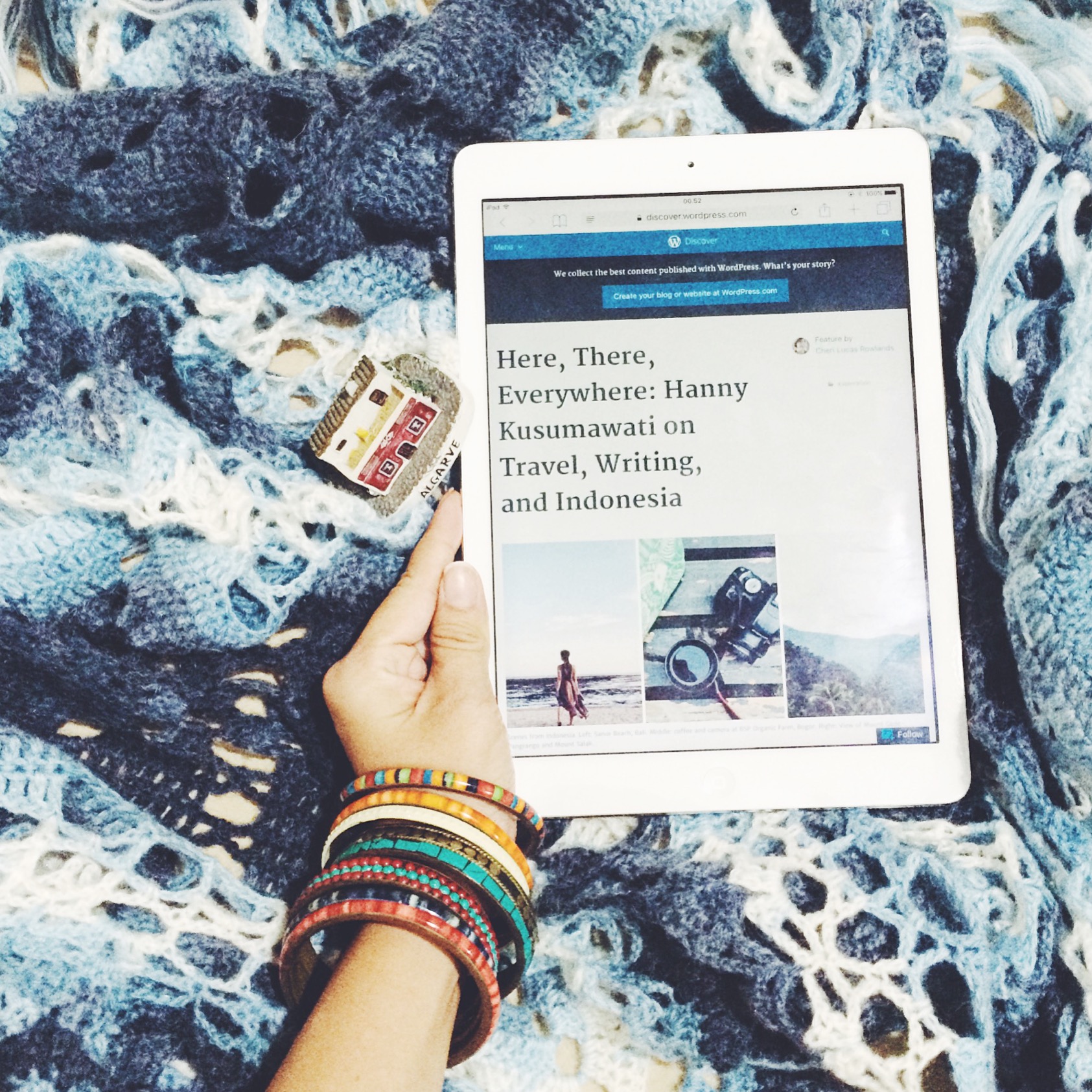
I remembered when a month before my 33rd birthday, an editor from WordPress, Cheri Lucas, contacted me and asked if she could make a profile about my blog in the Discover section of WordPress.

Processed with VSCO with f2 presetI remembered how, in some of my lowest days, I found comments or messages from people I didn’t know in or through the blog; saying that they had gone through the things I went through, saying that they could relate to my stories, saying that they enjoyed being around and read along, and then my days became instantly better.

***

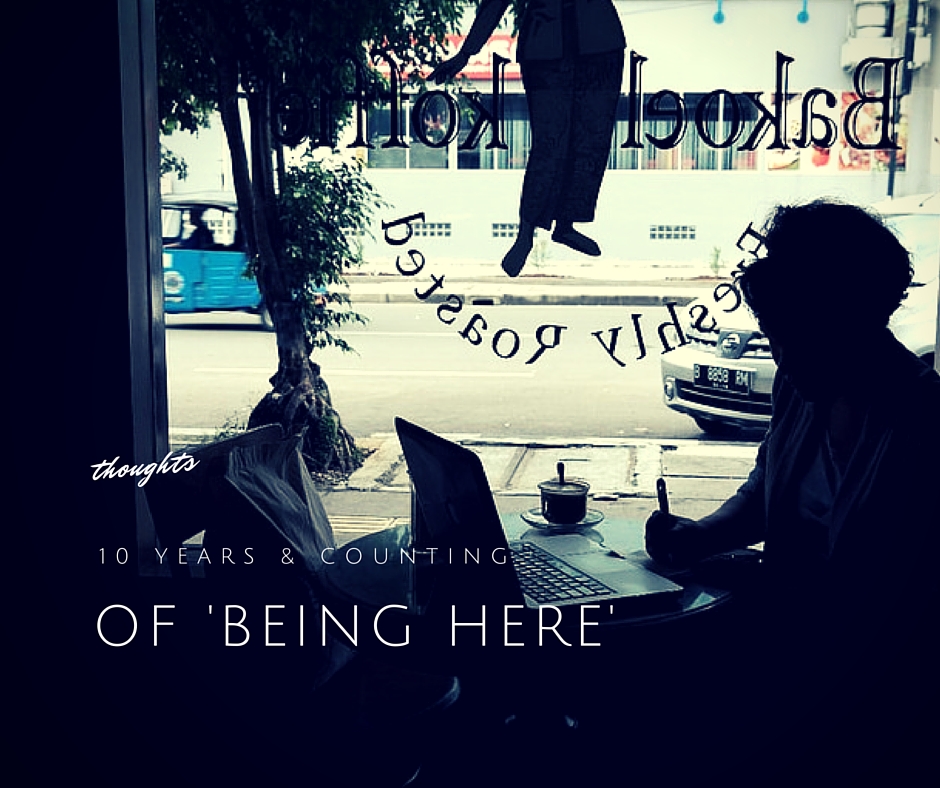
THE blog has been running for 10 years.

I didn’t remember it at first. WordPress reminded me when I woke up this morning. It’s been quite a journey.

Some of my friends decided to create a new blog after a few years. Some said that the old blog didn’t suit them anymore. That some of the things they posted years ago embarrassed them. I understood what they mean. I did feel a certain level of embarrassment when I flipped through my first few blog posts here, but I decided to keep them around.

Because they simply reminded me of who I was. About how my writings grew with me.

I once read that we tend not to notice how far we’ve come until we looked back to where we were 3 years ago, 7 years ago, 15 years ago, 25 years ago. For this reason, sometimes, I look back. It keeps me humble when I read my old posts once again and be reminded of where I came from. It keeps me optimistic to know how far I’ve come. It keeps me wondering about what I would see when I look back to this moment 10 years from now.

It reminds me that no matter how much I’ve been broken, I am still here.

hanny
WANT TO SHARE WITH SOMEONE WHO NEED THIS?

I can listen to you talking about your grand adventures for hours. About the foreign cities, you have visited. About Bosnia and Kosovo and Albania. About the exotic beaches and fellow travelers you meet at the seaside bar. About the things you see and the things you think about as you see those things. About the museums and the park and the rivers and the rooftop bars glimmering with lights.

I can live out of a backpack and walk beside you to explore the vast possibility the world has to offer. We’ll photograph each other with the stunning background from the countries we are in, upload it to Facebook and Instagram, and snap some pictures of our morning coffee and croissant, our afternoon’s garlic naan and tandoori chicken, our evening sangria. We’ll make friends with people from all walks of life and listen to their stories before going out together for a dance.

I can also listen to you talking about nothing for hours. About how you run for another 8 kilometers today, or 9 kilometers the other day. About how you clean some pots and pans or fix a loose hinge on the door. About how your client meetings go and the things you have on your to-do list for the rest of the day. About how you’re about to go to the nearest supermarket to buy a pack of cookies.

I can stay at home for months, with you ordering some interesting Kindle titles we have listed down on our wish-list so we can just read all day. We’ll be reading to each other every morning before we start our day and every evening before we end our day, one chapter each. We’re going to read someone else’s travel stories and journeying with them from wherever we are: the bed, the terrace, the kitchen.

We’ll have coffee in the morning and cook pasta in the evening–spaghetti carbonara or penne with smoked salmon and cream. You’ll be doing nothing, just sipping beer while watching another MotoGP race on a TV set in a small restaurant downtown; because we do not own a TV set. I’ll text you from the comfort of our kitchen desk that is full of art papers and watercolors, with the list of groceries to buy on your way home: some corn chips, please xx.

We’ll be doing nothing: just waking up in the morning and having breakfast, doing the laundry, going out for work and having lunch, finishing up some left-over work and playing squash, having dinner somewhere and heading out for salsa, reading books and watching old movies, whispering secrets, and trading childhood stories.

We’ll be doing everything: from traveling the world to experiencing new adventures, learning a new language, and dropping by at someone’s kitchen for a crash-course in cooking local delicacies, starting an exciting project together, and making all sorts of meaningful connections…

We’ll see sunrise and sunsets and the twinkling stars from our balcony again and again and again. We’ll see sunrise and sunsets and the twinkling stars from places far from home again and again and again. I’ll see you here and there and everywhere, again, and again, and again…

And still, I want to do nothing & everything with you.

hanny
WANT TO SHARE WITH SOMEONE WHO NEED THIS?
Hanny illustrator
Hi. I'm HANNY
I am an Indonesian writer/artist/illustrator and stationery web shop owner (Cafe Analog) based in Amsterdam, the Netherlands. I love facilitating writing/creative workshops and retreats, especially when they are tied to self-exploration and self-expression. In Indonesian, 'beradadisini' means being here. So, here I am, documenting life—one word at a time.

hanny

TAKE WHAT YOU NEED
VISIT THE SHOP