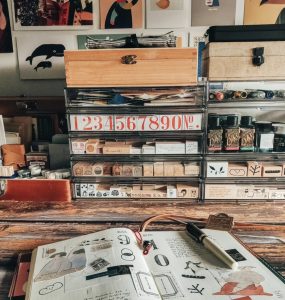
My mother was a maker. She baked the most delicious cookies and cakes. She sewed bags, patchwork blankets, and dresses out of a Japanese how-to book. Made hair bands and bead bracelets. Redesigned an old wooden bed-stand into a couch. If she was still alive, she would have launched a DIY tutorial channel on YouTube.

***

No. You haven’t showered!” she would scold me when—upon waking up in the morning—I dragged myself to the kitchen in the hope of joining her making kaasstengels.

Put on a proper dress!” she would dismiss my presence in my thin, rugged, and washed-out pajamas another time when I was excited to help her storing the unused beads based on their shapes and colors.

“Wash your hands!”
“Don’t sneeze!”
“Sit respectfully!”
“Get rid of that sulky face.”
“If you’re angry like that, stay away.”

I used to cry or sulk, even more, leaving my mother to work on her creation alone. I hated those moments, those words. To me, they all sounded judgmental, harsh, and patronizing.

I always thought that ‘making things’ was my mother’s. Not mine.

I was careless and sloppy; while my mother was neat and tidy.

***

A few months back, my friend Clara wrote a heart-warming piece about how, as a teenage girl, she had sworn not to grow up to be the adults her parents were. But of course, in her late twenties, she found out that she had actually become her parents. That she had grown to like the things they like and value the things they value.

I wasn’t sure when I started to make things again. Maybe that one time when I enrolled in a course to make batik. Then, silver jewelry. Cooking Balinese food. Watercolor painting. Weaving. Making prayer beads.

I have spent the last few years learning to ‘make things’.
Random things.

They came to me one by one, and I simply said yes. I don’t even know what I would do now that I know how to make these things. I am pleased simply from witnessing the way I can do something I couldn’t do a few hours before; amazed by how I can create something close-to-beautiful out of what seemed like scattered components.

I love how time silently flies when I am concentrating on the way my hands move: my nerves and muscles memorize the mechanics of how things work—sometimes by carefully listening to instructions, other times by listening to my intuitions.

From ‘making things’, I learn about humility—that there’s always something new under the sun. I learn about patience—knowing that everything takes time. I learn about commitment—to keep trying after a series of failed attempts until I can do it. I learn about harmony—on how to keep your brain and your hands moving in unison. I learn about respect—to treat each component: attentively as each one, no matter how small, would be the sum of the finished goods.

To me, it’s meditative.

After more than 30 years, I just realised that making things was my mother’s meditation. It was her practice. And she had put so much respect to it: the respect it truly deserves.

Before making things, my mother would take a long shower and put on a nice dress. She would put a light make-up, comb her hair, and spray herself with a body mist. She would then clean her ‘maker space’ thoroughly and keep the place as neat and tidy as possible throughout the making process. She would do everything in silence; or by reciting one of the 99 names of God in a whisper.

***

I watched the way my fingers silently weaved prayer beads last weekend, as I sat cross-legged on the porch of a Balinese compound in Ubud after a quick shower. The warmth of the morning sun was grazing my skin and the smell of coffee wafted gracefully from my working desk.

Maybe, just like my mother, ‘making things’ has become my practice, too.

And, just like Clara, I have somehow grown into my mother; more than I thought I ever would; more than I thought I ever could.

hanny
WANT TO SHARE WITH SOMEONE WHO NEED THIS?

Perfect Place: Wanted.

We’ve been looking for ‘the perfect place’ since we could remember, either consciously or subconsciously. We know such a place doesn’t exist, but we’re looking for it anyway, thinking that there must be something close to perfect somewhere, out there. It may not be perfect for everyone, but it could be perfect for us. Even its imperfection would be just perfect.

Perfect Place
Lazy Cat. A cozy cafe in Ubud.

When I was a little girl, I could not wait for the weekends. Weekends meant a trip to the swimming pool, to the mountains, to the bookstore, to the corner of the street. When I was an adult and had to slay an office job 9-to-5, I could not wait for the weekends. Weekends meant a trip to nowhere but a whole day of reading books and munching chips in bed.

When I’m traveling, I’m missing the comfort and familiarity of being home. When I’m home, I’m missing the excitement and adventure of exploring new territory.

***

My Perfect Place and Yours Can Be Both Different and Similar.

We’ve been looking for ‘the perfect place’ since we could remember, either consciously or subconsciously. We know such a place doesn’t exist, but we’re looking for it anyway, thinking that there must be something close to perfect somewhere, out there.

Our perfect place may differ: from a new house, a job, a spouse, a dress, a state of mind, a circle of friends, an office, a childhood memory, a lost love, a wedding, a family… but we’re all looking for it because we’re craving for the same feeling: the feeling of being in a perfect place; or the feeling we thought we would feel about it.

The feeling of being.
The feeling of settling in, delightfully.
The feeling of snuggling in, safely.
The feeling of knowing that this is enough.

I was back in Ubud a few days ago from the Philippines and got invited by a friend, Gianluca, to dinner. We had a barbecue on his porch and I spent the night learning how to keep the coconut charcoal burning by blowing them with a hair dryer. A few hours later, we started talking about our future plans. He told me that he’s been thinking to move to Barcelona and making the city his base.

“I want to find a place where I can stay and build my own house. That’s my dream, to build my own house,” he said. He’s been working and living in some other countries for some time, before ending up in Ubud. We talked about how Barcelona could be a better deal; a better place; a better option; a ‘perfect place’.

At the end, he shrugged and said, “You know, a perfect place is any place you commit to.”

I told him that it’s a Tweetable quote, and tweeted it away.

***

The Perfect Place to Commit.

We’ve been looking for ‘the perfect place’ since we could remember, either consciously or subconsciously. We know such a place doesn’t exist, but we’re looking for it anyway, thinking that there must be something close to perfect somewhere, out there.

There were many instances in life where I had been thrown into ‘imperfect places‘. Places I would want to run away from, places I would want to turn my back from, places I would want to forget. But during those times, I did not. I did not run away, I did not turn my back away, I did not forget. I stayed.

I, either consciously or unconsciously, committed.
Or chose to commit.
To put an effort through the hardships, the heartaches, the tears, the struggles…

Until I’ve given my best.
Until I’ve had enough.
Until it was time to leave.

We may think that we haven’t found our perfect place yet, but who knows maybe right now, some of us actually have. Here, right where we are.

Because a perfect place could look bright and sunny, easy-going and friendly, adventurous and interesting, vibrant and flowing, but the perfect place could also look grim. It could look like hard work and a sharp tongue. It could look dull and boring. It could look too stressful and too fast-paced.

And still, it could be the perfect place for us to mold ourselves. To hone our skills. To develop a thicker skin, creativity, a sense of compassion, or an appreciation of beauty.

Maybe a perfect place is about choosing what, where, and who to commit to–and make the most out of it.

Maybe a perfect place is about continuously finding balance between where we are and where we want to be–and to be okay in between.

hanny
WANT TO SHARE WITH SOMEONE WHO NEED THIS?
theoresia rumthe - behind the pages

Theoresia Rumthe co-authors the poetry book Tempat Paling Liar di Muka Bumi (The Wildest Place on Earth, 2017) with her partner, Weslly Johannes. Theo was born in Ambon and currently lives in Bandung, writing, and facilitating workshops on poetry making and public speaking. She is also one of the initiators of Molucca Project, an effort to bring some good vibes about her hometown in Maluku (Molucca).


How do you give birth to poetry?


Theo: Poetry is born out of the most mundane things inside of me. If you asked me how the process looks like: I love to observe. I love to observe the smallest things around me, for instance, the green grass, the dried leaves with their textures when I stepped on them, a droplet of water from the tree trunks that fall on my skin, raindrops crawling on the window, the glimmer of lights from the car’s headlights when it’s dark, and the eyelids of a lover. I love to observe these things closely, slowly. Once I observed them, I connect them to the feelings inside of me. The next step is to pour them into a piece of paper.


How does ‘the wildest place on earth’ look like?


Theo: The ‘wildest place on earth’, in my opinion, is inside our head. There’s a limitless world in there. If I need to give meanings to the word ‘wild’, then I would perceive it as an ‘adventure of feelings’—of how courageous we are in exploring each and every feeling inside of us, whatever those feelings are, bravely. When I thought of the word ‘wild’, I have this memory of when I was twelve or thirteen: I sneaked out of the house only to watch a midnight-movie in the cinema, without asking permission from my parents. (laugh)


Photo courtesy of Theoresia Rumthe


What kind of ‘wildness’ runs inside of you?


Theo: I like things that hit me first. Whether they are sentences that come first or feelings that come for the first time. I do not like to edit them. Something ‘raw’ is usually way more honest. This is the reason why I never edited my poetry, except when it comes to the choice of words. Something that is more ‘raw’, more ‘matter-of-factly’, more ‘honest’ has its own wildness. And that resides inside of me.


How do we find poetry?


Theo: I believe that inspiration can nudge whomever it visits. The problem is, who would be sensitive towards that, and who would not. When you get nudged and you’re indifferent, inspiration will find someone else. So, if you’d like to find poetry around you, there’s only one key: don’t be indifferent.

Poetry is not always about words. We can see this from the way the Universe creates poetry; could be from the rainbow, the colors of sundown, the breeze that caresses your face, the salty sea that sticks to your skin, the traces of sand on the sole of your feet.

Photo courtesy of Theoresia Rumthe


How does your birthplace influence your works and the way you see the world?


Theo: Ambon, my birthplace, significantly influences my works, the way I see the world, and my creative process. My Mother and Father had introduced me to ‘the stage’ when I was young. I grew up with two sisters, and we love singing since early childhood. Not only singing, but also reading poetry, and we’re quite friendly with the stage since we’re playing amateurish drama and theatre. My Mother and Father also introduced us to books. I remembered that I already composed my first short story when I was a teenager, although it remained unfinished until today.

The exotic natural landscape of Ambon also gives a stimulus for me, who grew up there, to create. I don’t know, but I feel as if the ocean is not only blue, but there’s a richer gradation of colors. And the mountains are not always green. They can have hues of salted eggs. There, I learned to see all possibilities in the midst of all impossibilities.


How do you stay true to your art, to the creative force inside of you?


Theo: Do you create poetry every day? If this question is posed to me right now, then the answer is yes—because I am preparing my next poetry book. But, sometimes, for a long time, I don’t create poetry.

Theoresia Rumthe
Photo courtesy of Theoresia Rumthe

What’s important for me is to give birth to creative works, and this should be done every single day. If I don’t make poetry, I write for my blog. If I don’t write for my blog, I write whatever sentences that come to mind in a small notebook I carry around, or on my mobile phone’s note page. If I am negligent about this, I feel anxious and restless.

I choose to stay true to the art and creativity inside of me. I think it’s simply about making your choices. My ‘fire’ won’t go far from art and creativity. To live and to choose to lit your fire consciously and fully, I look at it as an achievement in life. The most important thing about lighting your fire is to do it wholeheartedly, instead of doing it only to look ‘cool’.

So you won’t regret the day you die.

hanny
WANT TO SHARE WITH SOMEONE WHO NEED THIS?

“The thought of being whoever I want is a terrifying thing because I have only ever been who everyone has wanted me to be.”
Dianna Hardy, Saving Eve

I used to be a people pleaser. To some extent, I guess I still am. Not as much as before; but the tendency is still there.

I grew up in two ‘opposing’ families in terms of faith, values, and cultural background. Since I was little, I had taught myself to be accepted on both sides of the family by being a chameleon.

I’ll be whoever they want me to be. I’ll be whoever you want me to be.

It was a safe way to avoid conflicts. A safe way of not being rejected. To feel as if I belong here and there, at the same time.

My transition into adulthood posed another question though: Who am I, really? What kind of person am I, truly? 

Most of the time, I found myself saying the things I didn’t want to say, agreeing to things I disagree with or getting caught in a situation I didn’t want to be in–simply because I wanted to please others. Simply because I was afraid of saying these things out loud:

1. I don’t know

I used to feel ashamed of saying this. I felt incompetent. I felt stupid. I didn’t know where exactly I got the idea that I couldn’t simply say these words bluntly. Maybe at school, when I learned that most of the teachers wouldn’t accept those words kindly.

Either it was a marketing term, a new band, a song, a movie title, or breaking news… I used to pretend as if I knew everything. But it was tiring, really. And I just realized that it was actually pretty stupid to pretend as if I knew everything. Because it’s impossible for us to know everything.

Not knowing about something is okay. These days, I say I don’t know when I don’t know about something. I am surprised to know that most people are okay with that.

2. I can’t afford it now

It used to be a sensitive subject. Something you would avoid discussing. Probably because most of the time, we linked our success based on the things we can afford. Wasn’t it the case? When I was a kid, I saw how the adults around me measured each other’s successes based on how many things they can afford.

It was almost like a taboo to say: I can’t afford it. Or that I can’t afford it now.

When a friend asked me out to an expensive restaurant or went on a luxury trip somewhere, I used to feel as if I have to find a way to afford it. That I have to work for it. To make it happen.

It could be that I withdrew my savings. Took the money from another account that I had allocated for something more important. Spent the money anyway and braced myself for a week of only eating instant noodles. Or I would find a kind of lie to avoid the invitation altogether.

Was it shameful to say that we can’t afford something at a particular moment in life?

One time when I was still in university, my group of friends was planning to go to an expensive cafe. And one of them responded to that, light and loud: “I can’t join you, guys. I’m broke for the week!”

We all laughed. We understood. We didn’t perceive her as if she was less than before. We’ve all been there.

Sometimes, it’s not that we’re broke. Sometimes we’re saving money for something else. Sometimes, we have more expenses to cover at particular moments. Sometimes, we ran out of lies and excuses.

So, these days, I take it upon myself to be honest and straightforward with it: “I can’t afford it now. Maybe some other time?”

3. I’ll have to pass

I used to think that I need to be a good ‘follower‘ to be accepted. That I have to say yes even if I want to say no. I repeatedly found myself in a situation I didn’t want to be in, simply because I have no courage to say no, to turn down an invitation, or to just simply say, “Sorry, I’ll have to pass this time.”

In the old days, this would mean finding myself being really sleepy and tired, couldn’t wait to go home and curl up in bed; but forced to laugh, dance, and make jokes with a bunch of friends or colleagues until midnight.

I used to think that if I wasn’t there if I wasn’t present in each and every moment, I would lose my friends. Or they might enjoy the night without me and stop inviting me altogether. I was afraid that they would look down on me, or talk about me behind my back.

My insecurities made me suffer.

But I’ve had enough of that. If suffering is an option–like what Murakami said–then I would say: “Sorry, I’ll have to pass.”

4. Actually, I have a different opinion

I learned that it was safe to be similar, and it was dangerous to be different. The best way is to be like everyone else, doing what everyone else is doing, following the majority, and trying hard to be a part of it.

This was unnatural. Differences exist in life. We are all different in many different ways. What is it that makes us afraid of being different? Are we afraid of rejection? Of triggering conflicts? Of hurting others? Of hurting ourselves?

How did it get to us? Who taught us that we’re not allowed to be different, and to embrace our differences?

I used to go for the easy way: agreeing with everything everyone is saying. Just to be on the ‘safe’ side. But it only got me trapped in a more difficult situation: because how is it possible that you agree to everything, that you agree with everyone?

At some point in our lives, we need to know where we stand. So I start learning to disagree. And to voice my disagreement better. To accept that we can agree to disagree. To feel comfortable having my own opinion. To speak up. Sometimes, it starts with a tentative stutter: “Actually, I have a different opinion…”

5. I don’t want that. This is what I want

I was raised to accept whatever comes my way.

This is actually a good thing, to some extent. The other extent is when I thought I have to accept anything that comes my way; even if I don’t want it. This includes wearing clothes I didn’t like to allow disrespectful behavior towards me.

At a certain point, it became unhealthy.

There were times in life when I didn’t even know about what I really want because I thought I should want the things other people want. I used to feel as if I was not grateful enough to say that I didn’t want something; or if I wanted something else.

I learned to be assertive. To say the things I want and the things I do not want. I tried with the simplest things: “I want to eat pasta today.” Or, “I don’t want to go to that event because I don’t find it interesting.”

I am still amazed at how liberating it is.

I realized that I used to hold grudges against certain people in my life, because I felt as if I have to do the things I didn’t want to do, only to please them. Then I pitied myself, saying: why am I the only one who needs to make the sacrifice? I ended up hating these people, or blaming them for the way they ‘make my life miserable’, for the way they ‘make me feel this way’.

Only lately I realized that this scenario happened only in my mind. The other person might not really know about this. They are not mind-readers. They didn’t know how I actually feel because I was too afraid to tell them about what I really want.

What about you?

Do you have some things you were afraid to say as well? Why do you think you were afraid of saying these things? Did you manage to overcome your fear of saying those words out loud? How do you think saying these words make you feel better connected with who you really are?

hanny
WANT TO SHARE WITH SOMEONE WHO NEED THIS?
traveling alone

Traveling alone? Going solo on a trip of a lifetime? I know how challenging it could be, but it doesn’t have to be difficult. Here’s the thing: you don’t have to end up alone throughout your journey–if you don’t want to.  

TRAVELING ALONE DOESN’T MAKE YOU A LONELY TRAVELER.

It was a hot, cloudy, and humid afternoon in the mid of 2012. At around 1 pm, the beach of El Nido in the Philippines was deserted. The colorful boats were floating sleepily, swayed by the occasional waves.

Most tourists were out for island-hopping; or hiding from the scorching sun in one of the many bars and restaurants around town. There was really nothing much to do at this hour. Electricity was cut off from 6 am to 2 pm, forcing everyone to get out of their stuffy rooms.

“Don’t you feel lonely traveling alone?” asked Lani, a Filipino mother of two who sat beside me by the beach. 

This was the next question she asked—right after she learned that I was in El Nido by myself.

Maria and Klein, Lani’s giggly children, were the ones who found me first by the hammock. They said hello after spending some time curiously eyeing my DSLR. I signaled them to come closer and showed them how to take pictures with the camera. Once they got a hang of it, they ran around the beach capturing the sky, the ocean, the sand, as well as themselves.

Lani joined us a moment later, bringing over a plate of pink cold coconut jelly she made. She was there to enjoy her military husband’s day off with the kids.

“Even I still feel lonely here at times,” Lani said. “I moved here following my husband. Originally, I came from Nara—my family and friends were still there.”

I looked at Lani in disbelief. “What a coincidence, Lani! Two days from now, I am planning to go to Nara. But I still haven’t found out how to get there.”

“Really? You’re going to Nara?” Lani’s face lit up. And her voice caught a cheerful tone that wasn’t fully there before. “Hold on! Don’t worry. I’ll call a few friends!”

And just like that, Lani left me with a plate of pink cold coconut jelly. She was busy punching her mobile phone’s keypads and talked loudly and rapidly in Tagalog. Her hand is moving comically. She made several other phone calls afterward. A few minutes later, she came to me with a big grin on her face.

traveling alone

“All is taken care of! You’ll go by small bus to Nara. They’ll pick you up right here at 7 in the morning. Then you’ll switch to another bus at the terminal. The bus driver who picks you up here will hand you over to the next bus driver. Then they’ll get you off by a small path leading to the beach. There will be a motorcycle there already, waiting to get you to the beach resort you want to go to.”

I was impressed. And touched. I didn’t expect that everything could be arranged so instantaneously. I thanked Lani many times.

On the day of my departure to Nara, all went smoothly—just the way Lani had planned.

The bus drivers recognized me as Lani’s ‘foreign friend’ and always tried to make friendly conversations. On my way to Nara, Lani called the bus driver to check up on me. Even when I had arrived, Lani was still sent me text messages to see if I was doing okay, if I liked the resort, or if I needed more help.

I almost giggled, but then I was swept by a gush of love and affection towards her.

Lani acted like a mother: anxious when having to part with a daughter who needs to travel far for the first time.

That was when I got reminded of Lani’s question a few days before, by the beach:

Don’t you feel lonely traveling alone?

But with people like Lani on my journeys, how is it even possible for me to feel lonely?

traveling alone

TRAVELING ALONE ISN’T ALWAYS EASY. BUT IT DOESN’T HAVE TO BE DIFFICULT, EITHER.

Solo traveling is not forever light and easy.

I have to admit that there are loads of other challenges (apart from ‘being lonely’) need to be addressed when you’re traveling alone.

These include:

  • budget issue – it can be more expensive when you have to rent a car or a boat by yourself, while when you’re traveling with a group, you can easily share the costs.
  • quota issue – some activities, i.e. island-hopping, snorkeling, cooking class, etc. sometimes require a minimum quota of 3-4 people.
  • safety issue – when you’re going out late at night or finding yourself in a ‘tricky’ situation, you feel safer when you’re not alone.
  • social issue – sometimes you simply want to eat with someone, connect, have a chat, or a nice conversation over drinks.


However, lately, I started to recognize the most comfortable arrangements for me when traveling alone.

For instance, when I’m traveling alone, I would choose to stay in a hostel rather than in a hotel. Even if I have extra money, I would still prefer to splurge on a private room in a hostel rather than in a budget hotel. Or else, I would rent a room in a local’s house—preferably, with the owner living there.

In Kyiv, for instance, I stayed at a hostel in an artsy stretch of Andriyivsky.

traveling alone

When I got there in the morning, a lady with blonde hair gave me a warm welcome at the entrance. Her name was Katya. “If you have rested well, this evening just comes down to the common room,” she said. “We can go club-hopping together if you like dancing!”

Oh, I really love dancing!

One of the challenges I need to face when traveling alone is going to a dance club by myself late at night. For safety reasons, this particular activity does feel more comfortable to be experienced with at least another friend—except if the club is quite near to the place where I stay; or if I have recognized the surrounding areas really well.

That evening, when I came down to the common room, I didn’t only meet Katya. I also made friends with Fransisco—a Brazilian who traveled around Europe and stayed at different hostels because he wanted to open up a hostel, and his roommate, Francois—a French guy who resides in the UK. There were also a bunch of Russian guys and girls who didn’t speak English fluently—but fortunately, they never gave up on communicating and sharing their stories.

Together, we wandered around the streets of Kyiv at night: laughing, singing, dancing, and sharing taxis to move from one dance club to another—before ending up at a small restaurant, sipping chicken soup at 4 am.

In Mumbai, India, I met Tej.

I knew him through one of those sites that aim to connect travelers.

traveling alone

Since I was in Mumbai for a business trip, I stayed in a hotel not far from the city center. It’s a nice business hotel, but I still don’t know how to connect with other travelers in a hotel. As I was still keen to discover the city with a local and see Mumbai from a local’s perspective, I was happy when Tej generously made an offer to pick me up at my hotel and show me the city.

That afternoon, Tej took me for a walk around Coolaba market—helping me to bargain, choosing saris, as well as carrying a bag of storybooks I bought impulsively. In the evening, he took me to Bandra—an area that is well known for its lines of fancy homes and apartments that belong to Bollywood celebrities.

“Look!” said Tej, pointing to a house with many people crowding in front of it. “That’s Shahrukh Khan’s house. It’s usual for people to have a picnic in front of it. And that one, over there, that’s Karisma Kapoor’s apartment.”

Lani, Katya, Francois, Fransisco, the entertaining Russian guys and girls, and Tej: they were the reasons why I never felt lonely when I was traveling alone.  

TRAVELING ALONE? HERE ARE SOME TIPS ON HOW NOT TO BE (AND FEEL) ALONE: 

Find free accommodation, free tour, or a local friend to explore the city with at Couchsurfing.com

Through this site, you can find people from all around the world who open up their houses for you to stay in, for free. Choose a host that has been verified and received a lot of good reviews from other travelers. You can also search for various traveler’s meet-ups or joining a free tour around town that is often being offered by fellow site members.

Meet fellow travelers by booking your stay via Hostelworld.com

Living in a traveler’s hostel is the most comfortable way to meet with other travelers—especially with those who are also traveling alone. Through this site, you can find a hostel with the most suitable location and price for your needs. You can also read reviews about these hostels as well as interesting activities they are hosting for travelers. Having a credit card will be really handy to do bookings through this site.

traveling alone

Stay with a local and experience living with a local family via Airbnb.com

Compared to staying in a hotel, renting a room in a local’s house or apartment can be an option. It will be better if the host is living there with you. You can get a lot of interesting insights about the local’s favorite places to visit, or even get invited to spend time with your host and his friends! Your credit card will be very useful to confirm your bookings.

Meet like-minded friends in the city you’re traveling to by attending meet-up events via MeetUp.com

When you have a particular interest: cooking, dancing, language exchange, developing websites… it’s always nice to bump into a group of people who share the same enthusiasm towards these things. Finding meet-up events in the city you’re traveling to is a convenient way to get connected with people who share the same passion. You can also ask these people about secret venues/hidden gems in the city, based on your specific interests.

Traveling alone means having the opportunity to make more new friends along the way!

PS: You might want to check out this article: Yes, I’m Female. And I’m Traveling Alone. I wrote some safety tips on being a solo female traveler.
hanny
WANT TO SHARE WITH SOMEONE WHO NEED THIS?
passion
Finding your passion can be such a confusing feat. But the thing is, if you’re truly passionate about something, chances are: you’re already doing it.

passion

There were times when I tried to ‘find’ my passion. And on some occasions, I might have told one of you to ‘find’ yours. I was wrong. And I’m sorry.

The thing is, ‘finding’ my passion had been a struggle. I love doing many different things and learning many different things that I came to love. I love reading, and writing, and making arts. I love cooking, and dancing, and writing tiny proses. I love teaching, and traveling, and taking pictures. Recently, I took up water-coloring, brush-lettering, and knitting.

Am I multi-passionate, or am I confused?

The answer hit me as I was doing #WhatILearned, a 21-Day Challenge to document a single thing I’ve learned about life, every single day, for 21 days.

Maybe, we don’t find our passion.
Maybe, we are already doing it.

Here’s the thing: if we are truly passionate about something, we’ll be doing it; despite.

Because we are so passionate about it, despite our busy schedule–still, we do it. Because we’re so passionate about it, despite not getting the approval from our loved ones–still, we do it. Because we’re so passionate about it, despite being extra tired after two days of working overtime–still, we do it. Because we’re so passionate about it, despite being badly heart-broken–still, we do it.

Maybe passion is not something you’d like to do, nor something you would steal time for, sacrifice your sleep for, or spend money and energy on. Maybe passion is something you have always been doing, every single day, despite all odds.

You’ve stolen some time for it.
You’ve sacrificed your sleep for it.
You’ve spent some money and energy on it.

For me, this means reading and sharing.

I don’t always make time for the rest. For the rest, like cooking or traveling, or even writing, I can be too busy, too tired, or too demotivated. I like doing them, but I can find many excuses not to. I enjoy doing them, but sometimes they can be too demanding.

Reading about something and sharing what I have read/learned in many different ways (either through a picture, a conversation, a text, a video, an audio recording, a WhatsApp message)–these are the things I have always done every single day. These are the things I make time for.

What are the things you’ve made time for, despite?
Your passion might have been staring back at you right there all along.

hanny
WANT TO SHARE WITH SOMEONE WHO NEED THIS?
Hanny illustrator
Hi. I'm HANNY
I am an Indonesian writer/artist/illustrator and stationery web shop owner (Cafe Analog) based in Amsterdam, the Netherlands. I love facilitating writing/creative workshops and retreats, especially when they are tied to self-exploration and self-expression. In Indonesian, 'beradadisini' means being here. So, here I am, documenting life—one word at a time.

hanny

TAKE WHAT YOU NEED
VISIT THE SHOP