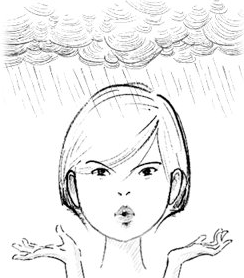
This morning, I woke up to a world enveloped by a thick white fog.

I stood behind the porch, still half awake, staring at the dim sky and the hazy rows of the neighbors’ flat. For a second, I thought my vision was blurry. Feeling a bit cold, I went to the kitchen and made myself a cup of tea; sipping it while sitting on a blanket by the window, watching the fog fading away ever so slowly.

As layers upon layers of fog melted away, giving way to the sun, I felt as if a certain heaviness had left my mind—parting an invisible curtain and enabling me to see things with a certain clarity.

I had been feeling a bit ‘foggy’ the whole week.

I had just completed a 21-day road trip two weeks before. Upon arrival, the first thing I wanted to do was just chilling at home for a few days, doing nothing to compensate for hours upon hours of being constantly on the road. But this ‘compensation period’ went longer than the original plan.

For the next few days in the past week, my heart was heavy.

Every morning, I needed to really whip myself to sit in front of my working desk—and actually work (and on most days, I started very late). After wrapping things up and meeting the deadline, I threw myself on the couch with a gray cloud hovering above my head. I, halfheartedly, flipped the pages of some books, played a Podcast I didn’t listen to and scrolled my social media feed mindlessly.

Probably it was something like a post-road-trip syndrome. Or a mid-thirty crisis. Or a PMS. But I started questioning why I am still doing the things I’m doing now, about where all these things are heading towards, about why I have so many options but cannot seem to pick and stick to one. 

My future seemed far and foggy, and I couldn’t seem to get this feeling out of the way.

Until I started writing.

I had a difficult start at first.

It was one of those days when you sat in front of your computer, wanting to write but couldn’t seem to start. It was one of those instances when you had a pen in hand but your hand refused to move an inch. It was one of those moments when you had so many things to tell, to share, to explore; but you were staring at a blank page on your notebook instead.

The good thing was that years after years of struggling with this had taught me how to trick it.

Here are the 5 tricks I use to start writing (even when I don’t know how to begin).

The goal?
To fill up that page in your screen or notebook, so you don’t have to stare at a blank space any more.

ONE.
THE MAGIC OF FREE WRITING

Set an alarm for 3, 5, 7, or 15 minutes, then go crazy. Just write anything that crosses your mind about the thing you want to write about. Don’t stop. Don’t think. Just be honest. Following the advice of Natalie Goldberg, start with: I want to write about… and keep going. If the things you write turn out to be strange, chaotic or don’t make sense, you’re doing it right. Keep going. If you’re feeling like going too far off-track, write another line of I want to write about…  and keep writing.

TWO.
QUESTION EVERYTHING

What do you want to write about? Instead of thinking about how to start writing that particular thing, ask yourself some questions. Who is this character? Why do I want to write about this? Why is his/her story important? Why I want a happy ending? List down at least 9 questions, set your timer for 3 minutes per question, then start answering them one by one.

THREE.
GENIUSES TALK TO THEMSELVES

Grab your phone and record yourself talking to yourself about this thing you want to write. Imagine as if you were sharing a piece of your mind with a trusted friend. Imagine this friend encouraging you to keep talking. The friend will ask: “Why? Tell me more. What is it about? Can you explain it a bit more?” Record for 10, 15, 20, or 30 minutes. As long as you need. Done? Transcript this ‘conversation’ into the paper.

FOUR.
PLAY SURGEON

Take your favorite book, article, or blog post. Read it and dissect it like a surgeon. Break the paragraphs and start digging for the structure. For instance, paragraph 1 – starts with how she missed the train (disaster!); paragraph 2 – she told the story of why she missed the train (back story); paragraph 3 – a dialogue showing her emotions about almost being late (conversations). You can also break it into something more simple like opening – how it begins – body/message – how it ends – closing. When you’re finished, you should see a certain skeleton showing how your favorite piece has been structured. Borrow that structure, and start writing according to this skeleton.

FIVE.
POST-IT, POST-IT ON THE WALL

This might be the greatest of them all. Get a bunch of Post-It notes. On each one, start writing one simple sentence about anything that comes to mind; related to the piece you want to write about. For example, Post-It 1, the food I eat | Post-It 2, the taste of the food | Post-It 3, the location of the restaurant | Post-It 4, the ambiance of the restaurant | Post-It 5, the waiter said something funny, and there you go. Basically, write down each sentence/scene you have in mind about the thing you want to write about. When you’re done, stick the Post-It notes on the wall. Arrange and rearrange the notes, swapping the order to get the best flow from the beginning to the end. When you’re satisfied, begin writing from the first note.

That day, I didn’t write about the things I want to write about.

I didn’t write a blog post or an article or a short story.

I wrote about my life.

About how I feel. About the questions swirling inside my mind. About my heavy heart. About my fear of having to navigate my way to a foggy future.

I went for trick 1 and 2 because naturally, they seemed like a good fit at that exact moment. And they helped me. As I layered sentences upon sentences on the page of my notebook, I could feel my burden getting lighter and lighter. Something had found its way out of my heart, out of my mind, out of the darkness of my being: right into the page.

I once wrote about the reason why I chose writing as my medium of expression (or about why writing chose me). It’s strange, though, how in some particular crossroads of my life there were always moments when I was fed up with writing. I felt as if writing ‘consumed’ too much out of me. At times, I was tired of it, feeling like I’ve had enough.

And I always find this somewhat ironic.

Because even though at certain times I was repeatedly tired of writing, writing never seemed to get tired of me. Even when I was ready to give it up, it had never given up on me. Somehow, writing always finds its way through the dark, and like a patient and passionate lover, lures me back to fall in love with it; over and over again.

hanny
WANT TO SHARE WITH SOMEONE WHO NEED THIS?

This was the thing that didn’t go as planned: we’re supposed to reach Munich, Germany, in 8 hours.

It was Friday afternoon—the first day of our 21-day road trip in Europe. We were supposed to pick up our rented car earlier at Schiphol Airport, Amsterdam, but we went into some last-minute frenzy and arrived a bit later. When we left Schiphol, already behind schedule, it started raining. With thunders.

We applauded ourselves for ‘leaving this rain behind’ and decided to adopt our happy, sunny summer mood. So off we went, accompanied by Despacito blaring from the stereo.

We should be in Munich by 7 PM. Or maybe, on the pessimistic side, 9 PM. But the reality was this: we didn’t reach Munich on our first day.

Entering Germany, we got caught in a horrible traffic jam.

I told D that the traffic jam made me feel as if I was on Jagorawi highway, back in Jakarta. I never thought there could be such a long and massive traffic jam in Germany. Sure, we started off in the middle of July, when summer vacation was in full swing and everyone was out with their campers and caravans. But there must be something more than this.

We sat in the traffic jam for hours: talking, singing, making jokes, and trying to find some means of entertainment until we got tired of them all. We also found out the culprit of the traffic jam: massive road works.

The good news was that recently, in June, the EU was set for free-roaming. This means we can use our Netherland or Italian SIM card to access the Internet without any roaming charges, all across the EU!

With the help of Google Map, we decided to find a detour—leaving the highway to avoid the road works. This detour led to another detour since the alternative road suggested was also undergoing road works and (un)welcoming us with roadblocks.

At the end of the day, we found ourselves being on a detour of a detour of a detour, driving along small and winding countryside roads.

That was when we realized that we would not be in Munich by the end of the day. Surrendering to this, we decided to adjust our plan and tried to find a place where we can camp, put up our tent, and sleep for the night before continuing our journey the morning after.

That day, we ended up in a small town called Frickenhausen.

Early in the morning, we left the camping ground and found out that the highway was not getting any better.

The traffic jam was still as bad as yesterday, so we had no choice but to leave the highway and once again, took the small countryside roads. This wasn’t all that bad, actually. I had to admit that I liked it more than the boring highways.

Sure, you would need to drive slower and it might even take a longer time to reach your destinations, but I love the view from the window of my passenger seat. The houses, the farms, the hills, the fields, the mountains, the charming old towns… I thought suddenly I understood the meaning of the sayings: the journey is the destination. It’s the moment when you stop counting the hours to your point of arrival; realizing that you are somehow enjoying these in-between hours to get ‘there’.

And then, I screamed.
I screamed when everything turned yellow.

We passed rows of sunflower fields!

Not many people are aware of this, but I have dreamed of standing in the middle of a sunflower field since I was a child.

For this reason, I love sunflowers. When I started a photography business with a friend of mine a few years ago, we called it Sunday & Sunflowers. We launched the business by sending pots of sunflowers to our friends and colleagues.

So, I was smiling and laughing and screaming uncontrollably when we were passing a random town that day and seeing sunflower fields along the way! It was like finally having your childhood dream in front of your eyes! Seeing this, D stopped the car in a quiet patch of road, and let me absorb the beauty of the flowers while jumping and dancing around happily.

I didn’t walk to the middle of the field, though, because the sunflowers were planted very close to one another and I was afraid that I might harm them. I just walked around back and forth sniffing the sunflowers and jumped backward in surprise when a huge bee was buzzing from one of the flowers, almost kissed the tip of my nose. I giggled. My heart was filled with a simple kind of joy, a simple kind of happiness.

Maybe, sometimes, things don’t go as planned because we need a detour.

Because maybe, if all goes well, we won’t see the things we would love to see, we won’t experience the things we might be happy to experience, or we won’t grow to be the person we could have been. Maybe things need to go wrong before it can get right. Maybe we are forced to go on a detour because we are too comfortable riding along the wrong path. Maybe it’s about surrendering instead of fighting, about trusting instead of fearing.

I could recall one moment in life when everything seemed to go wrong, then stumbled upon a saying that there is no wrong path in this life and that all roads lead to homeWith that being said, even when things seem like they don’t go as planned, they actually do.
They always do.

It kind of rings true to me, and more than everything, I want it to be true.

Because sometimes, what it takes to believe is simply believing. And I want to believe that a horrible traffic jam, a plan that goes awry, and a detour of a detour of a detour, would only lead me to my sunflower field.

I wish you all a happy summer. And may you, too, find your sunflower field anytime soon.

hanny
WANT TO SHARE WITH SOMEONE WHO NEED THIS?

Bernard Batubara (Bara) is an Indonesian author living in Yogyakarta, Indonesia. He begins his writing career as a poet. Today, his works have been published in newspapers, literary magazines, literary web portals, as well as several anthologies with fellow authors. His books are Angsa-Angsa Ketapang (2010), Radio Galau FM (2011), Kata Hati (2012), Milana (2013), Cinta. (2013), Surat untuk Ruth (2014), Jatuh Cinta Adalah Cara Terbaik untuk Bunuh Diri (2014), Jika Aku Milikmu (2015), Metafora Padma (2016), Elegi Rinaldo (2016), and Luka Dalam Bara (2017). Radio Galau FM and Kata Hati are now major motion pictures. He occasionally gives lectures on creative writing in high schools, universities, and communities.


How does Bara—the writer—see love and heartbreak in his writings?


Bara: My first novel draft was a love story. I wrote it when I was in junior high school. It was about the life of a rebellious high school student and a love story that blossoms with a classmate. A cliché, I know. Like a template. But it was only this kind of story that crossed my mind the first time I tried to write a novel. The draft was completed in 2 years.

I sent it to a big publishing company in Jakarta and got a rejection letter 6 months after.

At first, love-themed stories (and heartbreak; these two are actually a unit; it is impossible for each one to be written on their own) became the fuel for my writing. Simply because I felt that these stories were the ones closest to me. It was a theme I thought I understood the most. Actually, I wanted to write fantasy like Harry Potter novels, but all the monsters I could imagine already made their appearances there. I felt less imaginative to write fantasy and I didn’t read enough to write a historical novel. So, I wrote romance.

As time passed by, with 2-3 of my books were still talking about love, my readers (generally they are younger than me) labeled me: Bernard Batubara—the romance writer.

I started to be known (or seen) as a romantic guy because I write love stories. There was one time when I tried to ditch the label because it felt like I have been somewhat dwarfed by the market. I do possess other interests apart from writing love stories. However, now I accept it and think of that label (the romance writer) as a good opportunity to deliver various ideas outside my ideals about love itself.

My other books, although the ‘outer packaging’ is still revolving around love, are actually talking about a wide array of issues. I talk about illegal logging, horizontal conflict, social condition, law, modernism, urban living, existentialism, religion, and many more. Love stories are used as packaging, a prelude to my ideas.

One of the heaviest tasks for a writer is to make the reader feels connected to what he writes. Love (and heartbreak) story is the easiest material to get people to resonate with it. I use love stories as a bridge to talk about other things with my readers.

Bernard Batubara


How far do you process real-life experience into fiction?


Bara: At first, I thought one of the most important skills a writer should possess is imagination. Writing is about creating things that once did not exist. That’s the joy of writing.

However, lately, I feel as if I am not too clever in making things up. It’s easier for me to write about the things I have experienced.

I don’t need to find the scenes, characters, or situations that don’t exist. I need only to daydream for a while, remembering a situation or a scene from my past, then write about it.

Easy.

But of course, it’s not always easy to write about your personal experience. There were times when I didn’t want to remember the things I needed to remember. I want to write about the things I have experienced, but I don’t want to write them all.

However, censoring my memory means a betrayal to memories itself.

At the end of the day, I just face it. Anger, disappointment, sadness, all the negative feelings that surface when I remember certain parts of my memories… I learn about them. I dissect my memories. I ask myself why it happened this way or that way, to the point in which I am able to digest those negative feelings and understand them; while turning them into stories.

The first step to remember is by reminiscing the most important part of my experience. For example, if I am writing a love story based on my experience with my ex, I will remember the most impressive moment of our relationship. Usually, that part contains a conflict, and this becomes a conflict in the story as well. I will start writing them down. From here, I can move in many different directions. I can go forward, or backward to past experiences until those memories turn into a full write-up.

How far do I go? Radio Galau FM—almost all of it is based on my personal experience. Kata Hati only takes some ideas and conversations that happen in the real world. Cinta dengan Titik is about someone else’s experience (my friend). Milana, part of it is a personal experience, and the other part is not. And there it goes.

I am most straightforward in my latest book, Luka Dalam Bara. In some of my social media channels and talk shows, I told my readers that the book recorded my romantic experience with someone (most of them know who this someone is).


Someone says, write only for one person. Do you agree with this?


Bara: I would say that I am quite in agreement with that suggestion. It reminded me of one of my favorite writer’s advice, Kurt Vonnegut. He said, write to please just one person. “If you open a window and make love to the world, so to speak, your story will get pneumonia.”

Another favorite writer of mine, whose name I do not wish to mention here, once said that he writes only for one person: himself. I think I have done the same thing, writing only to please myself, and I did it because it’s easier than pleasing everybody. (Everybody means 7 billion people on earth? Scary)


All stories are love stories. How do you feel about this? Is this something you believe in?


Bara: Yes and no.

No, because there are good stories I have read, and the writer does not write about romance at all. Some good stories talk about war, violence, political intrigue, glum future world, and many more. Good stories are not always about love.

However, I think even in those stories where love-themes are avoided, at a certain point they will indirectly tell us something about love. Love becomes something subtle and inherent in the story of life, and this—at times, enables us to see love stories in novels that don’t fall under the romance genre. When I read 1984 by George Orwell, I read a love story between the protagonist and his female partner, although Orwell might want to tell a story about the forlorn future of humans.

All stories are love stories—this could be true for the previous reason: love is something inherent in life and it takes different shapes. We’re not only talking about eros love or platonic love but many different kinds of love. Just like it is impossible to write a story without a mention of human sufferings, it is also impossible to avoid bringing forth a love story, however subtle, in a story.

Bernard Batubara


As a writer, how do you see the difference between your male and female characters when they fall in love or heartbroken?


Bara: Male characters in fiction works I’ve ever read face their broken-heartedness in a way that is not too different from my male friends in the real world. First, they will deny it. Second, they find distractions. Third, they regret the things they have done. Fourth, they know it’s impossible for them to turn back time, so they’ll enter the next step. Fifth, they accept the fact that they are the real problem in that broken relationship.

The same goes for female characters. They’ll weep, mourn until their tears dry up, and in no time they find someone new to love.

I guess because fiction is a reflection and a result of contemplation of real-world events, the characters’ actions would not be that far different from what we have seen in the real world. These are also the things that make us feel connected to a novel or short story we are reading. We feel as if we are seeing ourselves (or our friends) in it.


How is your attachment to your works? How do you deal with compliments and criticisms?


Bara: I would think of myself as a writer that could move on easily when it comes to my work.

At the time a new book is being published, I no longer think about it. I am already focusing my mind on the next one. Sometimes, during talk shows, there were questions from readers about certain scenes in my book—and I had to dig my mind really hard to answer that—since I had detached myself quite far from that work.

I used to think of my published books as my children. In that sense, our relationship is like this blood-connection between a father and his children. But then, I thought, a good father could be one who lets his children grow independently and find their own ways to face the world. Furthermore, the world the children are facing is their own world—a world that is different from the world of their father.

My attachment towards my published works is limited to a chronological memory. Which book, published by when, or how I began writing that book… those kinds of things. But when it comes to emotional attachment or the like, I don’t think I have that kind of feelings inside of me.

I do not have enough energy to cultivate an emotional relationship with all of my works. Life moves forward and I invest my energy on my future works.

And speaking about criticism, I was once annoyed with the mocking of my works on social media. However, afterward, I realized that being annoyed had no benefit for me. So, that was it. Today, I think of all the responses to my work as appreciation. I only take into account inputs from people whose reading taste and thinking ability I trust.

The rest are just different forms of appreciation.

*) photos courtesy of Bernard Batubara
hanny
WANT TO SHARE WITH SOMEONE WHO NEED THIS?

One thing I love the most about my hometown, Bogor, is its proximity to the mountains. (Well, that, and the abundance of delicious street food). To me, beaches are lively and intense, forests are adventurous and mystical, but mountains are tranquil and relaxing. When I want to do nothing, I go to the mountains.

Tirta Arsanta Gunung Pancar

To do nothing at all is the most difficult thing in the world, the most difficult and the most intellectual.

—Oscar Wilde

A few days ago, I found my latest favorite spot for ‘doing nothing’ in Mount Pancar. I was surprised knowing that it was only 30-40 minutes away by car from Bogor, and the journey was free from traffic jams.

We drove to the mountain from Sentul Selatan exit; passing the posh residential complex and a gigantic amusement park before climbing further up until the road became narrow and bumpy. The sounds dimmed, the air cleared, the mountain top appeared, and we drove through the villages, further up, and further up. We stopped at Babakan Ngantai village and entered an establishment that looked like it could be someone else’s house.

Tirta Arsanta Gunung Pancar

Tirta Arsanta Gunung Pancar

Tirta Arsanta Gunung Pancar

Well, it is, to some extent.

The Hidden Gem of Mount Pancar.

Tirta Arsanta is a gorgeous family-owned hot spring retreat overlooking the mountain.

The place reminded me of those stories Indonesian kids wrote for our composition homework in elementary school: those stories about how we spend our fictional weekend visiting our fictional grandfather in a fictional village.

Only this time, the place is real.

Tirta Arsanta Gunung Pancar

Tirta Arsanta Gunung Pancar

Tirta Arsanta Gunung Pancar

The resort hosts four teak joglo villas—each with a private mineral hot spring pool—surrounded by gardens where bananas are hanging from its tree. The villas are rented for IDR 1.5 million on weekdays and IDR 1.8 million on weekends. However, the room is so spacious—and with extra beds, you can have 4-5 people sleeping there comfortably. Two private hot spring pools, each with a spacious seating area and private shower room, are also available for visitors who do not wish to spend the night at IDR 350K for 4 people.

Down below is a small river you can cross to reach the vegetable plantation and the pine forest. To get there, be prepared to say hello to the gouramis, the chickens, and the geese. If you’re lucky, you can also meet the friendly owner, Pak Faisol, and converse with him on various different subjects through the night.

Tirta Arsanta Gunung Pancar

Tirta Arsanta Gunung Pancar

Tirta Arsanta Gunung Pancar

Tirta Arsanta Gunung Pancar

Tirta Arsanta Gunung Pancar

Tirta Arsanta exudes a certain familiar warmth and smells of lemongrass. I was surrounded by the sounds of nature and the beautiful view of the mountain. Everything that came out from the kitchen tasted delicious: the crispy banana fritters, the pecel madiun, the grilled rice with salted fish, the kampung fried rice, the ginger lemon tea…

I sometimes wonder if eating our meal in a beautiful place can actually improve its taste.

Tirta Arsanta Gunung Pancar

Tirta Arsanta Gunung Pancar

I spent my time around the compound mostly barefoot, feeling carefree, and child-like. That day, I came with a book I wanted to finish, but at the end of the day, I was mostly just walking around, relaxing, daydreaming, and enjoying the view. Phone signal, like the Wi-Fi connection, was unreliable (the villagers use Indosat); but it was actually a good thing. I love to unplug every once and a while, as it helps me to rest and be still.

In the evening, Pak Henri—the manager of the resort, invited a massage lady from the nearby village. Bik Nur came to my room equipped with herbal oil and a sarong. The staff had prepared an extra bed for my full body massage; and after more than an hour, my muscles were so relaxed I felt like a jellyfish.

As the temperature went down, I stepped into the private hot spring pool by my villa’s terrace—feeling its comforting heat on my skin until sleepiness nudged me on the shoulder.

The Village of Hot Springs and The Pine Forest.

Mount Pancar is rich in hot springs. Near Tirta Arsanta retreat, there are 3 sources of hot springs the locals referred to as Red crater, Green crater, and Black crater. A 20-minute stroll from the resort, crossing the river, would take you to these craters. There was no strong sulphuric smell in the air, as the village hosts mineral hot springs, not sulphuric ones.

Tirta Arsanta Gunung Pancar

Tirta Arsanta Gunung Pancar

Tirta Arsanta Gunung Pancar

“You see, there are mosses growing here,” Pak Henri said when we visited the Green crater. “The locals believe that you can use it as a beauty mask. You can scrape the moss, add the mineral water from the hot spring, and blend it into a paste to be smeared on your face. After a while, it would harden and you’d feel as if your face was stretched out. Do you want to try? I can get some for you later when we’re back.”

“Sure!” I exclaimed. It would be an experience to get this local beauty treatment while I was there!

That morning, Pak Henri took me and my friend, Chyntia, on a hike to the craters and the pine forest surrounding the village. It was quite a mild hike (I was on my leather sandal), but the track could be steep at times. It took almost 3.5 hours for us to go there and back, but the hike offers lovely scenery of the vegetable plantations and the villagers plucking chilis and climbing trees.

Tirta Arsanta Gunung Pancar

Tirta Arsanta Gunung Pancar

Tirta Arsanta Gunung Pancar

Tirta Arsanta Gunung Pancar

Pak Henri, like all the staff at Tirta Arsanta, came from the village. During our hike to the pine forest, we made several stops at the villagers’ houses when the owner called out to him.

“We’re walking to the pine forest,” he said.
“Walking? From the resort? So far!” the villagers responded.

I was scared hearing this as I was reminded of the day when I got lost in Taipei’s Yangmingshan National Park, looking for hot springs. At the time, tired and sweating, I stopped by a police station to ask about the exact location of the hot springs, but it seemed like the police officers could not explain it in English.

They could only say, “Ah, far, far.”
When I asked, “How far?”
The police officers replied by extending their hands, and said: “Faaaaaaaaaaaaaar.”

But the pine forest was not that far, and we reached it in another 30-40 minutes. The forest is where the locals go for dating or family outings. “I don’t know why they love it here,” said Pak Henri. “I mean, there’s nothing here but trees.”

Tirta Arsanta Gunung Pancar

Tirta Arsanta Gunung Pancar

Tirta Arsanta Gunung Pancar

But Chyntia and I loved it there. The breeze was lovely and the view was beautiful. We walked around the area, posing at a huge rock, and watching a ladybird. Chyntia also found a green pinecone. It made me feel as if I was transported to a scene from Ghibli’s My Neighbor Totoro.

Tirta Arsanta Gunung Pancar

Tirta Arsanta Gunung Pancar

Tirta Arsanta Gunung Pancar

Tirta Arsanta Gunung Pancar

A Soak in Time.

The best thing to do after a hike was dipping our sore feet in the refreshing water of the river; had some breakfast, and then retreated to our villa for a hot spring soak by the terrace. Pak Henri had prepared our traditional moss-mask from the hot springs, so Chyntia and I started our DIY beauty treatment by the pool. I could feel how strong the moss-mask stretched my skin; although the application made our bathroom quite messy and muddy (sorry, Pak!).

Tirta Arsanta Gunung Pancar

Tirta Arsanta Gunung Pancar

Tirta Arsanta Gunung Pancar

Tirta Arsanta Gunung Pancar

Maybe the time spent ‘doing nothing‘ can actually be a time well-spent, even if it’s just a day!

Lately, I am so used to long-term travels—in which I am actually working while traveling. It is fun, yes, and I am grateful for the opportunity; although to be honest, at times it can also feel intense and tiring. Pausing a reset button for a day; doing nothing but enjoying nature and having a relaxing time with a friend was actually reinvigorating.

For a day, forget Facebook and Instagram. Get your feet dirty. Smear muddy moss-mask on your face. Smile to the villagers as you pass by. Smell the lemongrass. Sweat as you hike. Jump into the river. Soak in the hot spring. Slow down.

And then, be still.

hanny
WANT TO SHARE WITH SOMEONE WHO NEED THIS?

I am very protective of my mornings.

One thing I appreciate the most about working independently is the flexibility that comes with it: the flexibility to manage my own time based on my own pace. For me, this means protecting my mornings.

Naturally, I wake up early; as soon as there is sunlight in the room—which is why I love to sleep with my curtains and windows open. But I love to take my time in the morning. To go slow. I spend some time just lying in bed, feeling the way my body tingles with life after an 8-hour rest and remembering my dreams. Then I would reach out to my bedside table, grab a book, and start reading. I reserve at least the first 2 hours in the morning for myself: reading, writing in my journal, having coffee, dancing, or listening to uplifting or inspiring talks and interviews.

For this reason, I love late breakfast. I don’t like to prepare some food or fill myself up first thing in the morning, so breakfast has to wait. Until later. Until around 10.

Some mornings deserve a big hearty breakfast.

Those mornings are not meant for instant coffee and leftovers, yogurt and granolas, or apples and bananas. They are the kind of mornings when you are craving to be pampered with food. Good ones.

You know exactly when you experience these mornings from the time you wake up. You could be very sad, very happy, very tired, very energetic, very heartbroken, or very much in love; but you know that you just want to start your morning by slouching in someplace nice, ordering a full breakfast served in a beautiful plate with beautiful presentation, and sipping a good cup of coffee. A big cup of coffee.

breakfast in ubud

breakfast in ubud

breakfast in ubud

When I woke up groggy one morning, D suggested that we have it: that big hearty breakfast. Not knowing that by asking me to eat, he already lifted up my mood level a notch.

“Pick a place,” he said. “And we’ll go there.”

My ‘Secret place’ pick for breakfast in Ubud.

D and I have this thing about ‘secret places’. On slower days, after clearing each other’s schedule for the day, one of us would exclaim: “I am going to take you to a secret place today!”

A ‘trip’ to a secret place means:

  1. it is a place we have never visited together before
  2. it is either a beautiful place or a place offering a beautiful experience
  3. we will spend some time there relaxing and lazying around
  4. the person suggesting the secret place would offer to pay

That particular morning, for the big hearty breakfast, I decided to choose a ‘secret place’.

There was this cafe called No Mas in Ubud‘s Monkey Forest Road that we frequented in the evenings to catch up with friends. Below the cafe, there was this hipstery-looking place called FOLK. Usually, it was already dark and closed when we’re about to have some drinks at No Mas.

breakfast in ubud

I read some online reviews of the place and found quite a bunch of surprisingly mouth-watering testimonials. So, I told D to drive to No Mas; because our secret place for breakfast in Ubud would be ‘nearby’.

breakfast in ubud

I always opt for good food, not Instagrammable food.

When our order came, they looked exactly like Instagram food. So pretty and neat and clean, carefully carrying all the right color combination to look wonderful on my camera. They even came with edible flower petals. And the portion was quite big.

breakfast in ubud

breakfast in ubud

Imagine our surprise when instead of simply looking good, the food actually tasted delicious!

The good reviews were spot on!

We had the epitome of a big hearty breakfast: toast, poached egg, bacon, spinach, potato, and beans—and also a healthier version of toast, poached egg, avocado, and feta cheese. Plus a cup of cappuccino and latte. Each element of the dish is delicious in itself; each one a bomb of flavors, even when tasted separate.

A good hearty breakfast can always make my mornings and lift up my mood. And that day, I must have chosen a good secret place.

breakfast in ubud

breakfast in ubud

breakfast in ubud

Folk Kitchen & Espresso
Jl. Monkey Forest, Ubud, Kabupaten Gianyar, Bali 80571
hanny
WANT TO SHARE WITH SOMEONE WHO NEED THIS?
Sunset Spot in Ubud

Are you the sunrise type, or the sunset type?

I have been sharing a room with Mumun from the travel blog Indohoy during some of our trips, and before bed, she always said enthusiastically, “Let’s wake up early tomorrow and watch the sunrise!” – to which I responded with: “Well, let’s see tomorrow.”

Usually, the next day, we would open our eyes at around 7—looking at each other sleepily, still curling in bed, our stomachs growling, craving for breakfast. Nobody mentioned the sunrise that has completely risen by then.

So, let’s just say that I’m more of the sunset type.

Sunset Spot in Ubud

My latest sunset spot in Ubud.

Apart from the Tjampuhan Ridge, lately, my favorite sunset spot in Ubud is hidden just in the midst of its center. A few meters across Bisma Street, before the entrance to Tjampuhan Ridge, a rocky uphill path takes you to a narrow alley leading up to Subak Sok Wayah. There, a winding narrow track awaits: lined with cafes, guesthouses, and shops selling paintings and souvenirs on the left, and rice fields on the right.

Sunset Spot in Ubud

Sunset Spot in Ubud

Cafes and restaurants with sunset views are plenty along the track, perfect to wind down after a stroll around Ubud. A small cafe even offers a reading of your Vedic charts—could be a fun pastime for the curious! I personally love waiting for sunset while reading on Kindle at Sari Organik or Cafe Pomegranate. They are located not too far away from one another.

Sunset Spot in Ubud

Sunset Spot in Ubud

The Golden Hour.

There is something magical with the lights at this hour. When I was little, I used to think that sunset was a gate to another realm. There must be a door somewhere behind those beautiful lights, leading up to an enchanted forest with imps, fairies, and talking animals. As a grown-up, I still get the chilling excitement of watching the sun goes down; still having the feeling that I have just been transported ‘somewhere’ without actually moving, or leaving.

The In-Between.

My friend once told me, that we can feel the Divine between our breath: that tiny moment in-between inhaling and exhaling. There are many in-between moments in our daily lives: when we walk, in-between the changing of our left and right foot; when we brush our teeth, in-between the moment when the brush leaves and touches our teeth; when we eat, in-between the tasting and the swallowing of our food.

In watching sunsets. In-between light and dark: that tiny window into the magical world of a pivotal moment when eternity sneaks in through something so mundane and temporary.

Sunset Spot in Ubud

Sunset Spot in Ubud

SARI ORGANIK
Address: Jl. Subak Sok Wayah, Tjampuhan, Ubud
Phone: (0361) 972087

CAFE POMEGRANATE
Address: Jl. Subak Sok Wayah, Ubud
Phone: 0878-6080-3632

hanny
WANT TO SHARE WITH SOMEONE WHO NEED THIS?
Hanny illustrator
Hi. I'm HANNY
I am an Indonesian writer/artist/illustrator and stationery web shop owner (Cafe Analog) based in Amsterdam, the Netherlands. I love facilitating writing/creative workshops and retreats, especially when they are tied to self-exploration and self-expression. In Indonesian, 'beradadisini' means being here. So, here I am, documenting life—one word at a time.

hanny

TAKE WHAT YOU NEED
VISIT THE SHOP