Hello, there.

If you are following me on Instagram, you might have known that this year, I’ve been picking up a lot of creative projects in my spare time. Or maybe, I have really positioned my creative life on the top of my priority list. I started to pick up some of the things I have abandoned before, including painting, crafting, creating art, and journaling. Interestingly, these are the things I have always enjoyed doing when I was little.

ON JOURNALING IN A PHYSICAL NOTEBOOK

I have filled in several journals (from cover to cover, around 15 books all in all) in my life, especially during my teenage years. I always believed that writing keeps me sane, and journaling helps me navigating my chaotic life during many of my coming-of-age episodes.

When blogging came into the picture, I started using it as a platform for me to post my chaotic thoughts, building what might later turn out to be a ‘digital journal’. However, I have to admit that I miss the act of journaling on a physical notebook: seeing the way my handwriting changes, seeing the tear-stained pages, or festive fonts on celebratory days. There are certain emotions that digital platform—like blogs, or even Facebook Memories—could not evoke in me; the way a physical journal could.

These days, when I flipped some of my teenage journals, I could also remember those happy days of going to a stationery store with my mother to pick a new book. I could still feel the giddy feeling, the excitement, and the confusion of having to make decisions upon seeing those beautiful books and diaries. In the end, I could only pick one—the one that ended up coming home with me: becoming the source of my anger, sadness, happiness, and frustrations.

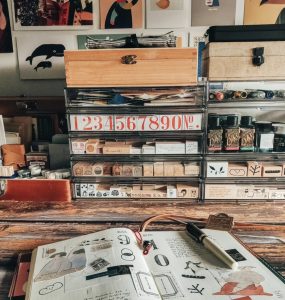
This month, I picked up journaling again, diligently. I got myself a Midori Traveler’s Notebook that I had been eyeing for more than 3 years now (always postpone yourself from buying things immediately; this is how you know if you really want something!); and started writing. I also have my daily bullet journal on the side (a cheap notebook I bought at Miniso), but the Traveler’s Notebook soon becomes my mood-lifter journal (the one you see in this post, where I collect things that can lift up my mood) and my travel journal (because those pictures and mementos got lost in the digital world).

I also started journaling while scrapbooking and making collages; then learning how to press flowers to be pasted on my mood-lifter journal. It feels so good to finish a spread and re-reading my life as I flipped through the pages.

Do you think you’d like to start a habit of journaling as well?

JOURNALING 101: SO YOU WANT TO START JOURNALING?

If you’re thinking of starting a journal or documenting your life in a creative way, here are some tips I have for you:

1. Start with a thin + cheap journal/notebook, and fill it in from cover to cover.

Don’t make a mistake of investing too much before picking up a new hobby. Try it out first. Who knows, maybe you don’t like it, maybe it’s not for you, maybe you lose interest quickly. If you want to start journaling, just pick up a notebook you already have (you can redecorate the cover and the pages) or get a cheap and thin notebook (around 48 pages).

Once you have this book, fill it in from cover to cover with anything: words, quotes, pictures, thoughts, candy wrappers… anything. But, finish the book. It may take you one day, one week, or one year. It doesn’t matter. The goal is to finish it. If you can fill it in from cover to cover, it’s a sign that you’re in for the journaling journey.

Only then, allow yourself to get a new journal you’ve been in love with.

2. Start with anything but a bullet/daily journal.

Keeping a bullet/daily journal can be a daunting task because you feel as if you need to write on it every single day (actually, you don’t have to—but I’ll talk about my own bullet journal style another day).

The original system, however, works beautifully when we are committed to logging in our notes on a daily basis. For me, the downside was the feeling of ‘failure’ when I missed a few days—leaving a gaping hole in my bullet journal. Somehow, there is a feeling of ‘ruining it’ and the feeling can linger for quite some time, making me feel somehow demotivated.

Or maybe that’s just me.

But if you’re also the kind of person who would feel that way, don’t start with a bullet/daily journal. Try to keep a journal that you can fill in whenever you feel inspired; something that won’t burden you with daily commitment.

I would suggest turning your 48-page journal/book into:

  • A gratitude journal. Where you list down all the things that make you feel grateful. You can also paste gift wrappers from a gift you received, pictures of your friends and families, as well as writing down happy events/moments in your life.
  • A mood-lifter journal. Where you can collect things that lift up your mood, like your favorite songs, quotes from a book you love, pictures that evoke a happy feeling inside of you, a letter from a lover, pictures from your last traveling journeys… anything. The idea is to have a collection of things that will make you smile when you see it again in years to come.
  • A dream journal. Where you can dream and design your ideal life. What would you be like? What would you do? Who are you with? Where would you be? How would you feel? It’s amusing to play this game and start filling the journal with your vision of an ‘ideal life’. Don’t forget to include every aspect of your life: family and friends, career and study, spirituality, health, and many more. Isn’t it nice to flip the pages of this journal every morning, to remind you of where you’re heading in life?
  • A learning journal. Where you can write down the lessons you’ve learned in life. These lessons can be an experience you’ve been through, an advice from someone you respect, a quote that speaks to you from a book, a movie with a certain message that is relevant to your situation, or simply new things you learned from the Internet.
  • A letter journal. Where you can write unsent letters to different people in your life. If you tend to avoid confrontations and like to repress your feelings, writing an unsent letter is a great way to channel your feelings and say the things you wish you could say. Or, you could also write a letter to a singer you like, a movie star you adore, a random guy you’ve seen at a coffee shop, a great-great-great grandmother you’ve never known. Let your imagination go wild.

Surely, the ideas are endless. But you got the point. Start a journal that doesn’t need your daily commitment, yet. At least, not until you’re ready to commit. The goal is, again, to fill in your book from cover to cover! The feeling of completion is a great feeling that will get your confidence-level up when you want to take up daily journaling later on.

3. Find a friend or a community.

Picking up journaling as a (potential) hobby doesn’t have to be a lonely feat. You can find some friends who love journaling and organize a Journaling Day-out where you compete to fill in your 48-page journal as fast as you can. Or find some videos on YouTube to get your dose of inspiration; and follow people who journal—just like you. Being surrounded by people who share the same interests with you (even online) can make you feel motivated and inspired.

START WITH WHATEVER FEELS NICE TO YOU

Fill in that 48-page journal however you like it. Don’t think too much. Take it as a personal project, as a practicing canvas. You don’t need to show it to anyone. Treat it as your experimental journal, to see how you’re approaching the art of journaling.

Get yourself used to making mistakes. Don’t worry about smeared pages, crumpled edges, blotted ink… remember, your task is only to fill in your journal from cover to cover. Just let yourself loose, and be honest. Pour your thoughts and feelings on the pages. The more you journal and make mistakes, strangely, you will gain more confidence. The more you hate the spread or the pages you’re working on, the more you’ll know what you like.

One day, there will be a time when you’re working on a spread in your journal and love it. Maybe it’s not perfect, but you feel like: this is it. And that’s usually the day when you know that you’re ready to take journaling as a new hobby.

Until then, your life is a story.
Write it down.

PS: I am conducting a reader’s survey on this blog here. If you have time, would you kindly help me to fill it in? I need to hear from you! :*
hanny
WANT TO SHARE WITH SOMEONE WHO NEED THIS?

After spending more than 5 years going back and forth to Bali (well, Ubud, to be exact), I have finally found some of my most favorite body care products that are made in Bali. I had a great amount of time illustrating them as well, so here are 7 of Bali body care products I personally love!

1. ALAM ZEMPOL SOLID PERFUME: BERGAMOT

I have been a fan of their solid perfumes for years! Each one comes in a small tin can that can be easily slipped into my wallet, jeans’ pocket, or handbag. I always bring one with me during international flights as well (due to security checking, it’s too much of a hassle to have liquid perfume in my bag).

However, what I love the most about their series of solid perfume is the soft, faint, and fresh fragrance. Every time I smell it, I feel as if I have just gotten out of a shower. Rose, Jasmine, and Frangipani are also some of my favorite fragrance from their collections. However, the Bergamot is currently my favorite!

2. BALIPURA AURIC SPRAY: PURE LOVE

I love spraying Balipura Auric Spray as face/body mist after exposing myself to the hot Balinese sun. Well, actually, this one is ‘marketed’ as a ‘healing spray’: made from holy water, blessed by a Balinese priest, and infused with crystals. Thus it helps to ‘cleanse’ your aura.

Despite this backstory, I simply love the way this spray feels on my skin; as well as its muted fragrance. Pure Love has always been my favorite fragrance. Besides, who doesn’t need a bit of pure love every now and then?

3. DUKHA SUKHA MINERAL DEODORANT: SOOTHE

This mineral deodorant has been my life-saver! In principle, I do not like gelly/liquidy deodorant with fragrances. I prefer the powdery ones, but most of the times, they stain my clothes. Dukha Sukha is a mineral deodorant without fragrance (although they come in three types: pale pink-Soothe, pale yellow-Glow, and pale green-Fresh).

To use it, simply wet the mineral with water, and use it like you would use a usual roll-on deodorant. And I have to tell you that this deodorant has helped me to clear the dark skin underneath my armpit; due to shaving. After a year of using it, I was surprised to see that my armpit’s skin has returned to its original shade! This deodorant is quite expensive but it can actually last for about a year.

4. UTAMA SPICE ESSENTIAL OIL: LAVENDER

Utama Spice has always been my go-to brand for essential oils. First, because they are working with local farmers. Second, because their price is quite reasonable. Third, because their oil is not too thick or more diluted than the more expensive (or serious) brands. For me, these reasons are enough to choose their essential oils for casual use.

If I have to choose one essential oil, Lavender would be it! I can use it to cure acne/pimples, repel mosquitoes, make a body spray, or put a few drops of it on my pillow for a good night’s sleep. (I also love to use this oil as a vaginal wash!). Don’t forget to dilute your essential oil with other carrier oil/water before using it!

5. DROP BALI VIRGIN COCONUT OIL

I love virgin coconut oil and I am not too picky about it. Most of the times, any brand will do. However, Drop Bali is definitely my favorite. Not only because it comes in a beautiful glass bottle (with a pipette!), but also because of its smooth texture and faint coconut fragrance. It feels as if their coconut oil is being absorbed more quickly when I applied it to my skin.

I use virgin coconut oil as body lotion, toothpaste, face/make-up cleanser, moisturizer, scrub (add some salt or coffee powder), lip balm, hair conditioner, and after-sun lotion. Sometimes, I also use it for oil-pulling. It is very versatile!

6. NADI’S HERBAL FACE CREAM: BALI MOON

This face cream does magic to my skin! I use it at night, before going to bed–and I always find my skin so supple and moist in the morning upon waking up. True, this face cream is very oily. Truth to be told, the moment after you’re applying it, your face will shine like fries. For this reason, I only use it before bed. But maybe this ‘oily’ feature is what gives the cream its magic?

The face cream contains some Ayurvedic ingredients like Amla and Tulsi oil. Amla (gooseberry) is believed to be rich in antioxidants and vitamin C; thus can help to tone and tighten our skin, make it firm and soft. Tulsi (sweet basil) oil has anti-inflammatory property to deal with skin irritations and acne. It also has a soothing and relaxing effect.

To date, this is the cheapest face cream I’ve ever used in my life. I’ve been using this (and only this, without other products apart from coconut oil and sunblock) for my face for more than 4 years now.

7. BALI ALUS MASSAGE OIL: CEMPAKA (CHAMPACA)

I love Bali Alus’ massage oil because of its faint fragrance and its smooth feeling when applied to the skin. The oil helps my fingers to slide smoothly when I massage my shoulder, arms, or legs early in the morning, or before my evening shower.

Cempaka (champaca) is my favorite fragrance so far because it truly reminds me of the smell of Bali! Sometimes I also use it as a moisturizer before bed, dabbing it a bit on my knee, elbow, and the sole of my feet.

Where can you find these Bali body care products?

Some grocery shops in Bali, like Bali Buda, Coco Supermarket, or Down to Earth Market have it. Or, the best way to get them is by ordering them online via your favorite e-commerce platform!

hanny
WANT TO SHARE WITH SOMEONE WHO NEED THIS?

DIGITAL NOMAD LIFESTYLE: CAN THE HYPE BE JUSTIFIED?

Is this so-called lifestyle overrated? Possibly.

I think there’s a certain debonair feeling attached to the idea of being a digital nomad. Being able to work from ‘anywhere in the world’ sounds fun, young, adventurous, and carefree. But is it? Or have we seen things from a rose-tinted glass? Glamorizing and romanticizing a particular kind of lifestyle that, we believe, would make our lives better, happier, and richer?

About four years into being a location-independent creative consultant/writer, I noticed that ‘The Lifestyle’ has been strongly associated with the idea of embracing freedom, endless traveling, and making money out of the Internet (including your blog, YouTube, or Instagram).

Most recent graduates I talked to are curious about how they, too, can adopt this lifestyle. Being able to work-from-anywhere has become their ultimate life goal (that, and being in a relationship). Some of the most recurring questions I got from time to time include:

How can I get paid to travel? 

How can I find a job that will allow me to work from anywhere? 

How can I be an ‘online influencer’?

Or for those who are already employed:

Should I quit my job to travel and be a digital nomad instead?

At some point, as these questions started coming in more frequently, I began to think that maybe (just maybe), there have been some misconceptions about this location-independent lifestyle and being a digital nomad. And maybe (just maybe), I can give another perspective to the many layers of this lifestyle based on my own experience.

But before we begin, let’s make sure that we’re on the same page.

Photo by Adam Wilson on Unsplash

Here is what Wikipedia says about being a digital nomad:

Digital nomads are a type of people who use telecommunications technologies to earn a living and, more generally, conduct their lives in a nomadic manner.

Here is what Daniele said about being location-independent:

To be location independent is not about having the freedom to travel, but the freedom to be anywhere you want (or, most importantly, NEED) to be.

With these being said, if you know someone who wants to adopt the digital nomad lifestyle, or has always been aspired to build a location-independent career, feel free to share this post with them.

***

1. WHY DO YOU WANT TO WORK FROM ANYWHERE?

Do you have the need/urge to do remote work, be a digital nomad, or be location-independent? Or do you merely want the freedom to travel more or longer?

I think this is the first question that you need to ask yourself. Do you want to adopt this lifestyle only because seemingly it will give you more chance and freedom to travel—or because you have the need or the urge to do it?

There are two reasons why I’m now working as a location-independent consultant/writer.

First, after my mother passed away a few years ago, my father lives in our family house all by himself. I want to have the freedom to be with him whenever I could; or should. For instance, when he got hospitalized for a few days and had to go for a series of physiotherapy last year, being location-independent allows me to be with him when needed: preparing healthy food, accompanying him to the therapy unit, and looking after his day-to-day progress for about two months.

I could imagine how stressful it would be if I were still working full-time in a corporation. Of course, I could apply for leave, but what if workloads were crazy, or if my teammates were also on holiday? What if I would still need to commute now and then to meet clients? And is it even possible for me to take a 2-month leave without feeling (or looking) bad? I don’t know.

But being location-independent allows me to be where I need to be. It gives me more flexibility to focus on what’s important or urgent at certain moments in life.

Second, after working for more than eight years in a communications consultancy (which I loved), I started to ask where it would lead me to. My last position was the Creative Director—a post I had been dreaming of since I was still in college. So, it was only natural for me to ask, where could I go from here? What would my career ladder look like from this point onwards? Where would I be if I continue this career of choice for another 5, 10, 15 years?

I could dream of something like a Managing Director, Vice President, Regional Director of a global communications agency, or maybe an owner of my own communications consultancy or creative agency. If everything goes well (and smooth), that’s how my career ladder would finally progress.

Then, I realized one thing: I don’t want them.

The images of those positions and possibilities do not excite me. The idea of managing hundreds of people or owning a successful agency is not something that amuses me.

I merely want to create things. I want to come up with excellent write-ups or meaningful stories. I want to tell stories that matter and to do something kind. I want to teach, to share the things and skills I’ve learned throughout the years. I want to do this based on my values, my interests, and the things I believe in—together with people I like and respect.

I decided to quit my job so I can do more of the things I have always wanted to do. Being independent also gives me more opportunities to work with smaller companies, individual clients, or NGOs, that could not afford to work with big consultancies.

These are my two reasons for choosing the location-independent lifestyle. What about you? What are your reasons? What are your whys? Do you have other reasons apart from wanting to travel more?

2. DO YOU SEE TRAVELING AS A BIG PART OF REMOTE WORKING?

Photo by Annie Spratt on Unsplash

Which one do you want? To work remotely and be location-independent, make a career out of traveling, or do anything as long as you can finance your travel?

Quite a lot of people I talked to would mention ‘traveling’ when asked about remote-working, being location-independent, or being a digital nomad. However, the truth is this: being location-independent or being able to work anywhere, does not mean that you have to travel regularly. You don’t. This also doesn’t mean that you have to do things that are related to traveling, like being a travel agent, travel photographer, travel writer, or travel blogger.

We’ve mentioned digital nomads before. According to the Wikipedia entry, they are the ones who live their lives in a more or less nomadic manner. They like to move from one place to the next while making a living through the Internet.

True, some digital nomads are travel bloggers or have travel-related work, but some also do other types of work that can be done as long as there’s an Internet connection. There are therapists, developers, designers, accountants, consultants, teachers, psychologists, business owners, entrepreneurs, start-up founders, personal assistants, and many more. The possibility is endless.

Being a digital nomad also doesn’t mean that you have to be a freelancer or own a business.

Many digital nomads are employed by a corporation or an organization that allows them to work remotely. Some require them to go back to their headquarters a few times a year, some don’t—but these people are more or less free to work from ‘anywhere’. Based on how good you are, the nature of your work, and the flexibility of your company or organization, remote-working can always be an option to be discussed.

On another hand, there are people who adopt a location-independent lifestyle. They might not travel or move around so much, but if they want to, they can work from ‘anywhere’ they like. For some, this means working from home or a cafe. For some, this means working from a co-working space in a foreign country, a bus station, or a secluded beach (but seriously, working with your laptop by the beach under the hot sun IS NOT nice—plus, where is the charger?).

So the idea is more on the ability to work from wherever you need or want to, not on the traveling part.

Some people are not only looking into being a digital nomad or being location independent. Some truly want to make a career out of traveling because it’s something they love or are good at. This is where all those travel-related jobs come into the picture.

Some others just want to travel—and are willing to do any work that can help to finance their travel. For instance, you’ll meet some people who do volunteer work abroad in exchange for food and accommodation. Some work as bartenders, hostel cleaners, or fruit pickers to get some money in between their travel destinations to support themselves. (I am not going to discuss the issue of legality here).

The question would be, which one do you want?

3. DO YOU HAVE THE MEANS TO SUPPORT YOURSELF?

digital nomad

Do you know the risks of choosing this lifestyle? Do you have enough savings and skills to start doing this? Do you have the right attitude to approach the lifestyle? Do you have a plan? Do you have a backup plan?

If you want to be a digital nomad or simply be location-independent (where you can work from ‘anywhere’) there’s one thing we need to clarify: before talking about being able to work from ‘anywhere’, first, you need to make sure that you CAN work, from wherever you are.

The thing is, as fun as it seems, being a digital nomad or being location-independent is not about beautiful Instagram pictures or slouching in bed with nighties and watching Netflix at 11 AM. Sure, it’s part of the deal—maybe 10% of the time if you’re lucky (or if you are an Instagram celebrity). The other 90% is similar to any typical working-class out there: work, peeking into your savings account, thinking about how to pay your bills, handling complaints, fixing problems, improving your skills and systems, and more work.

If you’re a freelancer, add up to this list more time, work, and energy to find clients, send offers or proposals, and go out networking to let people know that you (and your products/services) exist.

So, on the bottom line, this lifestyle is still about work. The question is not about how you can adopt a location-independent lifestyle. The question is: WHAT can you DO to adopt a location-independent lifestyle?

Do you have particular skills, attitudes, networks, or work experiences that will allow you to work from wherever you like? When you are not under close supervision, can you still give your best at work? When you can be flexible with your working hour, can you be disciplined about it? When you do not have your colleagues or partners next to you to discuss or brainstorm ideas, can you manage?

Especially if you are a freelancer without a fixed monthly salary, have enough savings before transitioning into this lifestyle. I would say that the ideal amount would be at least 3-4 months of your basic needs—enough to fulfil your monthly bills and responsibilities for a while.

I don’t like it when being a digital nomad or being location-independent is associated with being a burden for someone else, being childish, reckless, careless, or selfish. It shouldn’t be.

That’s why, apart from having enough savings, you also need to create a backup plan. What will happen if, after six months or a year, a location-independent lifestyle is not something you enjoy?

Sure, if you are employed, you might be able to go back to work from your company’s headquarter. But for freelancers, this could be even more challenging. How fast do you think you can find other jobs when the clock is ticking? Do you have a well-enough reputation that people will open their doors to give you work opportunities at the time when you most needed it?

Do you have other plans if things don’t go the way you want them to be?

I transitioned into my location-independent lifestyle with the compensation I got when I left my previous company (after eight years of service) and having the company as my 1-year retainer client. This means I know that—if everything’s okay—I will be quite well-off for about a year. Plus, I will still get monthly payments from my retainer client for at least another year.

There’s nothing reckless or careless about my decision, and I think neither should yours.

4. WILL WORK-FROM-ANYWHERE IMPROVE YOUR QUALITY OF LIFE?

healthy food

How can you be a better professional or a better individual by doing this? How does it contribute to your quality of life and your career?

One of the reasons why a location-independent lifestyle suits me is because it improves the quality of different aspects of my life.

Working from home; when I am back in my family house in Bogor, enables me to spend some time with my father and my dog.

Working from Ubud—my second base when I’m in Bali, enables me easy access to beautiful views and the opportunity to live close to Nature; surrounded by a plethora of healthy and mindful stuff—from food and exercises to organic products and social activities. I can also benefit from the fact that Bali is an hour ahead of Jakarta, which means I am always 1 hour ahead of my clients. When I am up and ready at 10 AM, replying to emails or submitting some documents, office hours for my clients in Jakarta had just started.

For similar or even better quality than Jakarta, prices for memberships in co-working spaces, accommodation, as well as food and beverages are significantly lower. This means I can save more while enjoying a better quality of life in general. Although Ubud was relatively quiet, it is still quite near to big cities like Denpasar—where I can fix my gadgets or laptops when necessary.

Another reason why I choose Ubud, Bali, as my base and Hubud as my co-working space is because it provides me with a vibrant and creative ecosystem where I can meet people, discuss, collaborate, and learn some new skills from other members.

To be honest, when it comes to focused work and meeting deadlines, I love doing solitary work from my rented house. I work best alone, so I don’t work from the co-working space on a daily basis. But I still need a community of like-minded people to function.

It can be uninspiring at times when you’re always working solo. It’s important for me to bounce ideas with different people and learn about other people’s perspectives. It keeps my mind curious, intrigued, and active. It keeps me up-to-date with what’s happening in the world. Inspiring talks, skillshare, and events organized by co-working spaces are always fun because they provide me with ideas I could apply in my next projects—or even in my personal life.

On another note, being location-independent also enables me to provide more corporate training or workshop outside Jakarta when needed, without having to worry about travel time or having to leave ‘the office’ for too long. It also gives me more opportunities to join classes, courses, or workshops on writing or crafting, even when they happen on a weekday, during office hours.

Since I am also in a long-distance relationship, being location-independent gives me more flexibility to spend some quality time with my partner. It helps that he is also a location-independent entrepreneur, so we don’t have to rely on the number of our leave days to meet up.

So, for me, a location-independent lifestyle merely works because it improves my quality of life. Isn’t that what we’re all looking for?

For some, however, a location-independent lifestyle could—on the contrary—decrease their quality of life.

Some people could be so happy to finally be able to work from home but end up frustrated because working from home gives them too many distractions. Children are crying or seeking attention, a salesperson is knocking on the door, something spills on the kitchen floor and they just have to clean things up. Since working from home doesn’t work, they allocate some time to go out and work from a coffee shop instead, only to realize that they have spent more time and money every day on driving down to the coffee shop, buying coffee, and paying for gas and parking. These are the time and expenses they thought they wouldn’t be spending when they are working from home.

Working from “anywhere in the world” can also pose a few logistical complexities. How do you know where to get healthcare if you’re working in a completely different country for a few weeks? What about prescriptions and other must-haves that you’ve grown comfortable with? Although with the Internet we can get everything from medicine to something as random as Versace eyeglasses in just a few clicks, these problems will eventually catch up. To be honest,  some things in the world are just a lot easier when you have a stable residence: sending and receiving packages, upgrading your Internet speed, sorting stuff out with your banks, paying taxes, contacting an accountant… 

Familiarity and convenience aren’t bad things. So, just know that this can go out the window if you move to a different location to work on a regular basis.

When you’re working from another city or country, do ask yourself whether you have chosen a place that can improve your quality of life and fit your lifestyle. If being location-independent only makes you even more stressed, worrisome, and miserable, what is the point?

5. ARE YOU READY FOR THE HARD WORK?

Can you develop self-discipline and daily habits to support this lifestyle? Can you still meet your roles and responsibilities at home or at work?

Freedom can be an advantage or a disadvantage. Some things flourish when they are given a lot of freedom; others might perish. What about you? Are you ready for the hard work despite the freedom and flexibility you will have when you can work from ‘anywhere’ in the world?

Once, I was assigned to be a host on a fam trip that invited some local and international travel bloggers. For those of you who think that being a professional travel blogger is fantastic, think again. Throughout the trip, I realized that I could never be a professional travel blogger.

These travel bloggers had to stick to a too-packed itinerary, sometimes only get a 4-hour sleep before hopping on a 6-hour bus ride, then off for the second flight of the day. At each destination, they needed to take pictures, record videos, fly a drone, listen to the guide’s explanations, and write down some information for their blog post. On the bus, the boat, or the plane, they started transferring and editing their pictures and videos, because they needed to post something every single day. They had to try foods they didn’t like, visit places they were scared of, or get involved in activities they hated.

But work is work.

I, myself, instantly passed out every time I saw the hotel’s bed. I stole some sleep on the bus, the boat, or the plane whenever I could. Those travel bloggers? They worked. I was amazed at their stamina and dedication. I wouldn’t be able to do that.

I am the kind of ‘travel blogger’ who goes on a journey somewhere and write about it three years later, then taking pictures from a stock photo website because I have accidentally deleted the travel-picture folder on my laptop.

So no matter how ‘glorious’ it might seem, work is work. Hard work is hard work.

And just because you’re a digital nomad or a location-independent worker, it doesn’t mean that you can ditch your roles and responsibilities—both at home or at work. Faraway doesn’t mean non-existent. Just because you can still be in pyjamas at 11 in the morning (lazying around with a bag of chips), doesn’t mean you should. Just because now you have the freedom (and hopefully, the means) to travel anywhere and anytime you like, doesn’t mean you would.

***

Now that you have come to the end of this post, is being location-independent still sound promising to you?

I think it’s human nature to think that the grass is greener on the other side. The truth is, there are many miserable digital nomads and struggling location-independent workers around. On the contrary, some of my closest friends are thriving and having fun climbing the corporate ladder in multi-national companies.

Here’s the thing: if you can’t be happy working from where you are right now, most probably, you will find something to be unhappy about when working from anywhere else. Just make sure that you have prepared yourself and answered the five questions above truthfully before making the jump to adopt a location-independent lifestyle.

Because truly being location-independent means you are always your independent self, wherever you are.

PS: If you have more questions about being a digital nomad or a location-independent lifestyle, feel free to drop me an email here.
hanny
WANT TO SHARE WITH SOMEONE WHO NEED THIS?

We met through an online site when I was 18.

I couldn’t remember how our conversations started, but after messaging one another back and forth for quite some time, we left the site and started emailing one another more frequently.

He was around my age—at times bold and rebellious, other times mellow and deeply curious about life, and always in love with reptiles the way people are in love with a purring kitten. Our friendship flows through words and thoughts, bursts of emotions and lines of secrets, alphabets, symbols, and pictures—these were the things that form our alternate universe.

We sometimes wondered how amazing it was to keep such a long-lasting friendship with a stranger: with someone who lives in another part of the world, someone we have never even met, someone we have never even had any phone conversations with.

But ours is the kind of friendship that blooms naturally, in a genuinely platonic manner, and lasts for another 16 years after our first online encounter.

***

I don’t check my Facebook messenger unless someone sent me something there, and told me to have a look. Just like a few days ago, when I opened my messenger only to check a message left by a friend. As I hovered around to find it, my eyes caught a message from unknown contact.

Usually, I would disregard the message without opening it, but that day, somehow, I clicked it.

Hanny, we never met, but I’m T’s Mom. It is with great sadness that I have to inform you of T’s death. He left me a small list of people he cared about and wanted them to know. Again, I’m so sorry.

I needed to read this message over and over again, each time with a sinking feeling in my stomach. I knew what it meant, but I just couldn’t grasp the cold reality of it. I couldn’t even cry because I couldn’t digest things properly at the time.

***

T left me a message about a week before.
It was one of our casual what’s up messages.

In the middle of my workloads and hectic business trips, I decided to save my reply for the next weekend, when I would be more chill and have the time to write longer. This wasn’t something strange in our friendship.

In 16 years, there were times when T would reply to my email two months later, or I would respond to his 2-3 weeks later, and there were also times when we did not write to each other for 5-6 months altogether. Nobody would chase anybody for a reply, apart from leaving some lines like hope-all-is-good or happy-birthday or congrats-for-that-thing.

We trust.

We know that no matter how infrequent, we would always get back to one another with longer updates and replies and intense email marathons. It’s like an unwritten rule: we will always get back in touch—no matter how late.

But maybe, this time, I was late.

***

I know that T had been dealing with depression his whole life.

A month into our friendship, he told me about the things he sometimes saw or heard, and when I responded to this story with more questions and curiosity, he said I was probably the only person that didn’t label him crazy.

Probably it was this trajectory that enables us to talk about T’s depression, medication, and his ways to cope up with it openly—along with other things in our lives: like the movies we watch, the song we listen to, our passion, our dreams, our current crush, our heartbreaks.

We didn’t have any agreement on this, but somehow we knew that if he emailed me saying, I-want-to-talk-to-you, this would be his way of reaching out during his lowest days. I would know to respond right away, and we would be emailing each other back and forth until he dropped our email intensity: a sign that he already felt a little bit better.

But what did I know?
The thing is, I know nothing.

We know nothing even about our closest ones.

What if I responded to T’s casual what’s up right away a week ago? Would things change? Would we talk things out? Would he still be alive? Was that even his usual and casual what’s up? Why did I come to that conclusion? What if that was his signal of reaching out, instead of the usual I-want-to-talk-to-you? What if, in reality, there was nothing casual about what’s up, ever?

These were the things that came to mind the first few hours after I heard about T’s death. I spent a few days after receiving the news of his passing by rereading our old email exchange, trying to bring back the feelings and memories of our friendship.

Maybe, I was looking for a clue.

How did I miss this one? How did I miss him? The day when he left me his last message, did he think about leaving? Did he make up his mind already?

***

I didn’t want to wake up. I was having a much better time asleep. And that’s really sad. It was almost like a reverse nightmare, like when you wake up from a nightmare you’re so relieved. I woke up into a nightmare. | Ned Vizzini, It’s Kind of a Funny Story

My partner told me that sometimes he wondered if people choose to leave to ease their pain or to free their closest ones and family members from the pain and trouble they thought they are causing. I sometimes wondered, too. And still, I didn’t know the answer.

However, this is what I know.

I know that T had the dream of coming to Asia and Australia, working with reptile researchers and conservationists. He used to send me pictures of his snakes and the baby alligator he’d been working with at a reptile hospital. He believed that reptiles were kind and gentle, but they were generally misunderstood.

I know that T decided to stay home after his sister moved out from their family house because he didn’t have the heart to leave his mother alone—although staying means putting his dreams on hold. “What if something happened to her and I didn’t know about it until hours or even days later?” he said.

I know that these are two of T’s happiest times: 1) when he worked with reptiles and 2) when he went to Hawaii and got to run through a rainforest barefoot.

***

A few weeks ago, I just wrapped up the writing of a book: a self-healing journal about nursing heartbreak and dealing with loss. At the time, I didn’t know that I would need this book for myself this soon.

Maybe, subconsciously, I wrote this book for myself, for the memories of T, and for those who have their hearts broken by depression every single day, struggling to survive another day.

I see you.
I hear you.

hanny
WANT TO SHARE WITH SOMEONE WHO NEED THIS?

It was a cloudy Saturday, but the weather forecast seemed promising. So, with our rented motorbikes, we drove down to the beach.

Our destination was a beach close to Nusa Dua. A friend told me it was a considerably quiet beach. We followed our Google Map faithfully–but it led us through a truly challenging off-road path. We didn’t give up, though, and thankfully, the sign to the beach showed up before we changed our mind.

Gunung Payung BeachGunung Payung Beach
The beach has a cave-cliff entrance–resembling the beaches along Uluwatu, and we need to climb down hundreds of stairs to get to the water. Good thing was that we were surrounded by trees along the way, providing us shelter from the afternoon sun.

Gunung Payung BeachGunung Payung Beach
The beach was quiet, as promised. The water was crystal clear, calm, and perfect for swimming. The sand underneath my feet was so soft and smooth. Vale was happy to find a huge cave for us to put our stuff and take a nap. It was a perfect spot to lie down on your beach towel and read a good book (I am currently reading Essence and Alchemy: A Natural History of Perfume by Mandy Aftel).

Gunung Payung BeachGunung Payung BeachGunung Payung BeachGunung Payung Beach
I love the fact that I could still find people from the village fishing here, along with visitors (and a dog!) who came for surfing, swimming, or having a picnic.

Gunung Payung BeachGunung Payung BeachGunung Payung BeachGunung Payung BeachGunung Payung Beach
There were only a few stalls selling food and drinks at the parking lot (young coconut, instant noodles) but there were none by the beach. And nobody was trying to sell me anything. After experiencing some crowded beaches here in Bali, this lovely little beach gave me room to breathe. To just sit still and stare at the seawater lapping at the sand.

Gunung Payung BeachGunung Payung BeachGunung Payung Beach

PS. Some of the pictures (capturing me by the beach) are courtesy of Daniele Besana.
hanny
WANT TO SHARE WITH SOMEONE WHO NEED THIS?

Reader’s Email:

I’m far from happy working in a cubicle and I feel strangled. I’m in limbo. There are things I want to do for the future that will make me happier. I just wish I could find the courage inside of me to get out of this limbo, pursue my passion, and roll the dice.

— A.S.

***

A 3-step listing exercise

There’s an exercise I usually do when I’m rolling in distress, feeling dissatisfied, or struggling with uneasiness.

Here’s the thing: sometimes we don’t really know exactly what caused us this distress, dissatisfaction, or uneasiness. Not knowing, sometimes, lead us to further distress.

Thus, the first step I do at this stage is to list down the probable causes of my distress.

Step 1. Create the HATE list.

When I am in limbo (to me this means: not really knowing what’s wrong, but at the same time knowing that something is wrong), I take a piece of paper and a pen, then start listing down the things that make me feel unhappy, uncomfortable or stressed.

Sometimes, this is a shortlist–and other times, a really long one. I list down everything: things I dislike or even ‘hate’. Things I’ve been worrying about. Things that have been bugging my mind. What stresses me out? What makes me feel dissatisfied and uneasy?

But the idea is not about creating an endless stream-of-consciousness journal.

The idea is simply to create a list:

For instance:

  • I hate being trapped in a 9-to-5 routine.
  • I am worried about my parents’ health.
  • I am angry at myself because I feel unproductive.
  • I hate last-minute cancellations.

Step 2. Translate the HATE list into a LOVE list.

When I feel like I have no more things to say, I stop writing and look at my list. There, I can see all the things I hate, I dislike. Things that stress me out, that makes me feel angry, depleted, or unhappy.

But the truth is this: what we hate actually tells us more about what we love.

If you hate injustice, maybe it means you love fairness. If you hate people who lie, maybe it means you love openness and honesty.

So, when we said we hate the 9-to-5 routine, for instance, what is it that we actually love?

Maybe hating the 9-to-5 routine means we love spontaneity or adventure. For some people, hating the 9-to-5 routine means they wish to have more variety in the work they do. For some, this means they simply need a rest, a holiday, a break, the ability to work from anywhere in the world, or a few days in a week to wake up later than usual. For others, this means they would love to have a job that gives them a sense of purpose, or a new challenge.

>>> Related post: How to Make Decisions, Especially When It’s Difficult


Although it might seem that we ‘hate’ the same thing, each one may translate to a different kind of love on the opposite side.

Everyone is different. So, the next step is to turn each sentence in our ‘hate’ list into a ‘love’ list.

For instance:

  • I hate being trapped in a 9-to-5 routine >> I love having the flexibility to work from anywhere in the world
  • I am worried about my parents’ health >> I love knowing that my parents are healthy
  • I am angry at myself because I feel unproductive >> I love the feeling when I can finish a personal project
  • I hate last-minute cancellations >> I love having online meetings because any cancellations won’t waste too much of my time

Notice that the ‘love’ list is the way I translated the ‘hate’ list. You might translate the ‘hate’ list into a different kind of ‘love’ list.

Step 3. Turn the LOVE list into a list of SMALLEST ACTION.


All of us can make plans for the future: if I have this, I can be happier. If I am that, I can be better.

Making future plans is good (I love making plans!) but most of the time, we are also making up excuses along the way. I cannot do it right now because of this and that. I need to get this and that first, only then I can follow through with my plan. We all know how it ends: the plan stays being a plan.

Why? Because the action we need to take is too big. Because the action we need to take is too far away from our current situation, condition, and limitation. So, now, looking at my LOVE list, I ask myself: how can I get more of these things I love into my life, no matter how small, with the situation and condition I am in right now?

For instance:

  • I love having the flexibility to work from anywhere in the world. Of course, an ideal action plan could be quitting my job and be a freelancer. But this is big and risky. The smallest action I can do at the moment with my situation and condition would probably >> Work on my passion project for 3 hours this weekend from a place that inspires me. This is something I know I can do, and I can commit to.
  • I love knowing that my parents are healthy >> Cook only vegetable dishes for Dad tomorrow.
  • I love the feeling when I can finish a personal project >> Make a 6-line poem and publish it on Facebook tonight.
  • I love having online meetings because any cancellations won’t waste too much of my time >> Always ask the client to do a meeting via Skype or phone call first.

I think you got the idea.

List down the smallest action you can do, immediately. It should be too small to the point that you can’t really make excuses for NOT doing it. If you’re still NOT doing it, make the action even smaller!

How it helps me

In my case, when I started freelancing after leaving my corporate job a few years ago, I was surprised to find myself feeling low and unhappy. It was confusing. Wasn’t this my ideal kind of working condition? To work from anywhere, to work with clients I like, to work on projects I am inspired with? Then, why did I feel distressed?

As I was doing the 3-step exercise, I realized that I was worried because I no longer have a ‘safe’ monthly income. I hated to feel uncertain, unprotected and insecure. I was uneasy with what might happen if I was sick and couldn’t work for a while because I no longer have the health insurance benefit my old company used to provide me with.

I love to feel safe and protected. I love to feel supported. I love to feel at ease.

Some of the smallest actions I chose to do in the following months:

  • Bought the cheapest health insurance I could afford.
  • Say the affirmation “I AM SUPPORTED” 15x before bed tonight.
  • Have no-shopping day once a week so I can save more.
  • Eat more fruits and vegetables.
  • Watch a course on meditation on YouTube,
  • and more small actions follow in the upcoming month.

Buying cheap health insurance was actually the very first thing I did after making my list. The feeling when I got back home with my insurance policy was amazing. I felt so light and happy as if part of my burden and happiness had been lifted up. Just by doing this simple act, I felt instantly better.

Does this mean I am 100% safe, protected, supported, and at ease?
Of course not.

But that feeling of satisfaction when I knew I have done something (no matter how small) to get closer to the kind of life I want to experience, is enough to drastically reduce my distress, worries, and uneasiness.

I wish you could feel that feeling, too.

PS: Feel free to let me know if this exercise works for you, too. You can also email me here if you like to share some of your personal/professional stories 🙂
hanny
WANT TO SHARE WITH SOMEONE WHO NEED THIS?
Hanny illustrator
Hi. I'm HANNY
I am an Indonesian writer/artist/illustrator and stationery web shop owner (Cafe Analog) based in Amsterdam, the Netherlands. I love facilitating writing/creative workshops and retreats, especially when they are tied to self-exploration and self-expression. In Indonesian, 'beradadisini' means being here. So, here I am, documenting life—one word at a time.

hanny

TAKE WHAT YOU NEED
VISIT THE SHOP